

InnerPlant’s CropVoice turns soybean plants into an early-warning network



For generations, soybean growers have relied on weather forecasts, disease models and field scouting to decide whether and when to apply fungicides. InnerPlant is developing a different source of information: signals generated from inside the crop itself.
The California-based agricultural technology company’s CropVoice platform uses a network of sentinel plots planted with InnerSoy, genetically engineered soybean plants that produce detectable optical signals when their immune systems respond to fungal pathogens. InnerPlant analyzes those signals alongside tissue samples, field observations, weather information and disease models before sending alerts to growers.
The company says the approach can identify an active infection within 48 hours, potentially weeks before symptoms become visible. That lead time is intended to address one of the most difficult crop-protection decisions farmers face: applying a fungicide early enough to protect yield without spraying when disease is absent or unlikely to cause economic damage.
Detecting disease from inside the plant
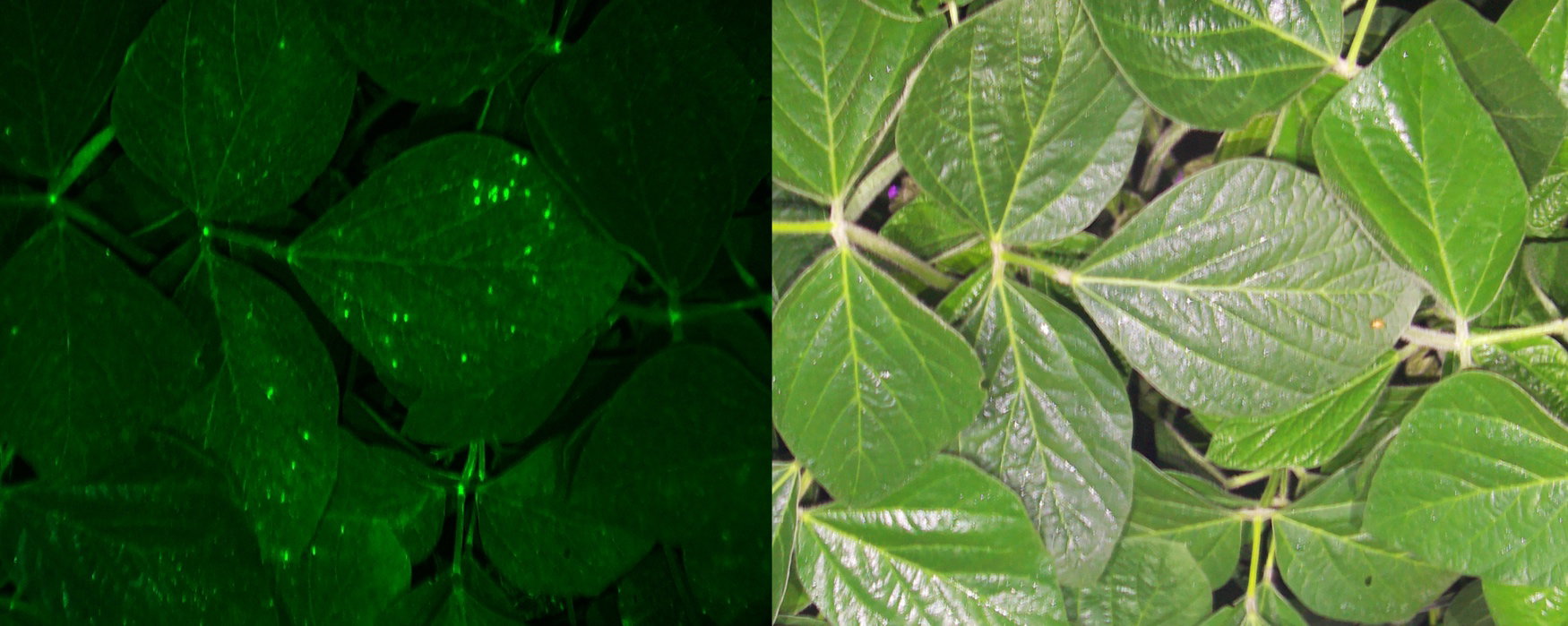
InnerPlant’s underlying technology builds on biosensors that have been used in laboratory research for decades. The company’s principal technical challenge was moving those sensors into commercial fields, where sunlight, weather and other background conditions can interfere with the faint signals emitted by plants.
InnerPlant developed algorithms to isolate its biological signals from background light, along with artificial-intelligence models that classify the thousands of images generated by the monitoring system. The objective is to convert otherwise invisible activity inside a plant into information that can support field-level management decisions.
When an InnerSoy plant is infected by a fungal pathogen, it activates its natural immune response. A gene inserted by InnerPlant activates alongside the relevant immune genes and produces a signaling protein that the company’s detection system can identify.
Because the signal is connected to the immune response, InnerPlant says it can indicate specific diseases, including frogeye leaf spot, white mold and Cercospora-related infections. Unlike conventional scouting, which generally depends on visible lesions or other symptoms, the CropVoice system is designed to confirm infection before crop damage can be observed from the field.
“Farmers now have access to data from inside the plants,” Aronov commented on her company’s technology to Fertilizer Daily. That information, she said, provides the missing biological component in disease-management systems that have traditionally relied on the presence of a pathogen, a favorable environment and a susceptible crop.
A four-week warning in a white mold case
InnerPlant said one of its 2025 alerts demonstrated the potential difference between biological detection and conventional scouting.
On July 25, the company issued a white mold alert based on signals from InnerSoy plants. At the time, experienced agronomists examining the sentinel plot could not find visible symptoms. White mold symptoms became observable in the same plot about four weeks later, according to the company.
In a separate commercial case described by InnerPlant, a grower who sprayed after receiving a CropVoice alert recorded a 25-bushel-per-acre difference between the treated area and an untreated test strip. The result represents a single company-reported case rather than a controlled, replicated assessment, but it illustrates the economic argument behind earlier disease confirmation.
Fungicide timing is especially important because many products provide their greatest benefit when applied before disease becomes visually established. Applying too late can leave yield unprotected, while routine preventive applications can add costs without providing a return when infection does not develop.
U.S. soybean producers lost an estimated 250.9 million bushels, or 5.4% of potential production, to disease in 2024, according to the Crop Protection Network. The scale of those losses creates demand for tools that can distinguish between conditions that merely favor disease and evidence that infection is actually occurring.
CropVoice expands tenfold
InnerPlant launched CropVoice commercially across 50,000 subscribed acres in 2025. The company said coverage expanded tenfold to more than 500,000 acres in 2026, concentrated in eastern Nebraska and western Iowa.
The platform does not require a separate sensor plot for every enrolled field. InnerPlant works with agricultural retailers and local agronomists to place sentinel sites across an overlapping regional network. Site selection considers topography, local weather, historical disease pressure, crop genetics and production practices such as row spacing.
The plots are intended to resemble surrounding commercial fields closely enough to produce locally relevant disease information. Data from individual sites are also evaluated alongside signals from other sites in the network before an alert is issued.
CropVoice alerts and scouting reports can be delivered by text message, email or through the John Deere Operations Center. InnerPlant plans to add an on-demand dashboard in 2027.
Corn, insects and nitrogen management
InnerPlant’s ambitions extend beyond fungal disease in soybeans. The company plans to introduce corn into the CropVoice network in 2027, while a soybean insect-stress sensor is also under development.
Another potential application is nitrogen management. InnerPlant said it is exploring a corn sensor that could signal the crop’s nitrogen status, potentially giving growers biological information to complement soil testing, crop models, remote sensing and weather data.
Such a system could have broader implications for fertilizer use. Nitrogen is among the largest variable costs in corn production, but the amount available to a crop changes with soil conditions, rainfall, temperature and biological activity. A plant-generated indicator could eventually help growers identify where or when additional nitrogen is needed rather than relying only on estimates derived from external conditions.
InnerPlant describes its broader platform as a potential operating system for plant-level agricultural data. While most precision-agriculture tools measure weather, soils, canopy appearance or other external factors, the company is seeking to create a new data layer based on crops’ physiological responses.
Whether those signals can consistently improve farm profitability will depend on the accuracy, geographic coverage and cost of the network, as well as independent validation across multiple growing seasons. However, CropVoice’s rapid expansion suggests agricultural retailers and growers are willing to test whether plants themselves can provide an earlier and more precise warning of threats developing in the field.

Enjoyed this story?
Every Monday, our subscribers get their hands on a digest of the most trending agriculture news. You can join them too!





Discussion0 comments