
Schlumbergera: How to grow and care for this Christmas cactus at home?

Contents:
- Flower’s overview
- Varieties of the Schlumbergera flower
- Caring for the Schlumbergera at home
- What to do if the Schlumbergera does not bloom
- Diseases and pests
- Advantages and disadvantages of having Schlumbergera at home
- How and when does the Schlumbergera bloom
- Wilted leaves in Schlumbergera: causes, prevention, treatment
- Schlumbergera leaves turn red: how to fix it
- How to buy correct Schlumbergera
- Signs and superstitions associated with the Schlumbergera
The Schlumbergera flower (commonly known as Zygocactus, botanical name Schlumbergera) is native to South America. From tropical forests, it confidently migrated to other regions, adapted well to the local climate, and can delight with winter flowering for about 30 years in regions with snowy winters. In this article, we share some useful information on how to properly grow a Schlumbergera at home.
Flower’s overview
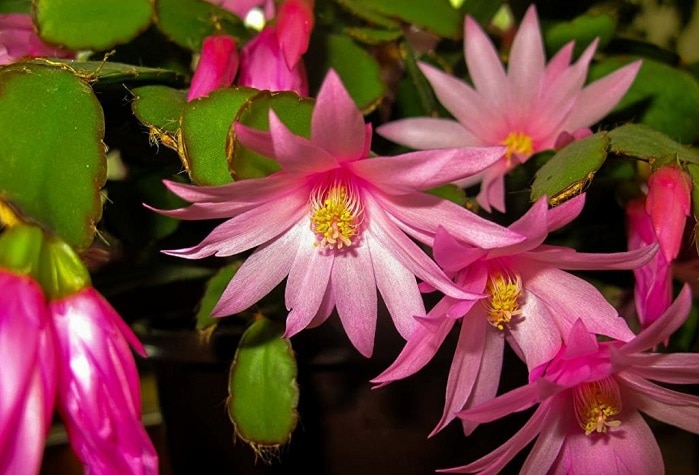
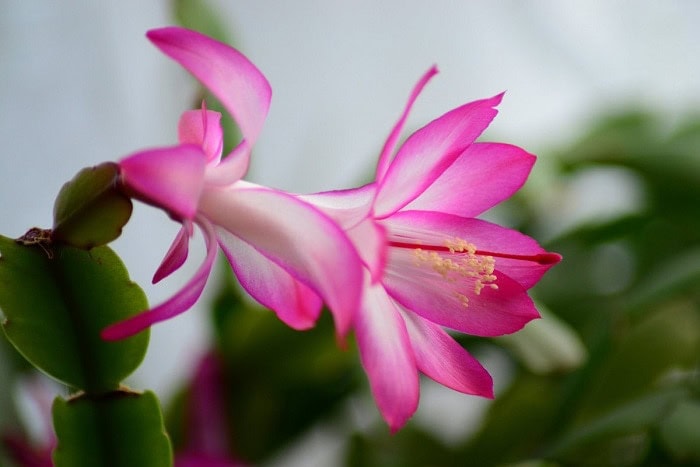
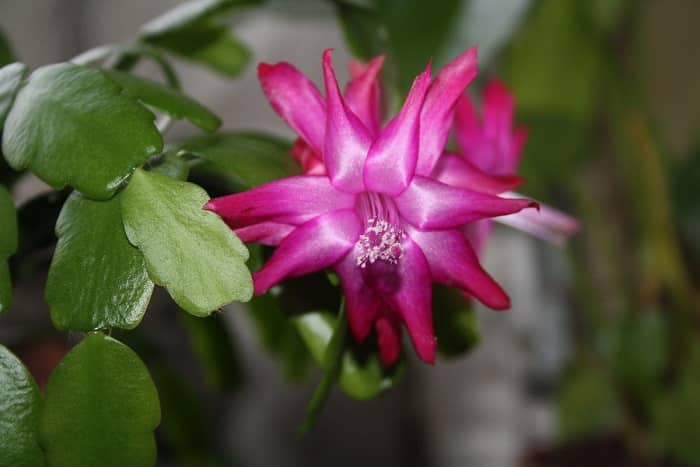
The tubular flower of the Schlumbergera resembles a multi-tiered crown, and its color can range from bright pink to purple. Numerous stamens merge into a tube and extend beyond the crown. The inner long petals grow together to the middle, and the outer short ones are divided and curved outward. The small seeds of the plant look like brown balls and ripen in a fruit like a rose hip. The roots are compact and sparse. Green shoots grow in pairs, symmetrical.
Varieties of the Schlumbergera flower
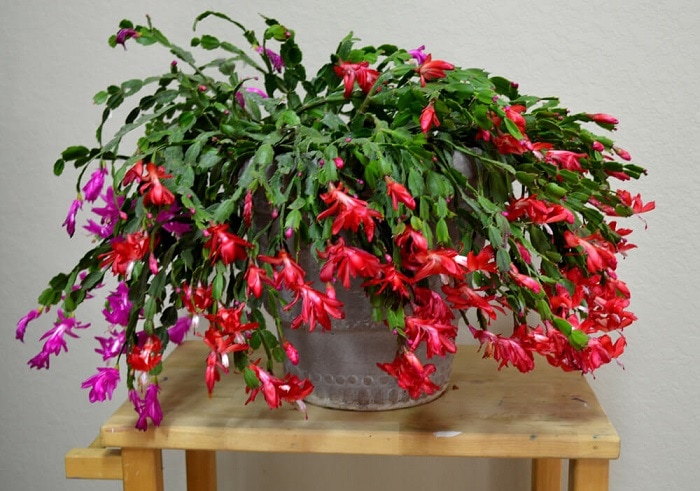
Initially, only two varieties of Schlumbergera were widespread—with white and red flowers. Due to breeding efforts, a range of new varieties emerged and continue to be replenished regularly.
The most famous varieties:
Russiliana
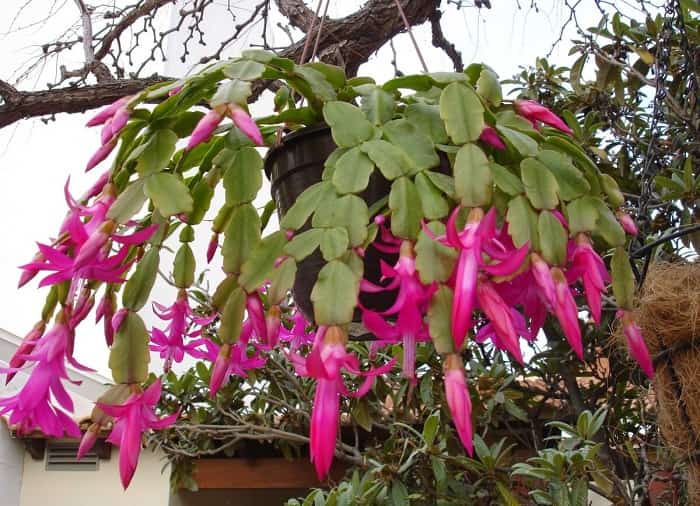
A bush distinguished by lush flowering and a tendency to branch, up to 30 cm (12 inches) high with long meter-long shoots. The petals of tubular flowers resemble bells with long stamens.
Truncated
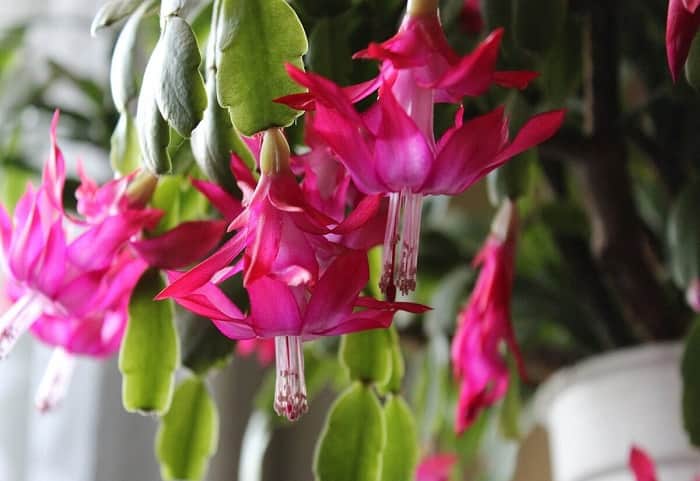
A spreading bush with light green long shoots. Multi-tiered flowers are decorated with pointed petals and a cascade of stamens. The color varies from lilac to white.
Buckley
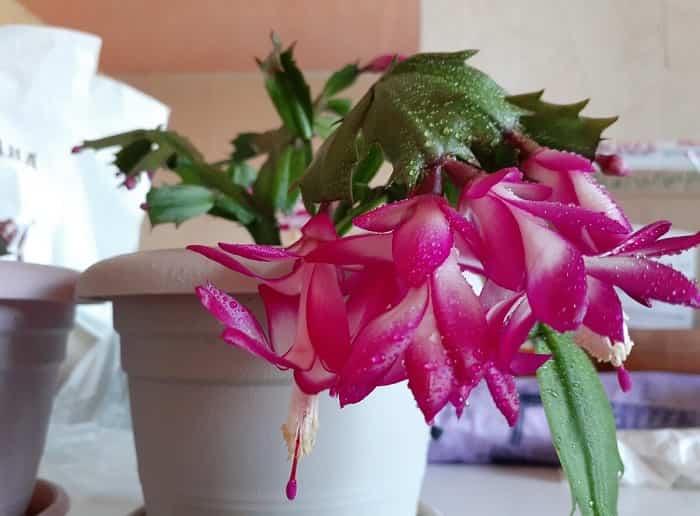
Bush up to 40 cm (16 inches) high with dark green fleshy shoots. Flowers from 8 cm (3 inches) in size. Color depends on the variety
More than a hundred Schlumbergera hybrids have been bred. They are combined into series, the differences between which are only in the shades and sizes of flowers. The growing conditions for the schlumbergera do not change.
Caring for the schlumbergera at home
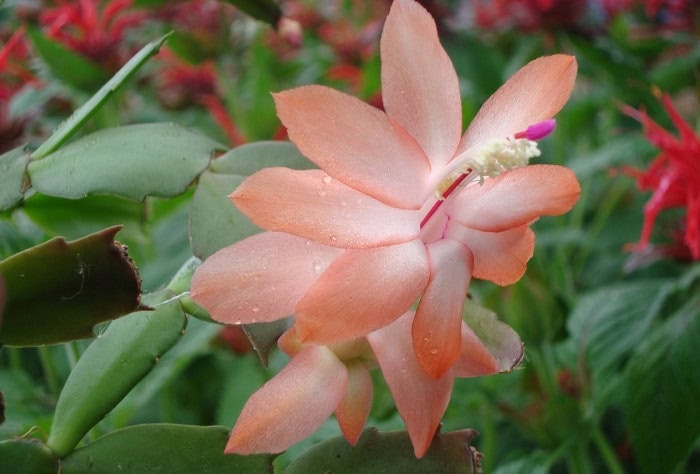
To grow a Schlumbergera flower, you need to know exactly what this exotic plant needs. On the one hand, it is unpretentious, despite its tropical origin. On the other hand, it is necessary to create favorable conditions so that the plant will please you with its flowering every year.
Recommendations for growing Schlumbergera:
- ensure sufficiently high air humidity (by spraying);
- protect from direct sunlight, otherwise, the shoots will turn red;
- do not use additional lighting since the plant prefers short daylight hours;
- avoid over-watering and over-drying of the soil substrate;
- take it out onto the terrace in summer, place it in partial shade;
- protect the plant from drafts.
Let’s talk in more detail about some of the features of growing Schlumbergera.
Lighting
Cacti like direct sunlight. The schlumbergera needs diffused light, but there should be no lack of lighting. A room with windows facing north is a good place to place the flower pot. The humidity of the kitchen and bathroom will also please it.
Watering
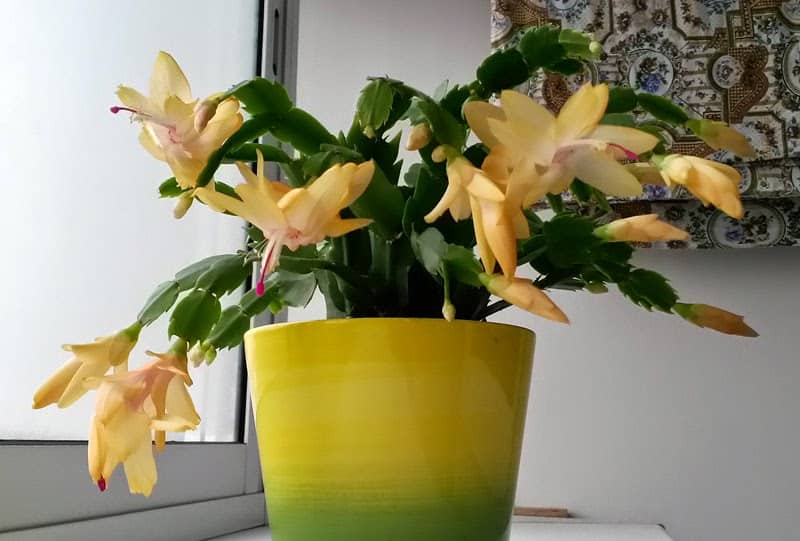
The frequency of watering depends on the stage of flower development. For watering, use settled water at room temperature. From October to January, when the period of budding and subsequent flowering begins, the plant needs abundant watering, but do not allow liquid to stagnate in the tray.
Humidity
The Schlumbergera likes high humidity. To promote vigorous growth and abundant flowering, spray the plant regularly or use a humidifier.
Temperature
The flower does not like temperature changes, and it also does not like excessive heat and cold. The optimal temperature range is +15…+25°C (59…77°F) degrees with air humidity of 75%. During budding, it is useful to harden the plant on the balcony at a temperature of about +15°C (59°F) degrees.
Fertilization
It is impossible to imagine caring for and growing Decembrist at home without regular fertilizing. A complex fertilizer for cacti is suitable for this purpose. Fertilizing is carried out according to the following scheme:
- From February to March, when the flower is resting, it is enough to only slightly moisten the soil. To prevent the soil substrate from drying out, the tray is lined with expanded clay and moss. Fertilizing is not carried out during this period..
- From April until the end of summer, the Christmas cactus enters a period of active vegetation. At this time, regular moderate watering is required. You can add ammonia to the water at a rate of 1 teaspoon per 1 liter (0.3 gl) of water. Fertilizer is applied once every 2 weeks. The main component is the NPK complex. The dosage of the preparation intended for fertilizing indoor flowers is divided in half.
- In September, the plant is preparing to bloom, which means it is time to limit watering. Remember to moisten the moss in the tray to maintain optimal humidity. As soon as the buds appear, intensive watering and fertilization begin.
Transplant
Although the plant grows slowly, growing schlumbergera does not exclude replanting the plant. If you buy a plant in a pot and the roots are sticking out of the drainage hole, replanting should be done immediately. If the roots are not visible, it can be postponed until the flower is 5 years old.
It is best to do this at the end of the flowering period. The plant’s roots are superficial and poorly developed, so a wide, shallow pot will do. In a too spacious container, the roots will actively grow to the detriment of flowering.
Repotting an adult plant begins with filling the pot with drainage by ⅓. The remaining ⅔ is occupied by compacted soil. The flower is moved from the old pot to the new one after thoroughly cleaning the roots from the old soil mixture. After this, all that remains is to carefully sprinkle the roots with soil and water lightly. As the substrate settles, you can add a little new.
Trimming
Young plants do not require pinching (pruning). You can only remove faded buds. After flowering, the crown of adult bushes is formed. Knives are not used for this, but simply with your hands, carefully remove faded, limp shoots and wilted buds.
Reproduction
Most often, propagation is carried out by cuttings and, in rare cases, by grafting onto succulents. In any of the scenarios, shoots without diseases and damage are selected for the purpose.
How to grow a Schlumbergera from a cutting? You can immediately root them in the soil or first place them in water. In the second case, the process is accelerated.
What to do if the Schlumbergera does not bloom
How to properly grow a schlumbergera so that it blooms every year? If the flowering season has come, but there are no flowers at all, there are several reasons for this – the timing of feeding and watering is violated, or the optimal temperature regime is not created. The problem can be eliminated by returning to the traditional care scheme. And by next Christmas, exotic flowers will delight you with bright colors.
Diseases and pests
The flower is immune to most pests and diseases if, of course, it is healthy. But against the background of excess or deficiency of watering, as well as in the case of proximity to sick plants, the schlumbergera’s immunity decreases.
Preparations that will help in the fight against pests:
- spider mites – “Fitoverm”, “Vertimek”, “Aktofit”;
- mealybug – “Aktara”, “Confidor”;
- scale insects – insecticides.
Advantages and disadvantages of having Schlumbergera at home
Schlumbergera is a houseplant that pleases its owner with bright flowering in winter. When purchasing this amazing flower, which also carries the name of Christmas cactus (Zygocactus, Schlumbergera), it is important to carefully learn caring instructions. If you do not provide the Schlumbergera with favorable conditions for growth and development and proper care, waiting for flowering is pointless.
The length of the bushes with branched stems reaches 40 cm (16 inches). In order for the bush to grow evenly, it should be systematically turned to the light with different sides. The main advantages of this indoor plant include:
- ease of care;
- abundant flowering;
- the possibility of propagation by pinching off branches of 3-4 segments without flowers and placing them in a container filled with water.
The disadvantage of the Christmas cactus is its susceptibility to fungal diseases such as late blight, Phytophthora, and fusarium.
How and when does the Schlumbergera bloom
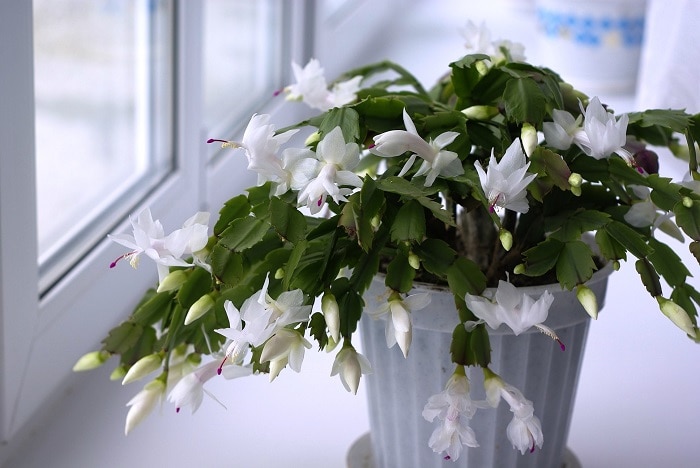
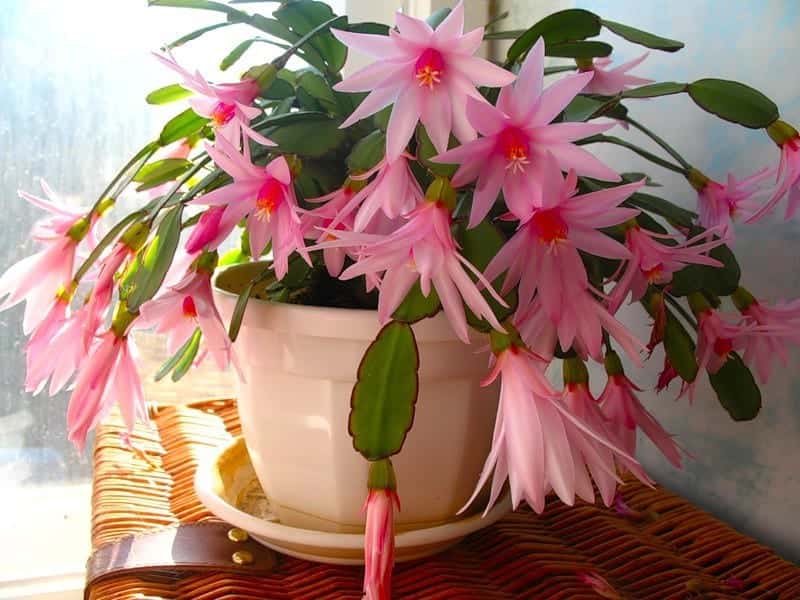
The schlumbergera blooms for 2 months. The buds begin to open in early December. During this period, multi-tiered, long-tubular flowers appear on the tops of the shoots. Bunches of long stamens hang down effectively. In the photo, you can see what a flowering plant looks like.
Wilted leaves in Schlumbergera: causes, prevention, treatment
Wilted leaves of the Christmas cactus indicate the death of the root system or the plant is affected by a fungal disease. As a rule, such a nuisance most often occurs against the background of fusarium, phytophthora and late blight. Until the disease has time to affect the root system, there is a chance to save the plant by treating it with one of the following preparations:
- «Fitosporin-M»;
- «Maxim»;
- «Topaz».
After treatment, the Christmas cactus must be transplanted into another container. Planting is carried out in new, uninfected soil.
Please note! If the Schlumbergera root system is damaged, the flower cannot be saved. In this case, it is more appropriate to take cuttings of the plant and grow a new one from its segments.
Schlumbergera leaves turn red: how to fix it
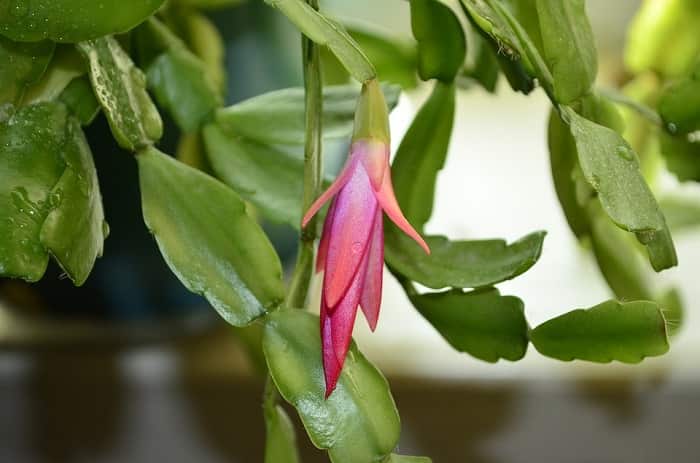
Often, the foliage of a domestic Schlumbergera turns red. The following factors may be the reasons for the change in color of the green mass:
- Too bright lighting in the room. The Christmas cactus prefers shaded areas, so flower pots should be placed on eastern or western windows. During hot periods, it is better to move the plants to the north side. On sunny days, gardeners advise shading the plant. If you do not follow the described recommendations for caring for the Christmas cactus, the foliage will begin to turn red and purple.
- Growth of new segments on foliage. In early spring, the crop begins to grow new segments. During this period, the tips acquire a reddish tint. Do not worry: as the growth process proceeds, the leaves will turn green again.
- Violation of the fertilizing schedule or use of fertilizers that are not suitable in composition. In order for the Christmas cactus to develop well, you should take care of the timely provision of the plant with nutrients. Experienced gardeners recommend adding cactus fertilizers to the soil from October to January, which contain a significant percentage of nitrogen, phosphorus, magnesium, and potassium. During the active growth phase of shoots, it is worth fertilizing the plants with mineral fertilizers in combination with organic matter.
- Often, the cause of the reddening of leaves is excessive watering. Schlumbergera does not like waterlogged soil, so the flower should be watered regularly but not abundantly. Constantly wet soil will cause the root system to rot. The foliage will begin to wither and turn red. To prevent the death of the crop, let the soil dry out well. After this, you can transplant the plant into new soil, not forgetting to wash the root system and remove the rotten part.
How to choose a Schlumbergera when buying
When buying a Schlumbergera in a store, you should pay attention to the appearance of the flower, as well as the quality of the soil in which it grows. The substrate should be slightly moistened, and there should be no signs of rot on the houseplant itself.
Although the flowering plant looks much more beautiful, it is worth choosing a specimen whose majority of flowers are not fully opened. When placed in home conditions, the Christmas cactus sheds most of its flowers. This is completely normal, so do not be upset.
It is not advisable to transplant immediately after purchase. However, if the procedure cannot be postponed, the plant should be carefully transferred to a larger pot. The soil lump should not be disturbed.
Proper care can create ideal conditions for the growth and development of Schlumbergera. Thanks to its lush green crown and bright, long flowering, this indoor plant will become a real decoration of any room during the cold winter months.
Signs and superstitions associated with the Schlumbergera
The most frightening superstition is that if the Schlumbergera dies, someone in the house will die. A positive sign is that timely flowering attracts wealth to the house. Depending on the flowering period and the abundance of flowers, people believe that the Schlumbergera foretells pleasant acquaintances, joyful news, and an addition to the family.


Discussion0 comments