
How to grow sweet watermelons in your garden


Contents:
- How to fertilize watermelons depending on the growing location
- Mineral fertilizers
- Organic fertilizers
- Selection of fertilizers depending on the growth phase
- How to stimulate the fast growth of watermelons
- Signs of nutrient deficiency
Big harvests are the pride of skilled summer residents who manage to grow sweet watermelons in the central zone and other regions. You can enjoy these tasty and juicy berries every year if you know how to fertilize watermelons in open ground and in a greenhouse. Our article contains basic recommendations for caring for melons and choosing the correct fertilizers depending on the season and the needs of the crop.
How to fertilize watermelons depending on the growing location
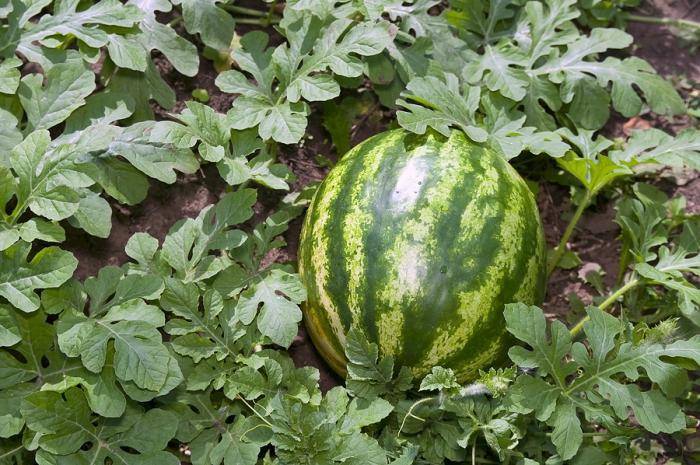
Timely and competent feeding of watermelons helps to stimulate growth and abundant fruiting. The taste characteristics of watermelons depend on a number of factors, including the correct choice of fertilizers consisting of a certain set of micro— and macroelements. Boron, magnesium and potassium are especially important for melons, the deficiency of which leads to a deterioration in taste.
In the greenhouse
For growing in a greenhouse, early—ripening varieties are selected, as well as hybrids adapted to a specific region. It is advisable to buy seeds from trusted sellers, so do not forget to look at the expiration dates. The fresher the seeds, the sooner they will germinate. There is no point in saving seeds from an eaten watermelon: the chances of germinating them and getting a good harvest are very small.
The sowing time for seedlings is the second ten days of April. The scheme is as follows:
- Checking germination: place the seeds in a salt solution (1 teaspoon per 1 cup of water), remove any that float to the surface — they are empty.
- Rinse the seeds to remove salt under running water, soak them in a weak solution of potassium permanganate for half an hour, and rinse.
- Stimulate seed growth by soaking them in a solution of Epin or Zircon.
- Prepare the soil for sowing: for each bucket of soil, consisting half of compost and garden soil, add 1 tbsp. of potassium sulfate and urea, 2 tbsp. of superphosphate.
- Place the seeds at a depth of 1 cm (0.4 in) in a small container up to 12 cm (4.7 in) in diameter, filled with soil, and cover with film.
The germination temperature is about +30°C degrees (86°F). The shoots should appear on the third day. At higher temperatures, germination slows down, sometimes the seeds die. At low temperatures, the sprouts will not develop. The seedlings are watered when the top layer of soil dries out. After the formation of 3 true leaves, a complex fertilizer for watermelon is added every week.
For seedlings, make holes up to 10 cm (4 in) deep at a distance of about half a meter from each other. Moistened soil is removed from the container together with the plant. The seedlings are distributed among the holes, watered, and mulched with sawdust or hay. When the plants grow to 30 cm (12 in) in height, the first watermelon feeding is carried out. Long-acting compositions are suitable. One of the proven compositions is “Kemira”. Dosage: 1 tbsp. per 10 liters (2.6 gal) of water. Each plant will need 0.5 liters (0.13 gal) of solution. “Kemira” can be replaced with urea mixed with ash.
During the growth period, watermelon fertilizer is applied every 2 weeks, and weekly during the formation and development of fruits. Plants are sprayed with Zircon and Elina.
In open ground
Favorable conditions for growing melons in open ground are good lighting, warmth and no wind. The south—eastern or southern side of the summer cottage will do.
Planting is scheduled for the end of May. The distance between the holes is about 1.5 m (59 in), and between the rows – 2 m (79 in). The seedlings are grown in the same way as for greenhouse cultivation. At the specified time, they are transplanted into the ground, the soil is sprinkled with sand 10 cm (4 in) around the bush. Watering is carried out with warm water. Two weeks after planting in the ground, the beds are fertilized with mullein or bird droppings. As the ovaries appear, 4 g (0.14 oz) of ammonium nitrate and calcium chloride, 6 g (0.21 oz) of superphosphate are used.
Mineral fertilizers
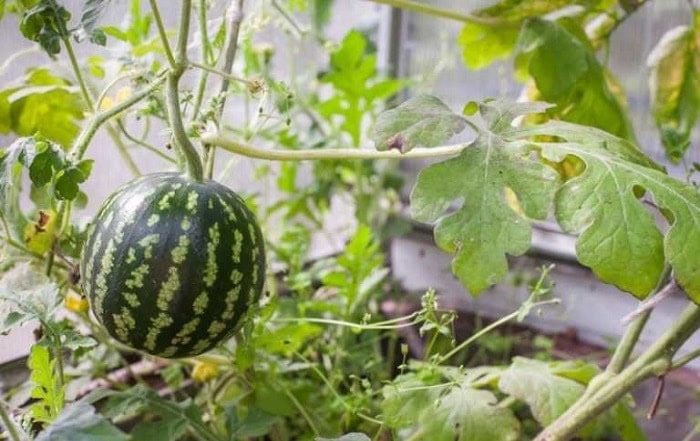
What can you feed watermelons with so that the crop does not stop developing and produces a good harvest? As they grow, watermelons need potassium and boron preparations. Examples are Mag—Bor, Kristalon, Green—Go, Boro—Plus. You also need to know what to feed watermelons with to grow and improve their taste. Below we will tell you in more detail what fertilizers to use during different growth phases.
Organic fertilizers
Folk remedies are very popular. One of the best fertilizers for watermelons, which can be prepared at home, is yeast infusion. To do this, place 100 g (3.5 oz) of raw yeast in a 10-liter (2.6 gal) container, pour 3 liters (0.8 gal) of water and add a little sugar. After a week, the concentrate is ready. It is diluted with water at the rate of 1 tbsp. per bucket of water and used for watering (1 liter (0.3 gal) per 1 plant).
Selection of fertilizers depending on the growth phase
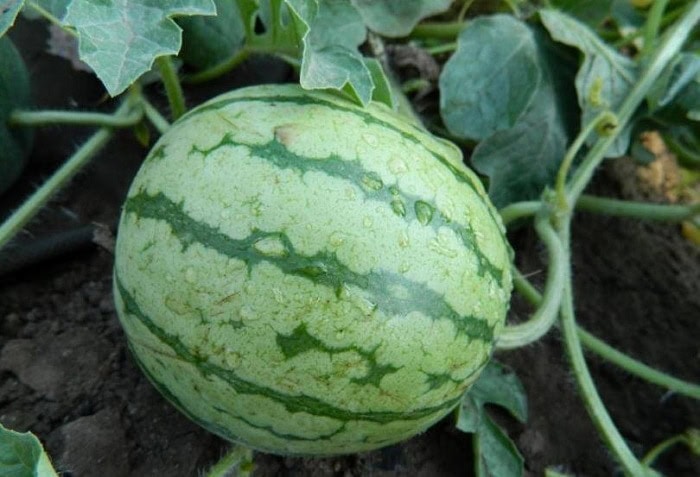
When choosing what to feed watermelons in open ground and greenhouses, take into account the stage of development of the crop and its corresponding nutritional needs.
For seedlings
With the help of nitrogen fertilizers it is possible to stimulate active growth of the plant. For this purpose the soil is fertilized with a solution of urea (1 tbsp. per bucket of warm water). You can use mullein and bird droppings in a concentration of 1:10. Seedlings respond well to a mixture of wood ash (1 tbsp. per 10 liters (2.6 gal) of water). The first feeding, as mentioned above, is applied after the formation of 3—4 true leaves, the second — 2 weeks before planting in the beds.
After the transplant
In order for the seedlings to adapt to the new conditions, it is important to provide the crop with additional nutrition 2 weeks after transplantation. To do this, use a solution of 10 liters (2.6 gal) of water and 20 g (0.7 oz) of saltpeter. Pour 2 liters (0.5 gal) of the mixture under each plant. You can use organic matter together with minerals by diluting mullein with water 1:10, adding 15 g (0.5 oz) of potassium chloride and 30 g (1.06 oz) of double superphosphate. The consumption is the same – 2 liters (0.5 gal) of solution per plant.
During flowering
Watermelons need potassium to set fruit, so a useful solution is prepared during flowering: 2 kg (4.4 lb) of Nutrivanta Plus fertilizer is taken per 200 liters (53 gal) of water. Use 1 liter (0.3 gal) of solution to water each plant. To increase fruit set, foliar feeding is carried out — spraying with a solution of boric acid, which is diluted in water at a rate of 0.1 g (0.004 oz) per 1 glass and brought to the desired concentration of 5 liters (1.3 gal) of clean water.
During fruiting
Use the complex composition “Uniflor Micro” in a dosage of 2 teaspoons per bucket of water. Another option is to dilute 1 tablespoon of azophoska, superphosphate and 1 teaspoon of potassium sulfate in a bucket of water. Use 1 liter (0.3 gal) of solution for each watermelon.
In summer and autumn
In July, additional fertilizers are applied as needed if the leaves turn yellow and the fruits do not grow. In general, in summer and autumn it is better to use complex fertilizers, for example, Terraflex Universal, which contains everything necessary for the complete nutrition of the crop. Dosage — 7 g (0.3 oz) per bucket of water.
How to stimulate the fast growth of watermelons
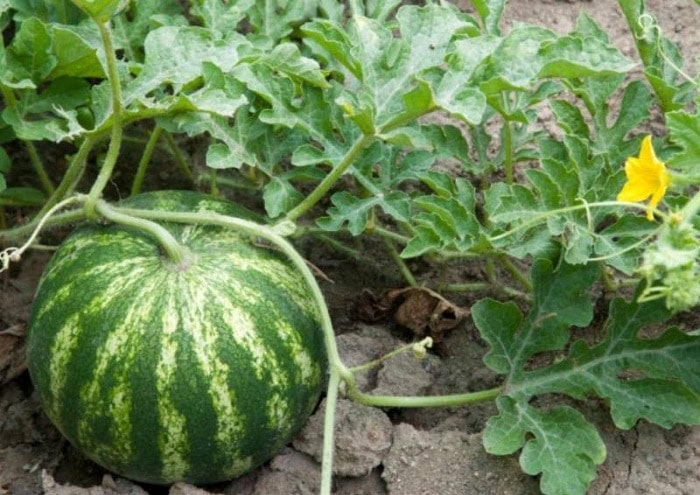
The size of watermelons can be increased by using ash. You can also speed up the growth of fruits using bird droppings, manure, yeast mash (recipe above). A spoonful of saltpeter is added to mineral fertilizers.
Signs of nutrient deficiency
When choosing what to fertilize watermelons with to make them grow, they are guided by the appearance of the crop. Nitrogen deficiency is visible by small light leaves. If there is not enough phosphorus, the roots grow poorly, the leaves become smaller and acquire a purple hue. Not enough potassium — the plant weakens, fungal infections develop.
In some regions it is difficult to get a harvest of sweet large watermelons, but if you follow the recommendations given, it is quite possible.


Discussion0 comments