Skip to content
  • Professionals
  • Gardeners
 
Search
Log in
EN
RU
  • Gardening Tips
  • Plants And Flowers
  • Fertilizer and Soil
  • Plant Protection
  • Indoor Plants
  • Rankings
Seasonal tips:
  • Spring
  • Summer
  • Autumn
  • Winter
Trending topics:
  • compost
    22
  • garlic
    2
  • lemon
    1
  • potato
    12
 
RU
  • Professionals
  • Gardeners
Sections
Events
Stock Quotes
Business Directory
Trending topic:
Featured company:
Follow us...
Helpful information
  • About
  • Team
  • Advertise
  • Contacts
  • Submit a Tip
  • Privacy Policy
  • Terms of Service
Sections
Seasonal tips
  • Spring
  • Summer
  • Autumn
  • Winter
Trending topics
  • compost
    22
  • garlic
    2
  • lemon
    1
  • potato
    12
Follow us...
Helpful information
  • About
  • Team
  • Advertise
  • Contacts
  • Submit a Tip
  • Privacy Policy
  • Terms of Service
Copyright © 2014-2025 DigitalTree LLC. All rights reserved.
We deliver content lightning-fast thanks to the managed cloud WordPress hosting with CDN.
16+

Home / Gardeners / Gardening Tips

How to take care of your lawn in winter


Editors avatar Editors
October 31, 2025, 11:00 am
15
Gardening Tips
Fertilizer and Soil
How to take care of your lawn in winter
Save for later
Share

While fall lawn care may seem like a lot of effort at first, it’s truly an investment into a healthier, denser lawn once spring returns.

From fertilizing to aerating and performing the last mow of the year, you can keep your lawn free of moss, diseases, and pests.

Fertilize

Farmer sprays pesticides on the garden, vegetable garden, farm, to protect plants from diseases and pests. Knapsack sprayer. Insecticides. Herbicides. Fungicides.

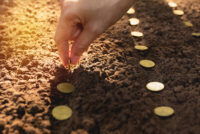
Whether you have a warm-season or cold-season grass, make sure to fertilize your lawn before winter to give it the nutrient boost it needs before the colder months.

ADVERTISEMENT

A warm-season grass should be fertilized while the temperature is still above 50°F-60°F. Once the temperatures drop below this range, your lawn will go dormant and will not be able to absorb the nutrients properly. For most climates, this makes September the final time to feed your lawn. However, if you live in a region that experiences warm winters, such as Florida, sometimes this can be done as late as early October.

A cool-season grass usually offers a bit more flexibility as it only stops growing once the temperatures drop below 40°F, allowing certain climates to fertilize even as late as November.

For best results, choose a fertilizer that has been specifically designed for the fall season. The fertilizer should have high levels of potassium and low levels of nitrogen, as this will strengthen the lawn’s roots, or a slow-release, balanced fertilizer. Using a feed that’s high in nitrogen this late in the season can cause weak, leggy growth, which is then highly susceptible to frost damage.

Aerate

Human palm touching lawn grass low angle view

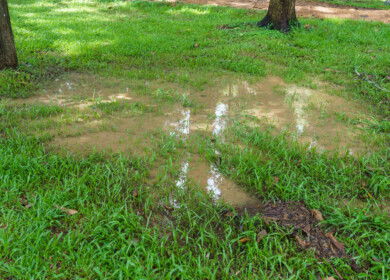
Your lawn will have seen a lot of use in summer, so it will likely be compacted from all the foot traffic. A compacted lawn will not be able to handle the increasing rainfall and melting snow, potentially leading to water pooling in areas of your lawn. This is why you should aerate it in early September if you have warm-season grass, or anytime from September to October for cool-season varieties.

For small gardens, you can use a manual aerator or a garden fork. Simply push your tool about 4-5 inches into the soil and pull it out so the grass lifts slightly. Repeat this process every 6 inches over the whole lawn.

For larger gardens, an electric or mechanical aerator is more efficient. Turn it on, set it according to your soil type and desired depth, then walk slowly across the lawn while it works.

Once you have aerated your lawn, make sure to overseed it to speed up its recovery.

Reduce mowing

Lawn mower cutting green grass in residential area in late afternoon light

During the colder months, you’ll want to gradually decrease the amount of mowing that you do as the grass growth begins to slow down. If you’re frequently mowing your lawn without giving the grass time to grow back, you can scalp your lawn, resulting in patchy and dead areas.

The last mow should then be completed as the grass prepares to go dormant. Depending on your climate, this is usually between October and November. Make sure to raise the mower’s height beforehand as the longer grass blades will help to protect your lawn from the frost and cold temperatures in winter, and choose a mild, dry day. Never mow a wet lawn as this is likely going to damage its grass blades, weakening it and making it look unkempt.

Keep your lawn clean

While leaving a few fallen leaves on your lawn may not seem like a big deal, doing so can cause your lawn to develop fungal diseases, such as red thread, and encourage moss to thrive as leaves trap moisture.

Red thread first appears as pink fungus that forms on the leaves, making them look like red needles. Apart from visual damage, red thread can weaken the turf, increasing its susceptibility to other lawn diseases.

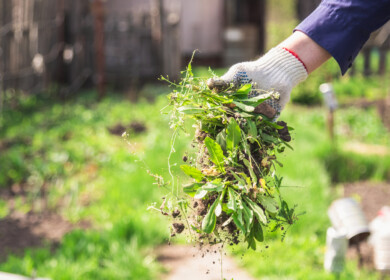
To prevent this, invest in a good-quality garden rake and remove these along with any other debris weekly.

————

About the Author: This article was prepared by Online Turf, a UK-based supplier of high-quality turf and lawn care products.
Autumn
gardening
grassland
lawn
tips
Winter

Discussion0 comments

Спасибо за комментарий, он будет опубликован на сайте после проверки модератором. Хотите, чтобы ваши комментарии появлялись на сайте мгновенно? Достаточно пройти регистрацию.
Congratulations, you can be the first to start the conversation.
Do you have a question or suggestion? Please leave your comment to ignite conversation.
What’s on your mind?
Cancel Log in and comment
Or continue without registration
Get notified about new comments by email.
Advertisement
In focus
How to get here?
Weather forecast

Most read
How to get rid of weeds in your garden?
Live
Meripa Corson
August 4, 01:18 pm
Where does the money actually go? As a timber land owner, how do I benefit from the legislation?
USDA commits $80 million to expand timber markets and improve forest resilience
Patonkas Luksompulus
January 21, 12:36 pm
Greece meeds biological fertilizers! Great news about De sangosse.
DE SANGOSSE expands operations with Greek subsidiary
Pedro Diaz
November 20, 2024, 08:42 pm
Is it a Roundup lawsuit or more about bad financials? I think the market reacted only to announced financial results.
Bayer’s shares are pressed down by ongoing Roundup cancer lawsuit
Johan Fredin
August 22, 2024, 07:57 pm
Europe is falling behind in this field. The concerns 30 years ago was reasonable. Now not so much. We need crops that can survive in a more extreme future climate. Handle droughts and hot weather better. Crops that are less tasty to pests like hogs and deere.
Gene-edited crops set for groundbreaking European trials
Timothy Kirkwood
July 23, 2024, 01:39 pm

Your article about Sargassum shows Kelp, not Sargassum.

Sargassum in the Caribbean: turning seaweed crisis into economic opportunity?
About
Sections
Markets  ·  Business  ·  Politics  ·  Technologies  ·  Interviews  ·  Rankings  ·  Environment
Support
About  ·  Team  ·  Advertise  ·  Contacts  ·  Submit a Tip  ·  Privacy Policy  ·  Terms of Service
Copyright © 2014-2025 DigitalTree LLC. All rights reserved.
We deliver content lightning-fast thanks to the managed cloud WordPress hosting with CDN.
16+
More to read
Schlumbergera: How to grow and care for this Christmas cactus at home?
How to fertilize geranium for abundant flowering and growth?
Essential tips for growing kaffir lime leaves at home
Advertising that helps us do quality reporting