Skip to content
  • Professionals
  • Gardeners
 
Search
Log in
EN
RU
  • Markets
  • Business
  • Politics
  • Technologies
  • Interviews
  • Rankings
  • Environment
  • Events
  • Stock Quotes
  • Business Directory
Trending topic:
Featured company:
 
RU
  • Professionals
  • Gardeners
Sections
    Events
    Stock Quotes
    Business Directory
    Trending topic:
    Featured company:
    Follow us...
    Helpful information
    • About
    • Team
    • Advertise
    • Contacts
    • Submit a Tip
    • Privacy Policy
    • Terms of Service
    Sections
      Seasonal tips
      • Spring
      • Summer
      • Autumn
      • Winter
      Trending topics
      • compost
        23
      • garlic
        2
      • lemon
        1
      • potato
        12
      Follow us...
      Helpful information
      • About
      • Team
      • Advertise
      • Contacts
      • Submit a Tip
      • Privacy Policy
      • Terms of Service
      Copyright © 2014-2026 DigitalTree LLC. All rights reserved.
      We deliver content lightning-fast thanks to the managed cloud WordPress hosting with CDN.
      16+

      Home / Business

      The evolution and impact of controlled-release fertilizer technology in modern agriculture

      Timothy Bueno avatar Timothy Bueno
      May 23, 2024, 10:00 am
      May 23, 2024, 10:00 am
      [esi post-views ttl=0]
      Business
      Technologies
      The evolution and impact of controlled-release fertilizer technology in modern agriculture
      #image_title
      Save for later
      Share

      In the quest for sustainable agriculture, farmers and agronomists face the dual challenge of maximizing crop yields while minimizing environmental impacts. Controlled-release fertilizers (CRFs) have emerged as a vital tool in this endeavor, offering a more efficient and sustainable method to nourish crops throughout their growth cycles.

      Plants require various nutrients to grow and complete their life cycle, but these nutrients often deplete over time. Fertilizers are crucial for replenishing these nutrients, ensuring optimal plant growth. The responsible use of fertilizers not only leads to healthier crops and higher yields but also aids in environmental conservation.

      At the heart of successful and sustainable farming lies effective nutrient management. This strategy enables farmers to precisely determine the specific nutrients needed at different growth stages, enhancing crop health and yield while providing financial benefits by minimizing unnecessary nutrient applications. This approach helps reduce risks such as nutrient leaching, runoff, or mineralization, which are detrimental to the environment.

      The application of CRFs is a significant advancement in nutrient management. These fertilizers release nutrients in a controlled manner, directly targeting the varying growth phases of plants. This method is especially crucial because plants assimilate nutrients progressively over time, not all at once. Therefore, the judicious use of fertilizers is essential for sustaining crops, increasing productivity, and limiting environmental impacts. However, traditional nutrient application methods, such as split applications or fertigation, while reducing nutrient loss, still require more resources, careful scheduling, and are not always effective in preventing nutrient loss.

      ADVERTISEMENT

      CRFs provide a sustainable solution to these challenges. These fertilizers, often coated with a semi-permeable material, slowly release nutrients into the root zone as plants grow. This process is typically influenced by soil temperature, which correlates with the growth rate of plants. Hence, as soil temperature increases, so does plant growth and nutrient uptake from CRFs.

      Unlike slow-release fertilizers (SLFs), which are affected by temperature, water, soil pH, and microbial activity, CRFs primarily depend on temperature for nutrient release. These polymer-coated fertilizers significantly improve nutrient management efficiency and eliminate the need for multiple applications throughout the season. Farmers can apply CRFs once at the start, and the nutrients will last all season long.

      The development of CRFs dates back to 1842 when Sir John Bennet Lawes patented a process for creating artificial fertilizers, laying the foundation for the modern fertilizer industry. This innovation led to the introduction of Osmocote®, the first CRF, in 1967, which marked a significant shift in how nutrients were delivered to plants. Osmocote® offered a gradual nutrient release, enhancing sustainability and efficiency in plant nutrition. By 2023, the controlled-release fertilizer market had grown to a valuation of US $2.2 billion, reflecting its impact on global food production and land use efficiency.

      ICL, a leader in fertilizer technology, has been at the forefront of CRF innovation. Their research and development team is dedicated to creating products that not only enhance grower efficiency but also protect the environment. ICL’s various CRF formulations, such as the semi-permeable E-Max coating, allow nutrients to dissolve gradually and be released through microscopic pores, reducing the frequency and rates of fertilizer application and boosting nutrient use efficiency.
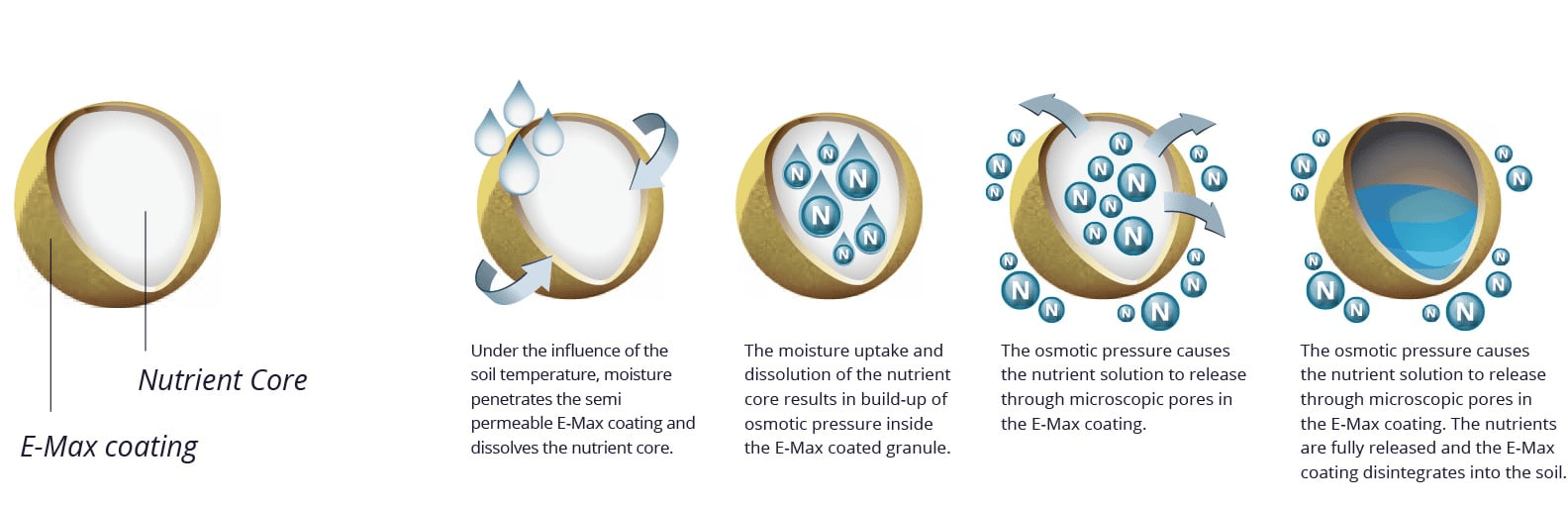
      ICL’s innovative product lines, such as Agrocote, Agromaster, and Agroblen, utilize this technology to meet the diverse needs of growers worldwide. These products help reduce nutrient loss through leaching, volatilization, denitrification, and P-fixation, providing a safe and efficient nutrient delivery system for crops.

      Furthermore, ICL has introduced eqo.x, a pioneering CRF with a biodegradable coating designed for open-field agriculture. Launched in September of the previous year, eqo.x is aligned with upcoming European fertilizer standards and aims to halve nutrient loss by 2030. This technology enhances crop yield, reduces nitrogen applications, and safeguards soil and groundwater quality.

      To assist growers in optimizing nutrient management, ICL developed the CRF Timer, an app that integrates data from weather stations to track nutrient release from CRFs based on local conditions. This tool helps growers select the appropriate ICL product for their specific environmental and crop requirements.

      In conclusion, controlled-release fertilizer technology plays a crucial role in the future of sustainable agriculture. With innovations like biodegradable coatings and precise nutrient management tools, CRFs help farmers achieve higher yields with fewer resources while preserving the environment. ICL’s commitment to sustainability and innovation in fertilizer technology ensures a healthier and more sustainable world for future generations.

      controlled-release fertilizers
      ICL
      Israel Chemicals

      Enjoyed this story?

      Every Monday, our subscribers get their hands on a digest of the most trending agriculture news. You can join them too!

      Sign me up
      Check the example

      Discussion0 comments

      Спасибо за комментарий, он будет опубликован на сайте после проверки модератором. Хотите, чтобы ваши комментарии появлялись на сайте мгновенно? Достаточно пройти регистрацию.
      Congratulations, you can be the first to start the conversation.
      Do you have a question or suggestion? Please leave your comment to ignite conversation.
      What’s on your mind?
      Cancel Log in and comment
      Or continue without registration
      Get notified about new comments by email.
      Advertisement
      In focus
      How to get here?
      Stock quotes
      Bayer
      11.52
      4.82
      Bayer Crop Science
      40.09
      3.77
      CF Industries
      122.33
      5.59
      Corteva Agriscience
      79.04
      0.21
      ICL Group
      5.33
      0.74
      Intrepid Potash
      41.61
      8.06
      Mosaic
      27.67
      5.6
      Nutrien
      77.79
      6.11
      Yara International
      28.47
      1.83
      See all
      Most read
      Agromin composts 1.25 million tons of organic waste in 2025
      Agromin composts 1.25 million tons of organic waste in 2025
      U.S. Justice Department opens antitrust probe into fertilizer producers amid price concerns
      U.S. Justice Department opens antitrust probe into fertilizer producers amid price concerns
      Middle East conflict threatens fertilizer supply ahead of U.S. planting season
      Middle East conflict threatens fertilizer supply ahead of U.S. planting season
      DeKalb may launch 30 new corn hybrids for 2026 season
      DeKalb may launch 30 new corn hybrids for 2026 season
      EU keeps importing nearly $1 billion of Russian phosphorus despite Ukraine war
      EU keeps importing nearly $1 billion of Russian phosphorus despite Ukraine war
      Events
      World Agri-Tech Innovation Summit
      San Francisco (CA), USA
      Mar 17 — 18, 2026
      FSHOW
      Shanghai, China
      Mar 17 — 19, 2026
      Argus Fertilizer Asia
      Bali, Indonesia
      Mar 31 — Apr 2, 2026
      CRU Phosphates
      Paris, France
      Apr 13 — 15, 2026
      CFEX
      Antalya, Turkey
      Apr 15 — 17, 2026
      See all
      Live
      Isabelita Barreiro
      December 11, 2025, 01:54 am
      Excellent management of water resources and effective use of water-soluble fertilizers!
      Argentine nano-fertilizer firm AKO Agro expands to Brazil
      Meripa Corson
      August 4, 2025, 01:18 pm
      Where does the money actually go? As a timber land owner, how do I benefit from the legislation?
      USDA commits $80 million to expand timber markets and improve forest resilience
      Patonkas Luksompulus
      January 21, 2025, 12:36 pm
      Greece meeds biological fertilizers! Great news about De sangosse.
      DE SANGOSSE expands operations with Greek subsidiary
      Pedro Diaz
      November 20, 2024, 08:42 pm
      Is it a Roundup lawsuit or more about bad financials? I think the market reacted only to announced financial results.
      Bayer’s shares are pressed down by ongoing Roundup cancer lawsuit
      Johan Fredin
      August 22, 2024, 07:57 pm
      Europe is falling behind in this field. The concerns 30 years ago was reasonable. Now not so much. We need crops that can survive in a more extreme future climate. Handle droughts and hot weather better. Crops that are less tasty to pests like hogs and deere.
      Gene-edited crops set for groundbreaking European trials
      About
      Sections
      Markets  ·  Business  ·  Politics  ·  Technologies  ·  Interviews  ·  Rankings  ·  Environment
      Support
      About  ·  Team  ·  Advertise  ·  Contacts  ·  Submit a Tip  ·  Privacy Policy  ·  Terms of Service
      Copyright © 2014-2026 DigitalTree LLC. All rights reserved.
      We deliver content lightning-fast thanks to the managed cloud WordPress hosting with CDN.
      16+
      More to read
      Controlled-Release Fertilizers Show Promise for Sustainable Agriculture
      Controlled-Release Fertilizers Show Promise for Sustainable Agriculture
      Haifa Group launches new controlled-release fertilizer blending facility in Brazil
      Haifa Group launches new controlled-release fertilizer blending facility in Brazil
      Nousbo and SK Leaveo partner to develop biodegradable fertilizers
      Nousbo and SK Leaveo partner to develop biodegradable fertilizers
      Advertising that helps us do quality reporting