Skip to content
  • Professionals
  • Gardeners
 
Search
Log in
EN
RU
  • Markets
  • Business
  • Politics
  • Technologies
  • Interviews
  • Rankings
  • Environment
  • Events
  • Stock Quotes
  • Business Directory
Trending topic:
Featured company:
 
RU
  • Professionals
  • Gardeners
Sections
    Events
    Stock Quotes
    Business Directory
    Trending topic:
    Featured company:
    Follow us...
    Helpful information
    • About
    • Team
    • Advertise
    • Contacts
    • Submit a Tip
    • Privacy Policy
    • Terms of Service
    Sections
      Seasonal tips
      • Spring
      • Summer
      • Autumn
      • Winter
      Trending topics
      • compost
        23
      • garlic
        2
      • lemon
        1
      • potato
        12
      Follow us...
      Helpful information
      • About
      • Team
      • Advertise
      • Contacts
      • Submit a Tip
      • Privacy Policy
      • Terms of Service
      Copyright © 2014-2026 DigitalTree LLC. All rights reserved.
      We deliver content lightning-fast thanks to the managed cloud WordPress hosting with CDN.
      16+

      Home / Business

      Causes and prevention of belt conveyor fires

      Editors avatar Editors
      June 3, 2024, 2:00 pm
      June 3, 2024, 2:00 pm
      [esi post-views ttl=0]
      Business
      Technologies
      Causes and prevention of belt conveyor fires
      #image_title
      Save for later
      Share

      The global leader in conveyor accessories, Martin Engineering, is dedicated to conveyor safety by educating the bulk handling industry on the hazards of conveyor fires. With the free conveyor training archive Foundations Learning Center, Martin experts give detailed insight into the causes and prevention of deadly fires. This article, written in collaboration with the authors of Foundations for Conveyor Safety, gives an overview of how to improve workplace safety.

      Causes of Belt Fires

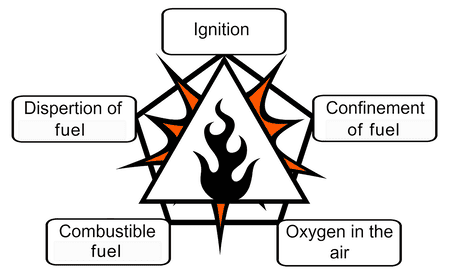
      To create a fire there must be three elements: oxygen, heat and fuel (aka, “the fire triangle”). One factor that makes conveyor fires so hazardous is that the belt itself can be the fuel.
      According to a study of belt fires conducted by National Institute for Occupational Safety and Health (NIOSH), any of the standard neoprene, PVC, chloroprene and BELT-approved SBR belts can ignite. Although some belts were self-extinguishing, the conclusion is that there is no non-flammable belt, particularly when accompanied by a combustible material.

      ADVERTISEMENT

      Possible Ignition Sources
      FrictionDust / Material / ChemicalMechanical / Maintenance
      • Frictional heating of belts riding on non-rotating components
      • Heat from brake friction
      • Belt rubbing on structure
      • Combustible dust
      • Out of control high-temperature processes where bulk material temperature exceeds belt capability
      • Slip of a belt on a pulley
      • Cutting and Welding
      • Mistracking
      • Bearing seal failure leading to seized bearings
      • Spillage of combustible bulk materials
      • Accumulations of bulk materials that can spontaneously ignite
      • Excessive temperature of the drive
      • Hot surfaces
      • Flammable liquids
      • Sparks and electrical causes

      Friction

      Inadequate belt cleaning in the discharge zone can lead to dust and carryback on the return side of the belt, causing a fouled tail pulley to run under a stalled belt, which creates tremendous heat.

      Dust emissions of any kind (combustible or noncombustible) originating from the loading or discharge zones have a tendency to foul rolling components, leading to failure of the seals and then contamination in the bearings and eventually causing the roller to seize. A rolling component can also stall if impact or cargo weight causes the bearings to collapse. Continuous frictional contact with a seized idler or the roller face can cause a loaded belt to exceed safe operational temperatures. It can also potentially result in extreme wear on the belt, degrading the main fire-retardant layer and exposing the heat-sensitive materials found in the belt’s inner construction.

      Controlling Fugitive Material

      Fugitive material control and regular cleaning of spillage are imperative. Without proper belt cleaning, chute sealing and belt tracking, spillage that collects around the loading/discharge areas and along the belt path can damage moving components, restrict access by fire crews and potentially act as fuel.

      Dust control is extremely important when handling combustible substances, and it is recommended — instead of just taking into account the fire triangle — operators consider the “Dust Explosion Pentagon.” Examples of highly combustible materials include:

      • Coal – Carbon-based, highly flammable material that burns at high heat, with dust that is easily ignited by a spark.
      • Petroleum coke (petcoke) – Carbon-rich derivative of oil processing, used as a coal alternative for power generation, among other applications. In dense concentrations, the dust is combustible with a high-energy spark.
      • Cellulose – A naturally occurring polymer found in wood, paper and grains; dust readily ignites.

      Significant amounts of dust can collect on the walls of the loading zone chute. If a foreign metal object is accidentally introduced into the enclosed area, a spark can potentially create an explosion. Additionally, common maintenance within the chute such as removal of the wear liner using a cutting torch often requires confined space entry by workers. If the inside of the chute is not adequately cleaned, this task could pose a serious hazard.

      Think Like an Inspector

      When examining conveyor equipment, one should approach the task with the same critical mindset as an inspector from OSHA, MSHA or the local fire department. Safety professionals recommend a holistic view of the system and the combustibility of the material. When making a conveyor fire risk assessment, also consider:

      • Spillage levels and cleaning schedules.
      • The conveyor’s proximity to workstations.
      • How the conveyor design (enclosures, narrow walkways, etc.) could create a hazard for employees.
      • Safe storage of flammable liquids.
      • Compliant signage.

      Considerations for Conveyor Fire Prevention

      Often, the potential return on investment (ROI) for prevention equipment isn’t recognized until managers are inspecting burnt rubble and negotiating with insurance adjusters. However, safety-minded operators understand that the same equipment they would implement for increased efficiency such as belt cleaners and impact cradles, can also help prevent fires.

      • Impact cradles and support cradles help reduce fugitive material by providing a flat, stable belt surface that facilitates effective sealing.
      • Transfer chute design is a critical element of fugitive material control, with sufficient settling zones and confinement. New raised chute designs also allow for external wear liners that eliminate the need for confined space entry or torch removal. When paired with improved skirt seal designs, fugitive spillage and dust emissions are drastically reduced.
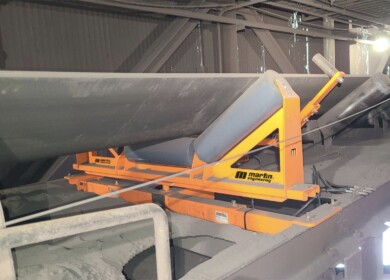
      • Modern belt trackers detect mis-tracking and correct the belt path immediately using troughed idlers or gripping return idlers.
      • A heavy-duty belt cleaner system featuring modern primary and secondary cleaners with an effective tensioner increases the volume of discharge and limits the amount of carryback and fugitive dust. Along with limiting spillage, tail pulley health is improved and there is less fouling of rolling components.

      Conclusion

      Operators should regularly contain airborne dust at transfer points and remove accumulation. Damaged rollers must be replaced promptly. Conveyor belt alignment is also an essential prerequisite to belt safety. Consider using flame-resistant grease and other lubricants. Fire detection and suppression systems must be tested in accordance to regulatory standards. Experience has shown that clean conveyor systems and ongoing maintenance form the best defense against fire.

      conveyor
      equipment
      fire
      industrial safety
      Martin Engineering
      safety
      tips

      Enjoyed this story?

      Every Monday, our subscribers get their hands on a digest of the most trending agriculture news. You can join them too!

      Sign me up
      Check the example

      Discussion0 comments

      Спасибо за комментарий, он будет опубликован на сайте после проверки модератором. Хотите, чтобы ваши комментарии появлялись на сайте мгновенно? Достаточно пройти регистрацию.
      Congratulations, you can be the first to start the conversation.
      Do you have a question or suggestion? Please leave your comment to ignite conversation.
      What’s on your mind?
      Cancel Log in and comment
      Or continue without registration
      Get notified about new comments by email.
      Advertisement
      In focus
      How to get here?
      Stock quotes
      Bayer
      11.52
      4.82
      Bayer Crop Science
      40.21
      0.3
      CF Industries
      123.29
      0.78
      Corteva Agriscience
      80.05
      1.28
      ICL Group
      5.38
      0.94
      Intrepid Potash
      41.94
      0.79
      Mosaic
      28.83
      4.19
      Nutrien
      79.55
      2.26
      Yara International
      28.45
      2.1
      See all
      Most read
      Agromin composts 1.25 million tons of organic waste in 2025
      Agromin composts 1.25 million tons of organic waste in 2025
      U.S. Justice Department opens antitrust probe into fertilizer producers amid price concerns
      U.S. Justice Department opens antitrust probe into fertilizer producers amid price concerns
      Middle East conflict threatens fertilizer supply ahead of U.S. planting season
      Middle East conflict threatens fertilizer supply ahead of U.S. planting season
      DeKalb may launch 30 new corn hybrids for 2026 season
      DeKalb may launch 30 new corn hybrids for 2026 season
      FMC secures first dual-mode herbicide classification for rimisoxafen
      FMC secures first dual-mode herbicide classification for rimisoxafen
      Events
      World Agri-Tech Innovation Summit
      San Francisco (CA), USA
      Mar 17 — 18, 2026
      FSHOW
      Shanghai, China
      Mar 17 — 19, 2026
      Argus Fertilizer Asia
      Bali, Indonesia
      Mar 31 — Apr 2, 2026
      CRU Phosphates
      Paris, France
      Apr 13 — 15, 2026
      CFEX
      Antalya, Turkey
      Apr 15 — 17, 2026
      See all
      Live
      Isabelita Barreiro
      December 11, 2025, 01:54 am
      Excellent management of water resources and effective use of water-soluble fertilizers!
      Argentine nano-fertilizer firm AKO Agro expands to Brazil
      Meripa Corson
      August 4, 2025, 01:18 pm
      Where does the money actually go? As a timber land owner, how do I benefit from the legislation?
      USDA commits $80 million to expand timber markets and improve forest resilience
      Patonkas Luksompulus
      January 21, 2025, 12:36 pm
      Greece meeds biological fertilizers! Great news about De sangosse.
      DE SANGOSSE expands operations with Greek subsidiary
      Pedro Diaz
      November 20, 2024, 08:42 pm
      Is it a Roundup lawsuit or more about bad financials? I think the market reacted only to announced financial results.
      Bayer’s shares are pressed down by ongoing Roundup cancer lawsuit
      Johan Fredin
      August 22, 2024, 07:57 pm
      Europe is falling behind in this field. The concerns 30 years ago was reasonable. Now not so much. We need crops that can survive in a more extreme future climate. Handle droughts and hot weather better. Crops that are less tasty to pests like hogs and deere.
      Gene-edited crops set for groundbreaking European trials
      About
      Sections
      Markets  ·  Business  ·  Politics  ·  Technologies  ·  Interviews  ·  Rankings  ·  Environment
      Support
      About  ·  Team  ·  Advertise  ·  Contacts  ·  Submit a Tip  ·  Privacy Policy  ·  Terms of Service
      Copyright © 2014-2026 DigitalTree LLC. All rights reserved.
      We deliver content lightning-fast thanks to the managed cloud WordPress hosting with CDN.
      16+
      More to read
      Conveyor Dust and Spillage: The Importance of  Skirtboard Sealing Systems
      Conveyor Dust and Spillage: The Importance of Skirtboard Sealing Systems
      Martin Engineering unveils new conveyor belt tracker that raises safety standards
      Martin Engineering unveils new conveyor belt tracker that raises safety standards
      Case Study: Safe Conveyor Equipment Design by Martin Engineering
      Case Study: Safe Conveyor Equipment Design by Martin Engineering
      Advertising that helps us do quality reporting