Skip to content
  • Professionals
  • Gardeners
 
Search
Log in
EN
RU
  • Markets
  • Business
  • Politics
  • Technologies
  • Interviews
  • Rankings
  • Environment
  • Events
  • Stock Quotes
  • Business Directory
Trending topic:
Featured company:
 
RU
  • Professionals
  • Gardeners
Sections
Events
Stock Quotes
Business Directory
Trending topic:
Featured company:
Follow us...
Helpful information
  • About
  • Team
  • Advertise
  • Contacts
  • Submit a Tip
  • Privacy Policy
  • Terms of Service
Sections
Seasonal tips
  • Spring
  • Summer
  • Autumn
  • Winter
Trending topics
  • compost
    22
  • garlic
    2
  • lemon
    1
  • potato
    12
Follow us...
Helpful information
  • About
  • Team
  • Advertise
  • Contacts
  • Submit a Tip
  • Privacy Policy
  • Terms of Service
Copyright © 2014-2025 DigitalTree LLC. All rights reserved.
We deliver content lightning-fast thanks to the managed cloud WordPress hosting with CDN.
16+

Home / Environment

UW-Madison engineers unveiled innovative nitrate monitoring soil sensors

Timothy Bueno avatar Timothy Bueno
June 28, 2024, 2:00 pm
331
Environment
Technologies
UW-Madison engineers unveiled innovative nitrate monitoring soil sensors
Save for later
Share

Engineers at the University of Wisconsin-Madison have created innovative soil sensors that offer continuous, real-time monitoring of nitrate levels in soil. This development could significantly impact farming efficiency and environmental health. These printed electrochemical sensors, designed to be both affordable and effective, are poised to transform how farmers manage soil nutrients, potentially leading to substantial cost savings and better crop yields.

Joseph Andrews, an assistant professor of mechanical engineering who spearheaded the project, highlighted the sensors’ ability to provide farmers with precise data on soil nitrate levels. This information is crucial for making informed decisions about fertilizer use, which can reduce excess spending and mitigate environmental risks associated with over-fertilization. “Our sensors could give farmers a greater understanding of the nutrient profile of their soil and how much nitrate is available for the plants, helping them to make more precise decisions on how much fertilizer they really need,” Andrews explained.

Traditional methods for monitoring soil nitrate are often cumbersome, costly, and unable to deliver immediate results. In response, Andrews and his team employed an inkjet printing process to create potentiometric sensors, commonly used in liquid solutions but not typically suitable for the abrasive conditions of soil. To overcome this, the sensors were enhanced with a protective layer of polyvinylidene fluoride, which has microscopic pores that filter out soil particles while absorbing nitrate-rich moisture.
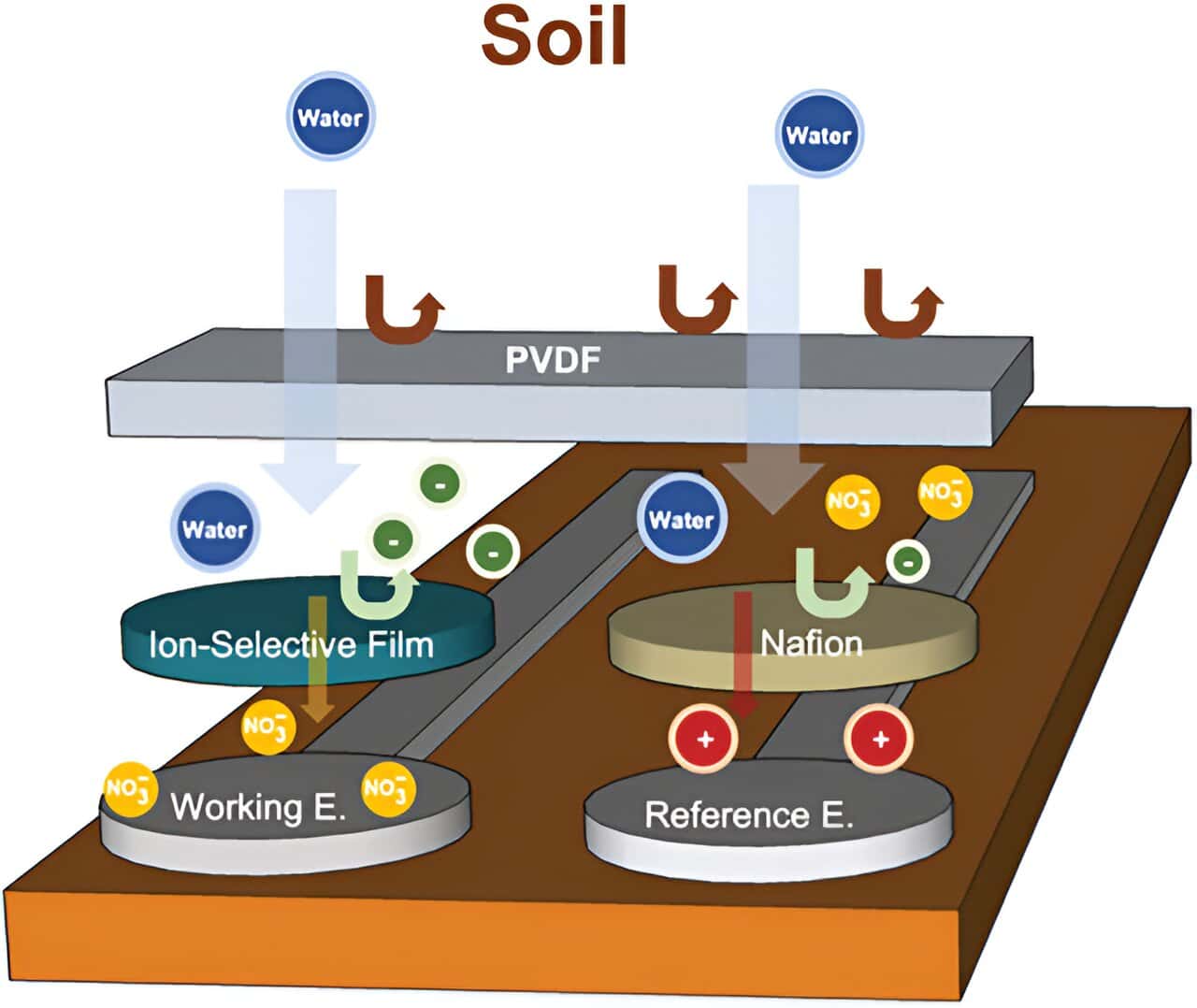
Schematic description of the working principle behind the open circuit potentiometric sensing enabled by the PVDF membrane.

ADVERTISEMENT

This innovative design allows the sensors to function effectively in the challenging environment of soil by capturing and analyzing nitrate-laden water. The research team’s findings, published in the journal Advanced Material Technologies in March 2024, demonstrated the sensors’ accuracy in two soil types prevalent in Wisconsin—sandy soil and silt loam.

Further enhancing the versatility of this technology, the sensors are part of a “sensing sticker” system that also measures moisture and temperature at various soil depths. These stickers are mounted on a flexible rod, allowing for comprehensive subterranean profiles that can track nitrate movement and leaching in real-time.

The research team plans to expand testing of their sensor technology in the summer of 2024 at two agricultural research stations operated by UW-Madison. This upcoming phase will involve deploying 30 sensing rods to gather more extensive data, potentially setting the stage for broader adoption of this technology in agriculture.

The study’s co-authors include Kuan-Yu Chen, Aatresha Biswas, Shuohao Cai, and Jingyi Huang, a professor of soil science. All are affiliated with UW-Madison and contributed to the development and testing of the sensors.

Source: Phys.org

precision agriculture
research
soil analysis
U.S.
University of Wisconsin–Madison

Enjoyed this story?

Every Monday, our subscribers get their hands on a digest of the most trending agriculture news. You can join them too!

Sign me up
Check the example

Discussion0 comments

Спасибо за комментарий, он будет опубликован на сайте после проверки модератором. Хотите, чтобы ваши комментарии появлялись на сайте мгновенно? Достаточно пройти регистрацию.
Congratulations, you can be the first to start the conversation.
Do you have a question or suggestion? Please leave your comment to ignite conversation.
What’s on your mind?
Cancel Log in and comment
Or continue without registration
Get notified about new comments by email.
Advertisement
In focus
How to get here?
Stock quotes
Bayer
9.66
1.02
Bayer Crop Science
33.31
0.8
CF Industries
77.88
2.93
Corteva Agriscience
66
0.44
ICL Group
5.18
1.33
Intrepid Potash
25.31
1.36
Mosaic
23.61
2.03
Nutrien
60.34
0.48
Yara International
19.23
1.16
See all
Most read
Bowery Farming’s $70M Georgia vertical farm heads to liquidation as startup’s collapse triggers nationwide sell-offs
Michigan tightens manure-spreading rules for large animal farms
Monarch Tractor may lay off 100 employees or shut down as it struggles to pivot away from manufacturing toward pure software model
Russia imposed temporary ban on sulfur exports until the end of 2025
Tyson shutters high-volume beef plant in Nebraska as the industry faces a downturn
Events
Argus Clean Ammonia Europe
Rotterdam, Netherlands
Dec 2 — 4, 2025
Organic Grower Summit
Monterey (CA), USA
Dec 3 — 4, 2025
IFS Conference
Cambridge, UK
Dec 10 — 12, 2025
Fertilizer Latino Americano
Miami (FL), USA
Jan 26 — 28, 2026
Argus Fertilizer Africa
Dar es Salaam, Tanzania
Feb 10 — 11, 2026
See all
Live
Meripa Corson
August 4, 01:18 pm
Where does the money actually go? As a timber land owner, how do I benefit from the legislation?
USDA commits $80 million to expand timber markets and improve forest resilience
Patonkas Luksompulus
January 21, 12:36 pm
Greece meeds biological fertilizers! Great news about De sangosse.
DE SANGOSSE expands operations with Greek subsidiary
Pedro Diaz
November 20, 2024, 08:42 pm
Is it a Roundup lawsuit or more about bad financials? I think the market reacted only to announced financial results.
Bayer’s shares are pressed down by ongoing Roundup cancer lawsuit
Johan Fredin
August 22, 2024, 07:57 pm
Europe is falling behind in this field. The concerns 30 years ago was reasonable. Now not so much. We need crops that can survive in a more extreme future climate. Handle droughts and hot weather better. Crops that are less tasty to pests like hogs and deere.
Gene-edited crops set for groundbreaking European trials
Timothy Kirkwood
July 23, 2024, 01:39 pm

Your article about Sargassum shows Kelp, not Sargassum.

Sargassum in the Caribbean: turning seaweed crisis into economic opportunity?
About
Sections
Markets  ·  Business  ·  Politics  ·  Technologies  ·  Interviews  ·  Rankings  ·  Environment
Support
About  ·  Team  ·  Advertise  ·  Contacts  ·  Submit a Tip  ·  Privacy Policy  ·  Terms of Service
Copyright © 2014-2025 DigitalTree LLC. All rights reserved.
We deliver content lightning-fast thanks to the managed cloud WordPress hosting with CDN.
16+
More to read
Osaka University showcased biodegradable soil moisture sensor
Transforming agriculture: Tennessee Tech’s groundbreaking soil-powered IoT system
Innovative electrode technique extracts fertilizer from manure
Advertising that helps us do quality reporting