

DJI Agriculture sees drone use surge, driven by looser rules and cost benefits

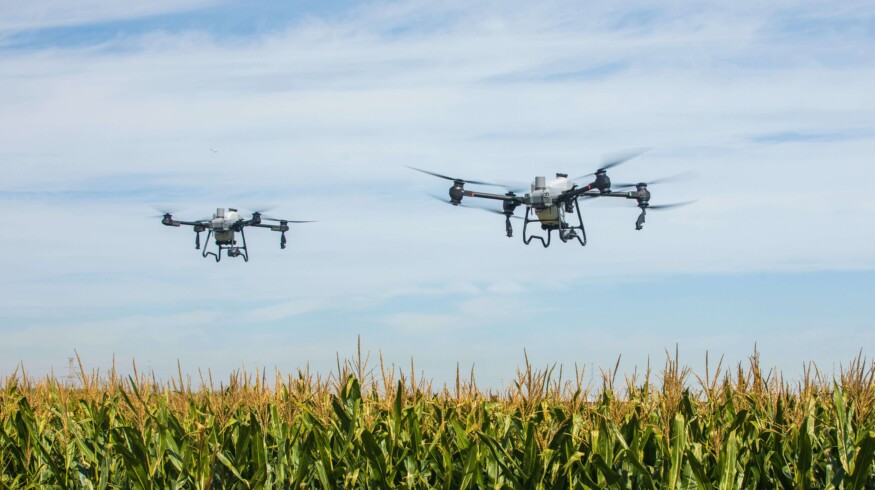
DJI Agriculture has released its fourth annual Agricultural Drone Industry Insight Report, pointing to growing global demand for drone-assisted farming as governments ease regulatory restrictions and producers seek cost-effective, sustainable crop management tools.
The report estimates that 400,000 DJI agricultural drones are in operation across 100 countries, managed by a similarly scaled network of trained operators. The global fleet—nearly double its size in 2020—now treats more than 300 crop types. According to DJI, the adoption of drone technology has helped save approximately 222 million metric tons of water and has reduced carbon dioxide emissions by 30.87 million metric tons.
“Research-based policies and standardized training have transformed agricultural drones into essential farm tools,” said Yuan Zhang, head of global sales at DJI Agriculture. “The trend is no longer isolated—it’s global, and it’s reshaping how farms operate.”
Policy reforms drive uptake
DJI attributes the expansion to a broad wave of national reforms and pilot training standards. In Brazil, for instance, the Civil Aviation Authority (ANAC) in 2023 removed airworthiness certification requirements for agricultural drones. The Ministry of Agriculture (MAPA) followed in 2024 by issuing new guidelines to regulate operator training and minimize regulatory loopholes.
Argentina has taken similar steps, streamlining authorization processes to encourage drone use in farming. Spain, meanwhile, revised its risk assessment standards to expand eligibility for aerial applications, authorizing over 120 agricultural drone operations under a new expedited process.
In the United States, the Federal Aviation Administration simplified the process to obtain Part 137 certification for chemical application via drones. Farmers can now control up to three drones simultaneously under the updated guidelines. The U.S. Department of Agriculture continues to support drone research for pesticide drift mitigation and yield optimization.
Efforts to mitigate chemical drift
Spray drift remains a technical concern for all forms of aerial pesticide application. DJI said it has conducted extensive field trials from 2021 through 2024—adhering to ISO 22866 standards—to refine airflow dynamics and nozzle design. The company claims its drones demonstrate less drift than conventional aircraft and comparable performance to ground sprayers.
The report outlines recommended best practices to further limit drift, including low-altitude operations, slower flight speeds, and the use of coarser droplet sizes depending on the crop and pesticide used.
Field reports underscore cost benefits
Case studies featured in the report point to substantial cost savings and efficiency gains:
- Coffee farming in Brazil: Use of DJI Agras T40 and T50 drones reduced operational spraying costs by 70 percent compared to manual labor and 50 percent relative to tractor-based spraying. The drones applied pesticides, fungicides and foliar fertilizers with more precision and less chemical use.
- Rice cultivation globally: Farmers using drones to spread pre-germinated rice seeds saw better distribution by adjusting altitude and disk speed. Proper terrain leveling and flight route spacing were cited as key variables.
- Vineyard management in Romania: A grower using DJI’s Agras T50 reported a reduction in chemical use from 241.64 liters to 111.94 liters and completed spraying in 2.5 hours—down from up to four days using conventional methods.
Market trends and competitive landscape
While DJI maintains a dominant share in the agricultural drone segment, the broader market is becoming increasingly competitive. Chinese and U.S.-based drone manufacturers, as well as agtech startups in Europe and Latin America, are entering the space with offerings tailored to local regulatory conditions and crop types.
Adoption barriers remain in several regions. These include limited rural internet connectivity, lack of access to financing for smallholder farmers, and the need for agronomic advisory services to translate drone data into actionable insights. Nonetheless, falling equipment costs, more user-friendly platforms, and growing support from governments and NGOs are expected to accelerate uptake through 2026.
Industry analysts forecast that the global agricultural drone market could exceed $10 billion in annual revenue within five years, driven by rising demand for precision spraying, variable-rate fertilization, and environmental monitoring.
DJI’s strategic direction
DJI’s report anticipates continued momentum in 2025 and beyond, particularly as countries refine national drone frameworks and more operators enter the industry. In 2024, over 12,000 women joined the agricultural drone workforce, signaling broader demographic participation.
The company says it will continue investing in firmware updates, training initiatives and field-modeling tools that allow for variable-rate spraying based on real-time crop conditions.
“By combining precision technology with policy reform, we are entering a new phase of smart farming,” said Mr. Zhang.
The full 2025 Agricultural Drone Industry Insight Report is available here.

Enjoyed this story?
Every Monday, our subscribers get their hands on a digest of the most trending agriculture news. You can join them too!




Discussion0 comments