

EU reaches trilogue deal on new genomic techniques

EU lawmakers have reached a provisional trilogue agreement on the regulation of New Genomic Techniques (NGTs), setting out a new legal framework intended to support plant-breeding innovation, strengthen food security and improve the competitiveness of Europe’s agri-food sector.
The deal, announced on 4 December, establishes differentiated rules for two categories of NGT plants. Category 1 plants—those considered equivalent to conventional varieties—will benefit from a simplified procedure and will not require product labelling beyond seed and reproductive material. Category 2 plants, which involve more complex or non–natural-equivalent genomic changes, will remain subject to existing GMO legislation, including authorisation, traceability and mandatory labelling. Member states will be permitted to opt out of cultivating Category 2 plants within their territory.
The agreement also introduces provisions related to intellectual property. Applicants registering Category 1 plants must disclose all existing or pending patents, with this information made publicly available. An expert group will be created to examine the implications of patenting for breeders, seed availability and sector competitiveness, ahead of a European Commission study expected one year after the regulation enters into force.
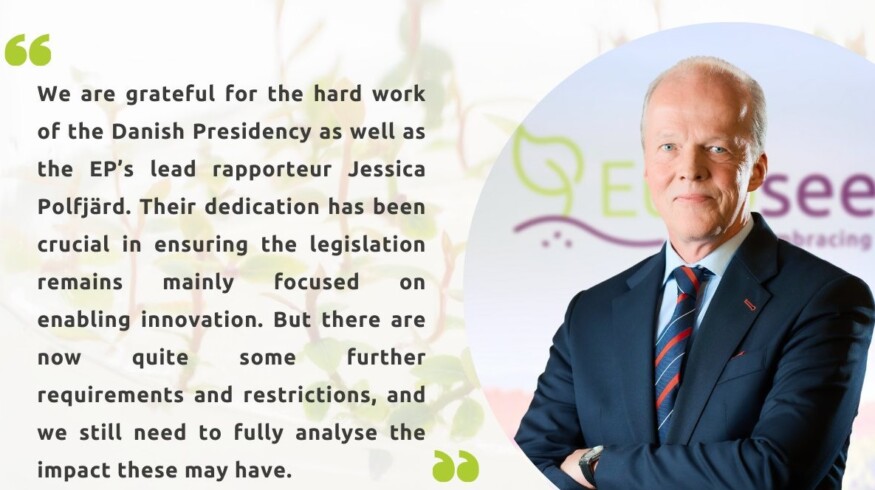
Europe’s seed sector has largely welcomed the outcome. Euroseeds, the association representing breeders and seed companies, said the agreement preserves the core intent of the European Commission’s original proposal, namely to enable the development and cultivation of conventional-like NGT varieties. These varieties are expected to help farmers manage increasing climate-related pressures, new pests and higher production risks.
At the same time, Euroseeds noted that multiple additional provisions were added during negotiations. These measures—ranging from new administrative steps to specific exclusions from the Category 1 list, such as herbicide-tolerance traits and plants engineered to produce known insecticidal substances—will require further analysis to assess their operational and cost implications.
The Danish Council Presidency and the European Parliament’s lead rapporteur, Jessica Polfjärd, were credited by industry representatives for steering the file to its conclusion. Euroseeds said it will work with regulators during implementation to support a transition that preserves the legislation’s innovation objectives while ensuring clarity for breeders, farmers and national authorities.
The provisional agreement must now be formally endorsed by the Council and the European Parliament before it can enter into force.

Enjoyed this story?
Every Monday, our subscribers get their hands on a digest of the most trending agriculture news. You can join them too!




Discussion0 comments