

Deep plowing shown to weaken soil resilience, new study finds

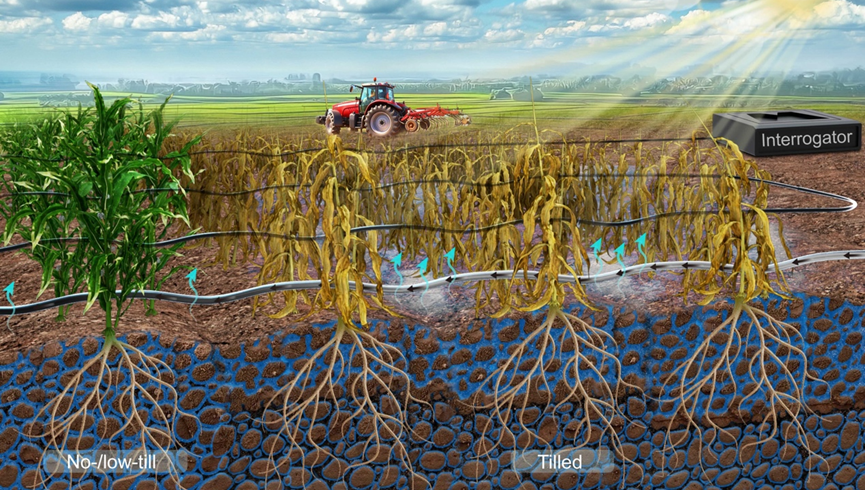
For decades, farmers and agronomists have debated whether intensive plowing improves or degrades soil health. A new international study led by the Chinese Academy of Sciences offers fresh evidence by introducing an unconventional method: monitoring soil through sound.
Published in Science, the research uses distributed acoustic sensing technology, in which fiber-optic cables detect minute underground vibrations. By sending laser pulses through the cables and analyzing their reflections, scientists can track how water moves through soil in real time without disturbing it.
The system was deployed across a 160-meter-wide experimental farm in the United Kingdom, allowing researchers to observe subsurface water dynamics continuously and at high resolution—something not possible with traditional soil sampling methods.
Soil as a living water network
The study highlights that healthy soil behaves less like loose dirt and more like a structured, living system. Its internal architecture consists of microscopic pores and channels that function as a natural water distribution network.
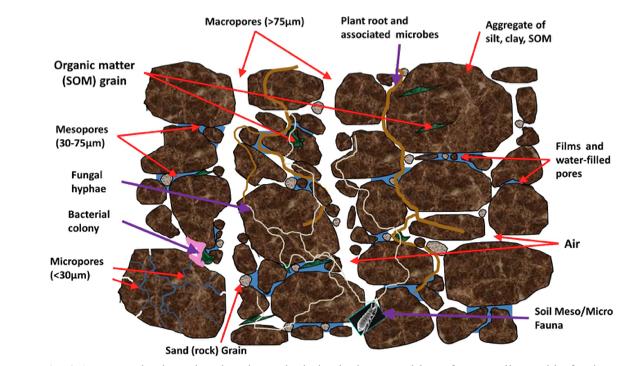
These interconnected pores allow rainwater to infiltrate deeply, where it can be stored and accessed by plant roots during dry periods. The system acts as a buffer, protecting crops from both drought and excess rainfall by regulating how water is absorbed, retained, and released.
How plowing and machinery alter soil behavior
In contrast, the findings show that repeated deep plowing and the use of heavy agricultural machinery can significantly disrupt this natural pore network.
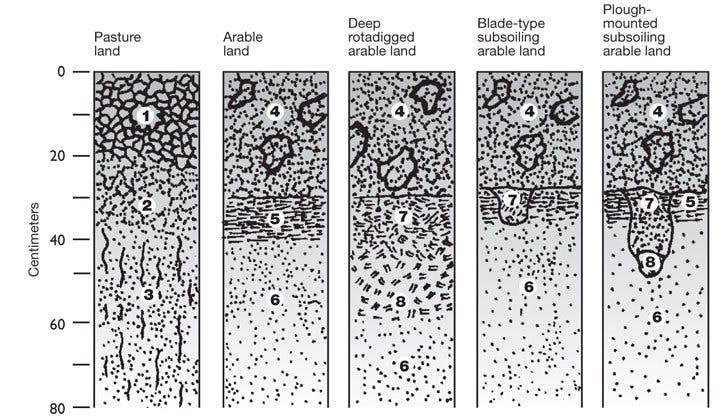
When soil is compacted or mechanically disturbed, its internal channels collapse or become disconnected. As a result, water tends to accumulate near the surface rather than infiltrating deeper layers. This shallow water is more prone to evaporation, leaving deeper soil dry and reducing plants’ access to moisture during critical growth periods.
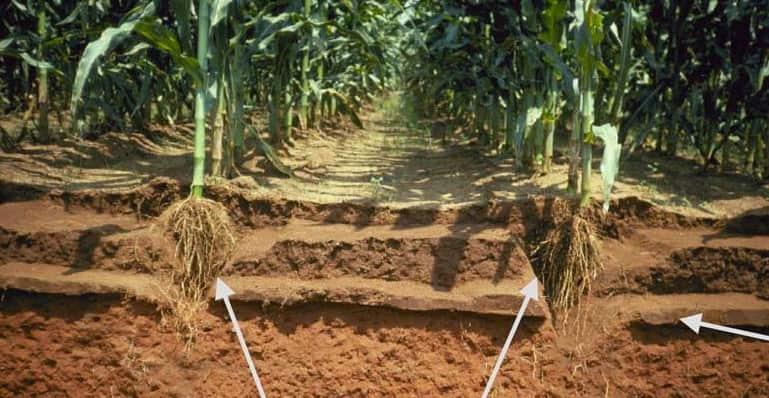
The study suggests that such changes weaken crops’ resilience, making them more vulnerable to both drought stress and extreme rainfall events.
Rethinking soil physics: the role of capillary stress
To explain these dynamics, researchers developed a “dynamic capillary stress” model that challenges conventional assumptions about soil strength. Traditional models focus primarily on overall water content, whereas the new framework emphasizes the configuration of pores and the capillary forces within them.
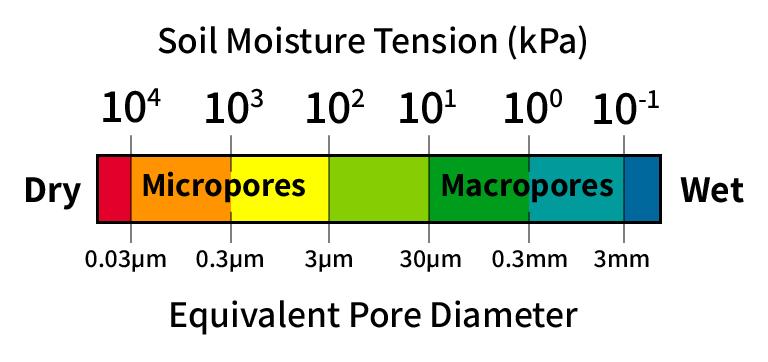
According to the model, thin films of water within tiny pores generate surface tension forces that act like elastic bonds, stabilizing soil structure when moisture levels are moderate. When these pores are damaged, the capillary system is altered, accelerating water loss and reducing the soil’s mechanical integrity.
This reframes soil not as a passive medium but as an active system whose structure directly governs water cycling and plant health.
Implications for farming and climate resilience
The findings carry significant implications for agricultural practices, particularly as climate variability increases. While plowing can provide short-term benefits—such as loosening topsoil and facilitating planting—it may undermine long-term soil functionality by breaking the structures that regulate water and air flow.
Preserving soil integrity could therefore become a central strategy for improving resilience to extreme weather. Reduced tillage, controlled traffic farming, and other conservation practices may help maintain the pore networks essential for sustainable productivity.
Toward real-time soil monitoring
The study also points to future applications of fiber-optic sensing in agriculture. Because cables are relatively inexpensive and scalable, they could be deployed more widely to continuously monitor soil conditions.
Combined with artificial intelligence, such systems could enable farmers to diagnose soil health in real time, optimize irrigation, and adapt field management strategies with greater precision. Researchers suggest this approach could help strengthen global food security by improving how soils are managed under increasingly challenging environmental conditions.
Source: China Daily

Enjoyed this story?
Every Monday, our subscribers get their hands on a digest of the most trending agriculture news. You can join them too!




Discussion0 comments