

MIT study: rice seeds germinate faster when exposed to rainfall sounds

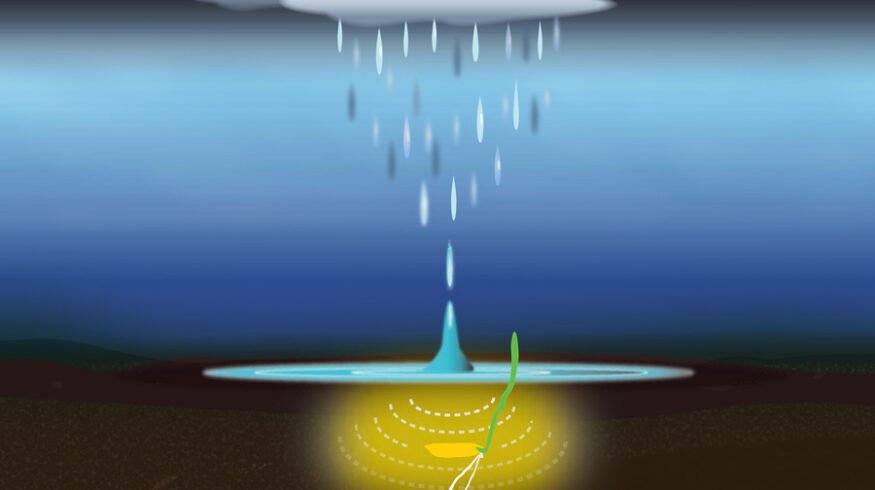

A new study from the Massachusetts Institute of Technology has found that rice seeds can detect the sound of falling rain and respond by germinating faster — adding an unexpected acoustic dimension to how crops read their environment.
Published in Scientific Reports, the research found that rice seeds submerged in shallow water germinated 30% to 40% faster when exposed to sound vibrations generated by simulated raindrops, compared with otherwise identical seeds kept in silence. That is a meaningful acceleration for a crop grown across hundreds of millions of acres worldwide.
The work focused on rice, which is typically cultivated in flooded or semi-flooded conditions where early germination timing can affect stand uniformity and yield. Researchers tested roughly 8,000 seeds under controlled laboratory conditions, placing them far enough from the water’s surface that only sound waves — not direct physical impact — could reach them.
The study found that rainfall vibrations, traveling through water and soil, disturb tiny structures in plant cells called statoliths — sensors the plant uses to detect gravity — triggering the biological cascade that initiates germination. Seeds closer to the surface responded more strongly, pointing to a potential adaptive mechanism: those positioned at the right depth may be better equipped to detect rainfall and begin growing under favorable moisture conditions.
Nicholas Makris, a professor at MIT and one of the study’s authors, noted that acoustic energy from raindrops travels more efficiently through water than air due to the higher density of the medium, allowing vibrations to penetrate shallow water and soil with enough force to influence seed biology. In that sense, the sound of rain may function as an environmental go signal for seeds already primed to grow.
The finding extends a growing body of research on how plants interpret mechanical forces beyond light and chemical cues. It also raises practical questions for agriculture: in flooded or irrigated systems, could ambient sound conditions subtly influence the timing and uniformity of crop establishment?
The authors caution that further research is needed to determine whether similar responses occur in other crops and whether the effect holds under real-world field conditions. But the study suggests the acoustic environment of a field — long treated as background noise — may be worth a closer listen.

Enjoyed this story?
Every Monday, our subscribers get their hands on a digest of the most trending agriculture news. You can join them too!






Discussion1 comments