

Amazon-backed project completes world’s first seaweed harvest at offshore wind farm


The world’s first harvest of seaweed grown within a fully operational offshore wind farm has been completed off the coast of the Netherlands, in a project supported by Amazon’s Right Now Climate Fund.
North Sea Farm 1, located 11 miles from The Hague inside the Hollandse Kust Zuid wind park, was developed by the nonprofit North Sea Farmers with €2 million ($2.29 million) in funding from Amazon. The initiative is the first global effort to combine renewable energy infrastructure with large-scale seaweed cultivation.
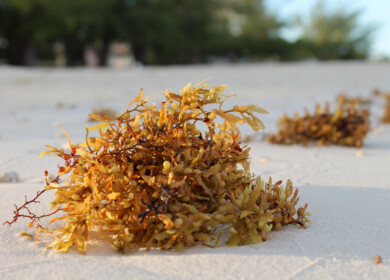
The United Nations has recognized seaweed as a highly efficient carbon sink, capable of capturing up to 20 times more carbon per hectare than terrestrial forests. It also requires no land, freshwater, or fertilizer while providing potential raw materials for food, textiles, bioplastics, and animal feed.
“This is a crucial step to demonstrate the scale-up potential of the European seaweed industry—and the benefits it could bring for marine ecosystems and climate resilience,” said Eef Brouwers, managing director of North Sea Farmers. The group has been developing the project for nearly a decade, beginning with early trials in 2014.
The farm spans 12 acres in a section of the North Sea closed to maritime traffic and uses nets suspended between wind turbines to cultivate sugar kelp. The harvest was carried out using custom equipment designed for offshore conditions, with crews carefully lifting mature seaweed to minimize environmental disturbance.
Research teams from Plymouth Marine Laboratory, Dutch hydraulic institute Deltares, and Silvestrum Climate Associates are analyzing the results, monitoring carbon uptake, biodiversity impacts, and seabed processes. Industry partners include seaweed extract producer Algaia, developer Simply Blue Group, and contractors Van Oord and Doggerland Offshore.
The project is part of Amazon’s broader strategy to reach net-zero carbon in its operations by 2040. Since launching its Right Now Climate Fund in 2019, the company has backed nature-based projects across Europe, including forest restoration in Germany, peatland recovery in Ireland, and habitat restoration in the UK.
The success of the first harvest demonstrates the potential for offshore wind infrastructure to support both clean energy and marine farming, providing a model that could be replicated globally.

Enjoyed this story?
Every Monday, our subscribers get their hands on a digest of the most trending agriculture news. You can join them too!


Discussion0 comments