

Missouri farmer turns swamp ground into thriving row crop operation


When farmland became available in Missouri’s Little River Drainage District in 2014, Justin Littleton saw an opportunity to establish himself as a first-generation farmer. The region, once covered by swamps and timber, was transformed into fertile cropland following the Swamp Land Act of 1850, which enabled the drainage of more than 500,000 acres.
Littleton, who grew up farming alongside his grandfather and extended family, quickly leaned on friends and neighbors for guidance. “Allen Below helped me so much when I started out on my own,” he said. “There’s no way I could ever repay him.” His brother, Austin, later joined the operation, and together with Below, the three farmers manage 12,000 acres of cotton, corn, soybeans, rice and peanuts.
Although the farms are legally separate entities, they function as a joint operation. “In today’s farming economic environment, you take advantage of, or create efficiencies, where you can,” Littleton said. Sharing equipment, fuel and labor has become central to their strategy.
Adapting to diverse soils
The operation’s ground ranges from sandy soil irrigated with pivots to heavy Sharkey clay better suited for soybeans and rice. Annual soil testing and variable-rate application of phosphate and potash are used to manage nutrients effectively. Cover crops, including cereal rye, vetch and radishes, are planted on 90% of the acreage to improve soil health.
Investing in scale and speed
High-speed planters with 57-foot toolbars allow seeds to be sown at 10 miles per hour, while foldable wings simplify transport between fields. “You would think a planter that covers 18 rows would be a headache, but it’s done nothing but improve our planting efficiency,” Littleton said.
The farmers minimize tillage and focus on residue management after corn and cotton harvests. Traditional options like bush hogs and flail shredders proved inefficient or maintenance-intensive, leading Littleton to test new approaches.
Cyclone cutter boosts efficiency
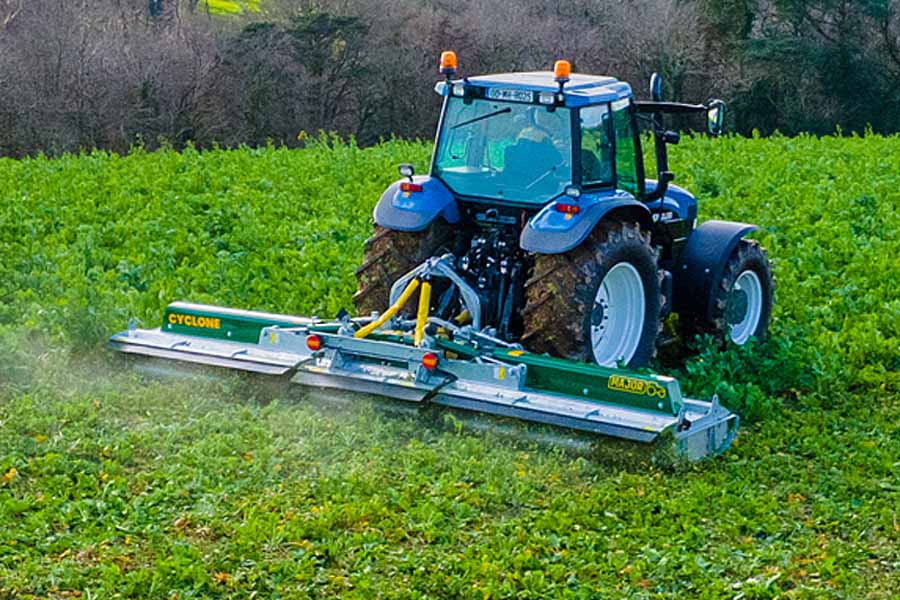
In 2022, Littleton adopted the MJ30-920 Cyclone Cutter from Major Equipment after seeing a neighbor use it. He said the machine offered clear advantages, including even residue distribution, fewer moving parts and reduced maintenance. “I don’t see it ever having balancing issues,” he noted.
Service support has also been a factor. When a bearing issue arose, Major Equipment replaced the parts under warranty without delay. “That impressed me almost as much as the Cyclone’s ability to fold up narrower than the insides of the duals on my tractors,” Littleton said.
For Littleton, who has built his farm around maximizing efficiency, the investment reflects a broader philosophy: working bigger, smarter and with equipment that reduces downtime. “I’m going to run it another year over all my corn and cotton stalks to see how it holds up, but I don’t regret buying it at all.”

Enjoyed this story?
Every Monday, our subscribers get their hands on a digest of the most trending agriculture news. You can join them too!





Discussion0 comments