

Koch-OCP Phosphate Fertilizer JV Enters Regulatory Review, Targeting 2.5M-Tonne Combined Capacity



Koch Ag & Energy Solutions’ planned investment in OCP Nutricrops’ Jorf Fertilizers Company I has entered regulatory review in Morocco, moving the companies’ second major phosphate fertilizer joint venture at Jorf Lasfar closer to completion.
Morocco’s Competition Council said on October 8 that KAES Phosphate Holdings, LLC, a Koch-controlled company, had notified the authority of its proposed acquisition of 50% of Jorf Fertilizers Company I, or JFC I. The transaction would give Koch and OCP Nutricrops joint control of the company.
If the transaction closes, Koch and OCP would jointly operate phosphate fertilizer assets with combined annual nameplate capacity of approximately 2.5 million metric tons at the Jorf Lasfar complex. That figure represents production capacity, not current joint-venture output.
Koch’s second major phosphate investment with OCP
Koch and OCP announced the JFC I agreement on July 17, 2026.
Under the agreement, Koch will acquire a 50% interest in JFC I from OCP Nutricrops. JFC I owns and operates an integrated phosphate fertilizer facility at Jorf Lasfar with capacity to produce up to 1.2 million metric tons per year of phosphate-based fertilizers.
The transaction follows Koch’s 2022 acquisition of a 50% interest in Jorf Fertilizers Company III, which was subsequently renamed Kofert.
That earlier facility has capacity of up to 1.1 million metric tons per year of phosphate fertilizers. The 2022 transaction closed on June 30 of that year, creating Koch and OCP’s first 50/50 operating joint venture at Jorf Lasfar.
| Asset | Koch-OCP structure | Phosphate fertilizer capacity | Status |
|---|---|---|---|
| Kofert / former JFC III | 50/50 Koch-OCP joint venture | Up to 1.1 million t/y | Operating JV since 2022 |
| JFC I | Planned 50/50 Koch-OCP joint venture | Up to 1.2 million t/y | Under regulatory review |
| Combined | Two 50/50 ventures | Approximately 2.5 million t/y | Subject to JFC I closing |
Regulatory review is now the key next step
The Moroccan Competition Council’s October 8 notice confirms that the transaction has moved beyond the initial agreement stage and into formal merger-control review.
The filing describes the deal as the acquisition of joint control of JFC I by KAES Phosphate Holdings alongside OCP Nutricrops through the purchase of 50% of JFC I’s capital and voting rights.
The Council said the transaction concerns the production of phosphoric acid and phosphate-based fertilizers.
Interested third parties have been invited to submit observations during the regulatory process.
The transaction therefore should not yet be described as completed. Koch and OCP have announced the agreement, but closing remains dependent on regulatory approval and other customary conditions.
What does JFC I actually produce?
JFC I is more than a standalone fertilizer granulation plant.
Information submitted as part of the Moroccan regulatory process indicates that the company operates industrial units involved in phosphoric acid processing, phosphate fertilizer manufacturing and sulfuric acid production.
OCP documentation has historically identified JFC I as one of several integrated fertilizer units at Jorf Lasfar producing products including DAP, MAP, NPK and NPS fertilizers.
The original JFC units were developed as part of OCP’s strategy to increase phosphate fertilizer production for international markets.
Why Jorf Lasfar matters to the global phosphate fertilizer market
Jorf Lasfar is not simply another fertilizer production site.
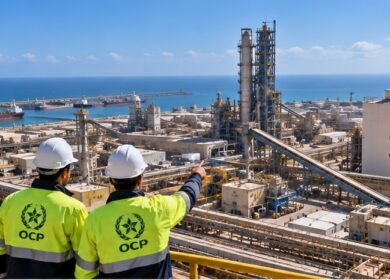
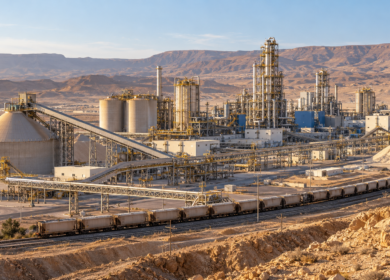
OCP describes the complex as the world’s largest integrated phosphate fertilizer production platform. The site covers approximately 2,000 hectares and combines phosphate processing, phosphoric acid production, sulfuric acid production, fertilizer manufacturing, energy generation, storage and port infrastructure.
OCP says Jorf Lasfar currently produces around 15 million metric tons per year of plant nutrition solutions across more than 100 grades.
The site receives phosphate from OCP’s Khouribga mining basin through a slurry pipeline and has direct access to port infrastructure used for international fertilizer and raw-material shipments.
This integration reduces the number of separate logistics steps between phosphate mining, phosphoric acid production, fertilizer manufacturing and export.
How phosphate fertilizer is produced at an integrated complex
The production chain typically begins with mined phosphate rock containing phosphate minerals such as fluorapatite and carbonate-fluorapatite.
After beneficiation, phosphate rock is reacted with sulfuric acid to produce phosphoric acid. That phosphoric acid can then be reacted with ammonia to manufacture major phosphate fertilizers including monoammonium phosphate and diammonium phosphate.
For a deeper explanation of the mineral and processing chain, Fertilizer Daily has examined how fluorapatite and phosphate rock are converted into phosphate fertilizers.
| Stage | Main input | Output |
|---|---|---|
| Mining | Phosphate ore | Phosphate rock |
| Acid production | Sulfur + energy | Sulfuric acid |
| Phosphoric acid production | Phosphate rock + sulfuric acid | Phosphoric acid |
| Ammoniation | Phosphoric acid + ammonia | MAP, DAP and related fertilizers |
| Granulation and logistics | Intermediate fertilizer materials | Finished export-grade fertilizer |
Why Koch wants direct exposure to phosphate fertilizer production
Koch Fertilizer has traditionally had a strong position in nitrogen fertilizers and fertilizer distribution. Its partnerships with OCP give the company direct exposure to large-scale phosphate fertilizer manufacturing.
The 2022 Kofert transaction already provided Koch with access to up to 1.1 million metric tons per year of phosphate-based fertilizer capacity.
Adding JFC I would expand that relationship to a second integrated production unit and increase the combined nameplate capacity represented by the two ventures to approximately 2.5 million metric tons per year.
The companies have also said their cooperation includes fertilizer marketing, ammonia and sulfur supply and logistics.
This makes the partnership broader than a simple equity investment. It connects OCP’s phosphate-resource and manufacturing base with Koch’s fertilizer distribution, raw-material sourcing and logistics capabilities.
The North American market is strategically important
The companies have explicitly connected their expanded partnership with fertilizer supply to North America.
When the JFC I agreement was announced, OCP said the expanded relationship would strengthen the companies’ ability to provide phosphate-based plant nutrition solutions to North American customers.
The timing is particularly significant because U.S. trade policy toward Moroccan phosphate fertilizer changed sharply in 2026.
The United States temporarily suspended countervailing duties on Moroccan phosphate fertilizer, reopening a wider import channel for OCP products.
Fertilizer Daily previously reported that OCP was preparing new phosphate fertilizer shipments to the United States following the temporary duty suspension.
The Koch-OCP partnership therefore combines production capacity in Morocco with a partner that already has a large commercial and logistics presence in North American fertilizer markets.
Capacity does not mean all 2.5 million tonnes will go to the U.S.
The approximately 2.5 million-tonne figure is the combined nameplate capacity of the two Koch-OCP joint ventures after the proposed JFC I transaction closes.
It should not be interpreted as:
- 2.5 million tonnes of current annual production;
- 2.5 million tonnes of additional new capacity;
- 2.5 million tonnes dedicated to the United States;
- 2.5 million tonnes of guaranteed exports.
Both facilities already exist. The transaction changes ownership and commercial alignment rather than constructing 2.5 million tonnes of entirely new fertilizer capacity.
Actual production and destination markets will depend on operating rates, product mix, demand, logistics and commercial decisions.
How large is 2.5 million tonnes in the context of Jorf Lasfar?
OCP says the wider Jorf Lasfar platform currently produces approximately 15 million tonnes per year of plant nutrition solutions.
On that basis, the combined nameplate capacity associated with the two Koch-OCP ventures would equal roughly one-sixth of the wider platform’s stated annual plant nutrition production.
This comparison is approximate because plant nutrition production and nameplate fertilizer capacity are not identical statistical concepts.
| Measure | Approximate scale |
|---|---|
| JFC I capacity | Up to 1.2 million t/y |
| Kofert capacity | Up to 1.1 million t/y |
| Combined Koch-OCP JV capacity after closing | About 2.5 million t/y |
| Jorf Lasfar plant nutrition production stated by OCP | About 15 million t/y |
Phosphate fertilizer supply depends on more than phosphate rock
Morocco’s large phosphate resources provide OCP with a major feedstock advantage, but phosphate fertilizer production also depends on sulfur and ammonia.
Sulfur is needed to manufacture sulfuric acid, which is then used to convert phosphate rock into phosphoric acid.
Ammonia is required to produce ammonium phosphate fertilizers such as MAP and DAP.
This explains why the original Koch-OCP partnership included cooperation on ammonia and sulfur supply as well as fertilizer logistics.
Disruptions in sulfur, ammonia, energy or freight can therefore constrain phosphate fertilizer output even when phosphate rock itself is abundant.
What the transaction means for competition
The regulatory filing is particularly relevant because it moves a large fertilizer production asset from sole OCP ownership to joint control by OCP and Koch.
Moroccan competition authorities will assess the proposed concentration under national merger-control rules.
The filing itself does not indicate that the transaction has been approved or rejected.
Until a formal decision and closing are confirmed, JFC I remains a planned joint venture rather than a completed Koch-OCP asset.
What happens next?
The next major milestone is the outcome of Morocco’s competition review.
If required approvals are granted and the remaining closing conditions are met, Koch will acquire 50% of JFC I and the companies will establish their second 50/50 operating joint venture at Jorf Lasfar.
Key developments to watch include:
- formal regulatory clearance;
- transaction closing;
- confirmation of the final ownership structure;
- marketing arrangements for JFC I production;
- future product allocation between North America and other markets;
- operating rates at JFC I and Kofert;
- changes in U.S. phosphate import policy.
Frequently asked questions
Koch, through KAES Phosphate Holdings, plans to acquire 50% of Jorf Fertilizers Company I from OCP Nutricrops, creating joint control of the company.
JFC I has nameplate capacity of up to 1.2 million metric tons per year of phosphate-based fertilizers.
Kofert is the former Jorf Fertilizers Company III. Koch acquired a 50% interest in the company in 2022, creating its first 50/50 phosphate fertilizer joint venture with OCP at Jorf Lasfar.
They represent combined nameplate capacity of approximately 2.5 million metric tons per year of phosphate-based fertilizers after the JFC I transaction closes.
No. As of October 2026, the transaction is undergoing regulatory review in Morocco and remains subject to approval and closing conditions.
No. The 2.5 million-tonne figure represents combined production capacity, not a U.S. export commitment. Actual sales will depend on global demand and commercial allocation.
It is an integrated phosphate-processing and fertilizer-production hub combining phosphoric acid, sulfuric acid, fertilizer manufacturing, utilities, storage and port logistics at one location.
Sources: Morocco Competition Council, Koch Fertilizer, OCP Group, OCP Group

Enjoyed this story?
Every Monday, our subscribers get their hands on a digest of the most trending agriculture news. You can join them too!




Discussion0 comments