Skip to content
  • Professionals
  • Gardeners
 
Search
Log in
EN
RU
  • Markets
  • Business
  • Politics
  • Technologies
  • Interviews
  • Rankings
  • Environment
  • Events
  • Stock Quotes
  • Business Directory
Trending topic:
Featured company:
 
RU
  • Professionals
  • Gardeners
Sections
Events
Stock Quotes
Business Directory
Trending topic:
Featured company:
Follow us...
Helpful information
  • About
  • Team
  • Advertise
  • Contacts
  • Submit a Tip
  • Privacy Policy
  • Terms of Service
Sections
Seasonal tips
  • Spring
  • Summer
  • Autumn
  • Winter
Trending topics
  • compost
    22
  • garlic
    2
  • lemon
    1
  • potato
    12
Follow us...
Helpful information
  • About
  • Team
  • Advertise
  • Contacts
  • Submit a Tip
  • Privacy Policy
  • Terms of Service
Copyright © 2014-2025 DigitalTree LLC. All rights reserved.
We deliver content lightning-fast thanks to the managed cloud WordPress hosting with CDN.
16+

Home / Environment

Drought-resistant seed coatings, microbial fertilizers and stress-detecting sensors may help adapt to climate change

Editors avatar Editors
November 1, 2024, 6:00 pm
112
Environment
Technologies
Drought-resistant seed coatings, microbial fertilizers and stress-detecting sensors may help adapt to climate change
Save for later
Share

As the planet warms, agriculture faces the dual challenges of adapting to more frequent droughts and feeding a growing global population without increasing the carbon footprint of fertilizer production. Researchers at MIT are addressing these issues through various innovative approaches, including engineering stress-responsive plants and enhancing seed resilience to adverse conditions.

Benedetto Marelli, an associate professor at MIT and director of the Wild Cards mission of the Climate Project, emphasizes the urgent need for inventive food production methods to sustain a future population of 10 billion. This mission aims to discover unconventional, high-risk, high-reward solutions to pressing global challenges, including agriculture.

Marelli has pioneered a method of seed coating using silk and other polymers that protect seeds during germination, particularly under drought conditions or in nutrient-depleted soils. This technique not only helps seeds retain moisture but also embeds them with growth-promoting bacteria that fix nitrogen and deliver essential nutrients, which are crucial for plant growth in compromised soils.

In collaboration with Mohammed VI Polytechnic University in Morocco, Marelli is adapting these innovations to the local agricultural conditions of Morocco, which has suffered from prolonged droughts. This partnership focuses on using locally sourced biopolymers, which could offer a scalable, environmentally friendly solution well-suited to the region’s needs.

ADVERTISEMENT

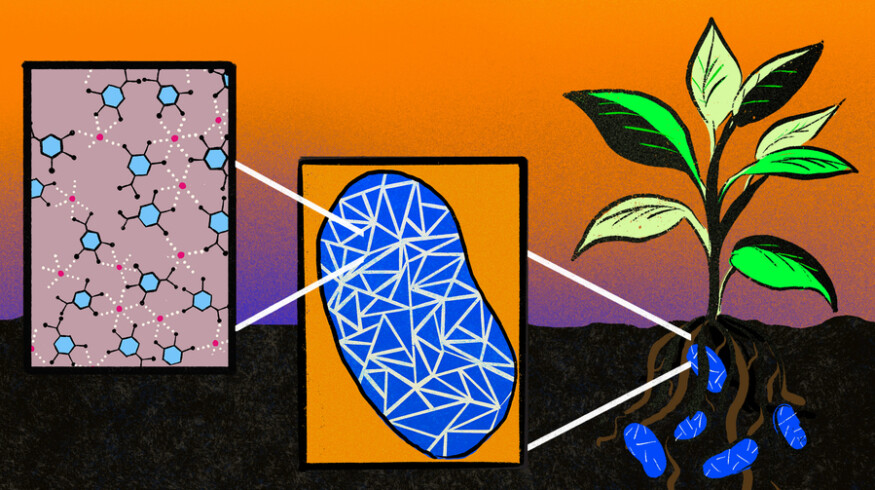
Meanwhile, MIT chemical engineer Ariel Furst is developing microbial alternatives to synthetic fertilizers, which are less harmful to the environment and reduce dependency on the energy-intensive Haber-Bosch process responsible for significant greenhouse gas emissions. Furst’s approach involves encapsulating nitrogen-fixing bacteria in a metal-organic framework that protects them from environmental stresses, thereby making them more viable for long-term storage and transport.

The technology could revolutionize how fertilizers are used, integrating them directly with seed coatings to reduce the need for additional fertilization and thus decrease both cost and carbon emissions. Furst has founded Seia Bio to commercialize these technologies, with ongoing field tests in Brazil.

Another innovative development at MIT involves the use of internal plant sensors to detect stress signals. Led by Michael Strano, researchers have developed sensors based on carbon nanotubes that can be embedded in plants to monitor health indicators in real-time. This technology enables farmers to respond more quickly to stress factors such as drought, pests, or excessive sunlight, potentially preventing crop loss.

Finally, Kripa Varanasi is tackling the inefficiencies in pesticide application. His research has led to the development of technologies that improve how pesticides adhere to plant leaves, significantly reducing runoff into the environment. This not only decreases the amount of chemicals entering ecosystems but also helps farmers reduce costs by optimizing pesticide usage.

Source: MIT News

agricultural research
agricultural sustainability
climate change
MIT
research
study

Enjoyed this story?

Every Monday, our subscribers get their hands on a digest of the most trending agriculture news. You can join them too!

Sign me up
Check the example

Discussion0 comments

Спасибо за комментарий, он будет опубликован на сайте после проверки модератором. Хотите, чтобы ваши комментарии появлялись на сайте мгновенно? Достаточно пройти регистрацию.
Congratulations, you can be the first to start the conversation.
Do you have a question or suggestion? Please leave your comment to ignite conversation.
What’s on your mind?
Cancel Log in and comment
Or continue without registration
Get notified about new comments by email.
Advertisement
In focus
How to get here?
Stock quotes
Bayer
9.76
2.01
Bayer Crop Science
33.58
1.97
CF Industries
80.23
1.19
Corteva Agriscience
66.29
1.52
ICL Group
5.18
1.33
Intrepid Potash
25.66
0.54
Mosaic
24.1
0.46
Nutrien
60.05
0.03
Yara International
19.01
0.96
See all
Most read
Bowery Farming’s $70M Georgia vertical farm heads to liquidation as startup’s collapse triggers nationwide sell-offs
Michigan tightens manure-spreading rules for large animal farms
Monarch Tractor may lay off 100 employees or shut down as it struggles to pivot away from manufacturing toward pure software model
Russia imposed temporary ban on sulfur exports until the end of 2025
Tyson shutters high-volume beef plant in Nebraska as the industry faces a downturn
Events
Argus Clean Ammonia Europe
Rotterdam, Netherlands
Dec 2 — 4, 2025
Organic Grower Summit
Monterey (CA), USA
Dec 3 — 4, 2025
IFS Conference
Cambridge, UK
Dec 10 — 12, 2025
Fertilizer Latino Americano
Miami (FL), USA
Jan 26 — 28, 2026
Argus Fertilizer Africa
Dar es Salaam, Tanzania
Feb 10 — 11, 2026
See all
Live
Meripa Corson
August 4, 01:18 pm
Where does the money actually go? As a timber land owner, how do I benefit from the legislation?
USDA commits $80 million to expand timber markets and improve forest resilience
Patonkas Luksompulus
January 21, 12:36 pm
Greece meeds biological fertilizers! Great news about De sangosse.
DE SANGOSSE expands operations with Greek subsidiary
Pedro Diaz
November 20, 2024, 08:42 pm
Is it a Roundup lawsuit or more about bad financials? I think the market reacted only to announced financial results.
Bayer’s shares are pressed down by ongoing Roundup cancer lawsuit
Johan Fredin
August 22, 2024, 07:57 pm
Europe is falling behind in this field. The concerns 30 years ago was reasonable. Now not so much. We need crops that can survive in a more extreme future climate. Handle droughts and hot weather better. Crops that are less tasty to pests like hogs and deere.
Gene-edited crops set for groundbreaking European trials
Timothy Kirkwood
July 23, 2024, 01:39 pm

Your article about Sargassum shows Kelp, not Sargassum.

Sargassum in the Caribbean: turning seaweed crisis into economic opportunity?
About
Sections
Markets  ·  Business  ·  Politics  ·  Technologies  ·  Interviews  ·  Rankings  ·  Environment
Support
About  ·  Team  ·  Advertise  ·  Contacts  ·  Submit a Tip  ·  Privacy Policy  ·  Terms of Service
Copyright © 2014-2025 DigitalTree LLC. All rights reserved.
We deliver content lightning-fast thanks to the managed cloud WordPress hosting with CDN.
16+
More to read
Microbes can be a sustainable alternative to chemical fertilizers – MIT study
The Seed Protection Institute has been launched in the Voronezh region
Exclusive: Stamicarbon’s Stephen Zwart on reducing industry’s carbon footprint
Advertising that helps us do quality reporting