

Friday’s Insider: Why Trump’s new budget could derail blue & green ammonia projects

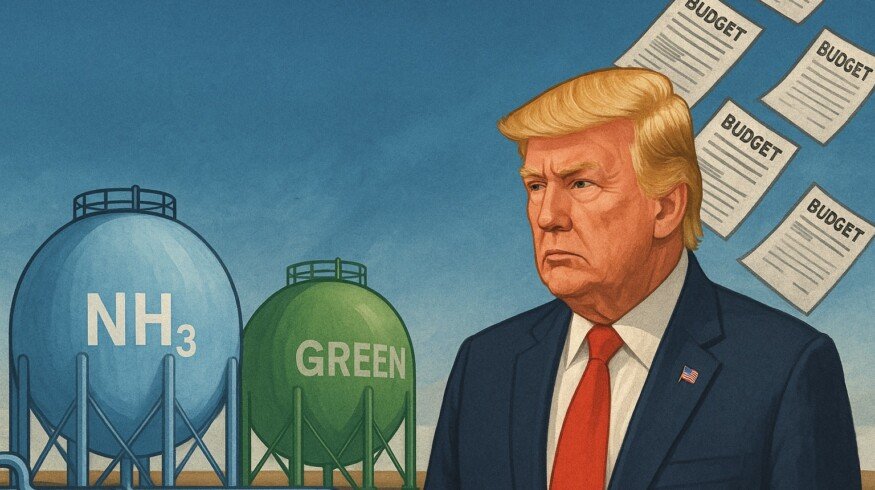

Reflecting on IFA 2025, one thing is clear: green and blue ammonia continue to dominate industry discussions. Widely recognised as essential tools in the global decarbonisation toolbox, these technologies have benefited from broad public support and generous subsidies.
Yet across the Atlantic, concern is growing. Conversations with peers in the U.S. suggest that the tide may be turning. President Trump’s recently proposed FY 2026 “skinny” budget, combined with the House Republican tax plan, poses a serious threat to the future of low-carbon ammonia development. Here’s why:
1. Deep Cuts to Clean‑Energy Tax Credits
The plan accelerates the sunset of key clean-energy incentives, including those for hydrogen and ammonia, forcing developers to begin construction within 60 days and complete projects by 2028, far earlier than the current 2032 deadline.
The proposed repeal of the 45V tax credit (supporting green hydrogen production) and the dilution of the 45Q carbon-capture credit would severely undermine the economics of both green and blue ammonia facilities.
2. Major Cuts to Federal Clean-Energy Programmes
An estimated $3.7 billion in federal clean-energy demonstration funding is being cut, including funds previously earmarked for hydrogen and carbon-capture initiatives.
The FY 2026 budget includes a ~74% reduction in the Department of Energy’s renewable energy programmes, alongside a 31% cut to fossil-energy R&D, leaving developers with little federal support.
3. Supply Chain & Market Disruption
Proposed sourcing restrictions and tariffs, such as a 25% levy on Canadian ammonia, would inject further cost and uncertainty into already complex project planning.
Meanwhile, other countries (UK, EU, Japan, South Korea) are defining “clean ammonia” based on carbon intensity. Without consistent domestic standards and policies, U.S. producers risk falling out of sync with international benchmarks.
4. Collapsing Investor Confidence
A shrinking policy safety net has already led to delays and downsizing of major projects, including Air Products’ $8 billion blue hydrogen and ammonia plant in Louisiana.
The knock-on effect? Lost jobs, stalled infrastructure buildouts, and weakening momentum in what was one of the fastest-growing sectors in U.S. energy.
What’s at Stake
Without robust and reliable tax credits (like 45V and 45Q), sustained Department of Energy funding, and globally harmonised carbon-intensity standards, the U.S. risks forfeiting its leadership in low-carbon ammonia development.
These projects are not fringe innovations — they’re foundational to decarbonising fertiliser production, enabling hydrogen-based shipping fuels, and building long-duration energy storage systems. Just as importantly, they help the U.S. maintain its competitive position in the global clean-tech economy.
Policymakers, investors, and industry leaders must step forward. Congress must act to protect critical tax incentives and programme funding before progress in clean ammonia becomes yet another casualty of partisan budget politics.
————
About the Author of “Friday’s Insider”: Ilya Motorygin is the co-founder of GG-Trading and brings 30 years of experience to the fertilizer industry. Renowned for his comprehensive problem-solving skills, Ilya expertly manages deals from inception to completion, overseeing aspects such as financing, supply chains, and logistics.

Enjoyed this story?
Every Monday, our subscribers get their hands on a digest of the most trending agriculture news. You can join them too!








Discussion0 comments