Skip to content
  • Professionals
  • Gardeners
 
Search
Log in
EN
RU
  • Trade & Policy
  • Markets
  • AgTech & Research
  • Corporate
  • Sustainability
  • Interviews
  • Rankings
  • Events
  • Stock Quotes
  • Business Directory
Trending topic:

Strait of Hormuz

Featured company:
 
RU
  • Professionals
  • Gardeners
Sections
    Events
    Stock Quotes
    Business Directory
    Trending topic:

    Strait of Hormuz

    Featured company:
    Follow us...
    Helpful information
    • About
    • Team
    • Advertise
    • Contacts
    • Submit a Tip
    • Privacy Policy
    • Terms of Service
    • Site Map
    Sections
      Seasonal tips
      • Spring
      • Summer
      • Autumn
      • Winter
      Trending topics
      • compost
        25
      • garlic
        2
      • lemon
        1
      • potato
        15
      Follow us...
      Helpful information
      • About
      • Team
      • Advertise
      • Contacts
      • Submit a Tip
      • Privacy Policy
      • Terms of Service
      • Site Map
      Copyright © 2014-2026 DigitalTree LLC. All rights reserved.
      We deliver content lightning-fast thanks to the managed cloud WordPress hosting with CDN.
      16+

      Home / AgTech & Research

      UC Riverside robot maps orchard soil moisture tree by tree to cut water use

      Timothy Bueno avatar Timothy Bueno
      June 3, 2026, 1:30 pm
      June 3, 2026, 1:30 pm
      [esi post-views ttl=0]
      AgTech & Research
      Drones & Robotics
      Precision Agriculture
      UC Riverside robot maps orchard soil moisture tree by tree to cut water use
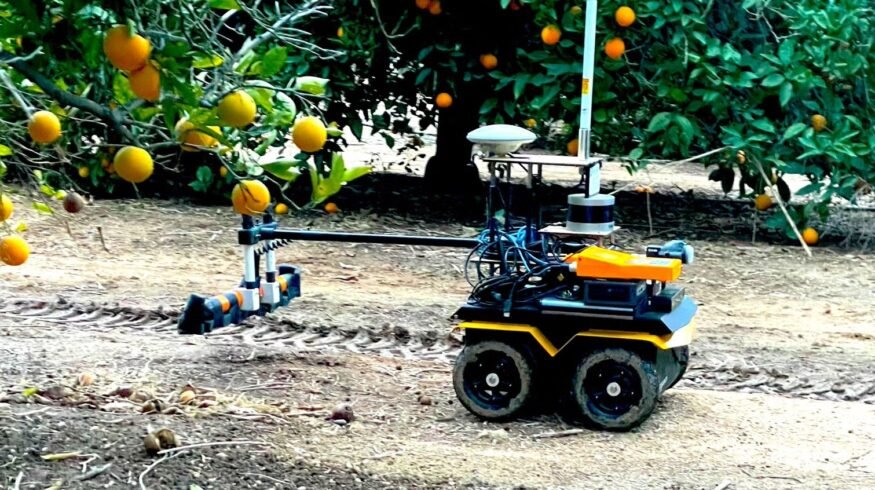
      Image Credits: UC Riverside
      Save for later
      Share

      A University of California, Riverside research team has developed a robotic system that maps soil moisture tree by tree across an orchard, giving growers a way to water only the trees that need it as drought and groundwater limits tighten across the U.S. West.

      The approach targets a costly blind spot in irrigated agriculture. Most growers rely on a handful of buried soil-moisture sensors and then irrigate uniformly, even though water availability can swing sharply from one tree to the next. Beyond wasted water, overwatering pushes nitrogen and other nutrients below the root zone and into groundwater, turning an irrigation problem into a fertilizer-loss and pollution problem.

      From buried sensors to a moving map of the orchard

      The system, described in the journal Computers and Electronics in Agriculture, was developed by the group of Elia Scudiero, associate professor of precision agriculture and director of UC Riverside’s Center for Agriculture, Food, and the Environment. A robot drives through the orchard measuring soil apparent electrical conductivity, then combines those readings with data from a small number of fixed moisture sensors to build a statistical model that predicts water content across the entire field.

      The output is a tree-by-tree picture of how much water is actually available, rather than a single average for the block. Soil texture is a key reason conditions vary so much: fine soils hold water tightly, while sandy soils drain quickly, so neighboring trees under identical sprinklers can experience very different moisture levels.

      ADVERTISEMENT

      What is soil electrical conductivity?

      Soil apparent electrical conductivity measures how easily an electrical current moves through soil. It responds to moisture as well as to clay and salt content, so when it is paired with direct readings from buried sensors it can be translated into accurate, spatially detailed estimates of soil water content without installing a sensor at every tree.

      Why overwatering is also a fertilizer problem

      Keeping moisture in a narrow band matters for more than yield. Too little water stresses trees and leaves them open to pests and disease, while too much starves roots of oxygen and drives nutrients past the root zone. “There’s a sweet spot,” Scudiero said. Applying only what each tree needs reduces the risk of washing fertilizer into the environment, a growing concern as states tighten groundwater rules and nitrate limits.

      From research plots to commercial farms

      The project has been in development since 2019 and was tested at UC Riverside’s Citrus Research Center and Agricultural Experiment Station. The team has filed a patent covering how the robot interacts with sensors without disturbing their readings. Next steps include trials with commercial growers and ruggedizing the machines for varied crops and weather conditions, with private partners potentially turning the technology into a commercial product. For growers facing tighter water supplies and rising costs, the payoff could be significant, or, as Scudiero put it, “More crop per drop.”

      Source: UC Riverside


      UC Riverside’s precision irrigation robot: five things to know

      It addresses overwatering in orchards. Growers typically rely on a few buried moisture sensors and then irrigate the whole block uniformly, even though soil moisture varies tree to tree. The system maps moisture across every tree so water is applied only where it is needed, which matters as drought and groundwater limits tighten in California and other dry regions.

      A robot drives through the orchard measuring soil apparent electrical conductivity. Those readings are combined with data from a small number of fixed, buried moisture sensors to build a statistical model that estimates water content across the entire field, producing a tree-by-tree moisture map rather than a single field average.

      Soil texture is a major factor. Fine-textured soils have more surface area and hold water tightly, while sandy soils with larger particles drain quickly. As a result, neighboring trees receiving the same amount of irrigation water can end up with very different amounts of plant-available moisture.

      When fields are overwatered, applied nutrients can be flushed below the root zone and into groundwater. By delivering only as much water as each tree needs, the system reduces the volume of water moving past the roots, limiting nitrogen and phosphorus leaching and the associated water-quality impacts.

      It remains at the research stage. The project has been in development since 2019 and was tested at UC Riverside’s Citrus Research Center and Agricultural Experiment Station, and the team has filed a related patent. Commercial use would require trials with growers and ruggedized machines, with private partners potentially adapting the system into a marketable product.

      agricultural robot
      AgTech
      California
      citrus industry
      irrigation
      precision agriculture
      precision irrigation
      research
      soil moisture
      United States
      water scarcity

      Enjoyed this story?

      Every Monday, our subscribers get their hands on a digest of the most trending agriculture news. You can join them too!

      Sign me up
      Check the example

      Discussion0 comments

      Спасибо за комментарий, он будет опубликован на сайте после проверки модератором. Хотите, чтобы ваши комментарии появлялись на сайте мгновенно? Достаточно пройти регистрацию.
      Congratulations, you can be the first to start the conversation.
      Do you have a question or suggestion? Please leave your comment to ignite conversation.
      What’s on your mind?
      Cancel Log in and comment
      Or continue without registration
      Get notified about new comments by email.
      Advertisement
      In focus
      How to get here?
      Stock quotes
      Bayer
      9.87
      2.66
      Bayer Crop Science
      34.1
      2.93
      CF Industries
      113.48
      0.16
      Corteva Agriscience
      77.57
      0.14
      ICL Group
      6.21
      3.37
      Intrepid Potash
      38.07
      0.31
      Mosaic
      23.3
      0.13
      Nutrien
      68.5
      1.54
      Yara International
      27.21
      0.04
      See all
      Most read
      IPL finalizes 1.346mt DAP purchase from 14 global suppliers at $930–935/t CFR
      IPL finalizes 1.346mt DAP purchase from 14 global suppliers at $930–935/t CFR
      OCP warns Hormuz disruption has evolved into global fertilizer supply shock
      OCP warns Hormuz disruption has evolved into global fertilizer supply shock
      Sulphuric acid tops $500 per tonne as Hormuz closure tightens phosphate fertilizer production inputs globally
      Sulphuric acid tops $500 per tonne as Hormuz closure tightens phosphate fertilizer production inputs globally
      California peach growers forced to remove 420,000 trees after bankruptcy of Del Monte Foods canneries
      California peach growers forced to remove 420,000 trees after bankruptcy of Del Monte Foods canneries
      EPA approves continued use of atrazine herbicide despite widespread environmental concerns.
      EPA approves continued use of atrazine herbicide despite widespread environmental concerns.
      Events
      Fertilizer Summit
      Chicago (IL), USA
      Jun 1 — 2, 2026
      Argus Clean Ammonia Asia
      Tokyo, Japan
      Jun 2 — 4, 2026
      Wood Mackenzie Hydrogen Hydrogen Conference
      London, UK
      Jun 4, 2026
      Agriculture & Organic Farming Summit
      Paris, France
      Jun 17 — 18, 2026
      International Crop-Science Conference & Expo
      New Delhi, India
      Jun 25 — 26, 2026
      See all
      Live
      Stefan Petko
      May 6, 06:48 pm
      It is alarming to see these developments in California. As a vineyard grower, I have faced significant challenges this year, with fertilizer costs rising sharply while market conditions have made it difficult to sell the harvest.
      California peach growers forced to remove 420,000 trees after bankruptcy of Del Monte Foods canneries
      Estebel
      April 23, 10:26 pm
      Sounds like magic ))
      MIT study: rice seeds germinate faster when exposed to rainfall sounds
      Isabelita Barreiro
      December 11, 2025, 01:54 am
      Excellent management of water resources and effective use of water-soluble fertilizers!
      Argentine nano-fertilizer firm AKO Agro expands to Brazil
      Meripa Corson
      August 4, 2025, 01:18 pm
      Where does the money actually go? As a timber land owner, how do I benefit from the legislation?
      USDA commits $80 million to expand timber markets and improve forest resilience
      Patonkas Luksompulus
      January 21, 2025, 12:36 pm
      Greece meeds biological fertilizers! Great news about De sangosse.
      DE SANGOSSE expands operations with Greek subsidiary
      About
      Sections
      Trade & Policy  ·  Markets  ·  AgTech & Research  ·  Corporate  ·  Sustainability  ·  Interviews  ·  Rankings
      Support
      About  ·  Team  ·  Advertise  ·  Contacts  ·  Submit a Tip  ·  Privacy Policy  ·  Terms of Service  ·  Site Map
      Copyright © 2014-2026 DigitalTree LLC. All rights reserved.
      We deliver content lightning-fast thanks to the managed cloud WordPress hosting with CDN.
      16+
      More to read
      Phytech’s Oren Kind: ‘Our technology enabled a 20% reduction in water usage’
      Phytech’s Oren Kind: ‘Our technology enabled a 20% reduction in water usage’
      UW-Madison engineers unveiled innovative nitrate monitoring soil sensors
      UW-Madison engineers unveiled innovative nitrate monitoring soil sensors
      Sentinel Ag and Nave Analytics to integrate irrigation and nitrogen intelligence
      Sentinel Ag and Nave Analytics to integrate irrigation and nitrogen intelligence
      Advertising that helps us do quality reporting