

Magnetic field technique triples ammonia output in breakthrough catalyst study



A team of German scientists has developed a catalyst production method that tripled ammonia yields during electrochemical nitrate conversion, a finding that could advance efforts to decarbonize fertilizer production and reduce the environmental footprint of ammonia manufacturing.
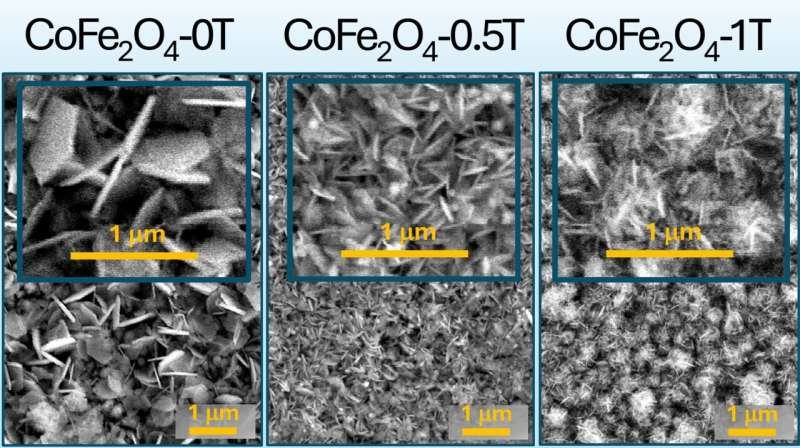
Researchers from the Helmholtz-Zentrum Berlin and the University of Cologne reported that applying a 1-Tesla magnetic field during the synthesis of cobalt ferrite (CoFe₂O₄) electrocatalysts significantly improved their performance in converting nitrate into ammonia. The results were published in the journal Advanced Functional Materials.
The research focuses on an emerging alternative to the Haber-Bosch process, the century-old industrial method used to produce ammonia. Haber-Bosch currently accounts for an estimated 1%–2% of global energy consumption and nearly 1% of annual greenhouse gas emissions. Scientists are exploring electrochemical nitrate reduction as a lower-energy route that could also help remove excess nitrate pollution generated by intensive agriculture.
According to the study, catalysts synthesized under a magnetic field generated three times more ammonia than identical materials produced without magnetic assistance. The researchers found that the magnetic field altered the catalyst’s surface structure and stabilized catalytically active cobalt ions, making nitrate reduction more efficient while suppressing competing hydrogen-producing reactions.
The strongest-performing catalyst, CoFe₂O₄ synthesized under a 1-Tesla magnetic field, also delivered ammonia yields 22 times higher than similarly produced iron oxide catalysts, highlighting cobalt’s critical role in the reaction. Computational modeling supported the experimental findings, indicating that cobalt lowers kinetic barriers for nitrate reduction while reducing unwanted side reactions.
Researchers said the approach could offer a scalable method for designing more efficient electrocatalysts. Unlike some magnetic-field-assisted processes, the magnetic field is only required during catalyst fabrication, not during ammonia production itself.
The study suggests that magnetic fields could join temperature and pressure as an additional tool for controlling catalyst properties at the atomic level, potentially accelerating the development of next-generation technologies for sustainable chemical and fertilizer production.
Source: Phys.org

Enjoyed this story?
Every Monday, our subscribers get their hands on a digest of the most trending agriculture news. You can join them too!






Discussion0 comments