Skip to content
  • Professionals
  • Gardeners
 
Search
Log in
EN
RU
  • Trade & Policy
  • Markets
  • AgTech & Research
  • Corporate
  • Sustainability
  • Interviews
  • Rankings
  • Events
  • Stock Quotes
  • Business Directory
Trending topic:

Strait of Hormuz

Featured company:
 
RU
  • Professionals
  • Gardeners
Sections
    Events
    Stock Quotes
    Business Directory
    Trending topic:

    Strait of Hormuz

    Featured company:
    Follow us...
    Helpful information
    • About
    • Team
    • Advertise
    • Contacts
    • Submit a Tip
    • Privacy Policy
    • Terms of Service
    • Site Map
    Sections
      Seasonal tips
      • Spring
      • Summer
      • Autumn
      • Winter
      Trending topics
      • compost
        25
      • garlic
        2
      • lemon
        1
      • potato
        15
      Follow us...
      Helpful information
      • About
      • Team
      • Advertise
      • Contacts
      • Submit a Tip
      • Privacy Policy
      • Terms of Service
      • Site Map
      Copyright © 2014-2026 DigitalTree LLC. All rights reserved.
      We deliver content lightning-fast thanks to the managed cloud WordPress hosting with CDN.
      16+

      Home / AgTech & Research

      Guarding by location: danger and compliance

      Editors avatar Editors
      October 27, 2023, 10:00 am
      October 27, 2023, 10:00 am
      [esi post-views ttl=0]
      AgTech & Research
      Guarding by location: danger and compliance
      Save for later
      Share
      Never miss important fertilizer news

      The global leader in conveyor safety is disputing the idea that putting conveyor equipment out of reach or inconveniently placed away from workers — known as “Guarding by Location” — is a valid form of safety.  After decades of safe equipment design and comprehensive conveyor safety training in the bulk handling industry, Martin Engineering experts have witnessed where “guarding by location” has led to a lapse in workplace safety, resulting in injuries and – in some cases — fatalities.

      Most people readily accept that conveyors and other machinery require safety guards when positioned near workers or walkways.  Guarding by location is the assumption that when hazards, such as moving conveyor belts, are positioned beyond the normal reach of a worker they don’t require a guard.  Yet they can still present a serious hazard.

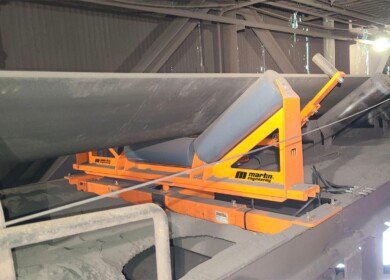
      Unguarded return rollers over walkways can fall and produce a serious hazard.

      Worker Risks from Guarding by Location

      Some regulations define a general safe height for components based on the average height of workers.  This means taller employees (1.82 m / 6 ft. in height or more) can easily suffer an injury reaching up into a moving component that is 2.13 m / 7 ft above the ground.  Working above machinery that is considered guarded by location exposes workers to increased severity of injury if they slip or fall to a lower level.

      ADVERTISEMENT

      Reach-in hazards (“breaking the plane”) can apply to both the mesh size and the height of the barrier.

      Most regulations do not account for the potential buildup of spillage underneath the conveyor or in walkways, which can easily change the distance between the working surface and a hazard.  It’s also fairly common practice to purposely collect a pile of material or fill a bin to gain access for service or inspection of an elevated component.  Using tools and methods that extend a worker’s reach while the belt is running is a hazardous activity that can contribute to serious — and possibly fatal — accidents.

      Height prevents a worker from reaching hazardous areas until the reality of bulk operations proves otherwise.

      Hazards From Above

      By not requiring a physical barrier, guarding by location creates what is considered by some to be an exception to the general requirements for the guarding of hazards in the workplace.  Several hazardous locations are beyond the normal reach of staff when working or walking under or around elevated conveyors.  These hazards are commonly found in or around nip points between the belt and return rollers or drive components such as pulley shafts, couplings, drive belts, gears and chains.  Additional hazards from falling components may be inadvertently ignored if considered guarded by location.

      Return roller guards ensure detached rollers don’t pose a hazard to workers or harm the system.

      Guarding Best Practices

      The logical solution to guarding by location is to simply install guards and baskets to protect workers from lateral and overhead hazards, while still offering safe and easy access.  For maximum risk reduction, all nip points, shear points and moving or rotating components should be guarded, regardless of location or access.

      All moving or rotating components should be guarded, regardless of location.

      However, there is also no global standard for guard mesh sizes and mounting distance from the hazard.  Most standards use a gauge to measure the distance which varies by mesh size.  When a bulk material handling guard is placed relatively close to a hazard it greatly reduces the ability to inspect components without removing the guard, thereby encouraging guard removal for routine inspections.

      It would be far better (and safer) to standardize on a few mesh sizes and mounting distances allowing maintenance workers to build guards to a short list of materials, using standard mounting distances and eliminating the use of the gauges. Below is the recommendation included in Martin Engineering’s book FOUNDATIONS for Conveyor Safety.
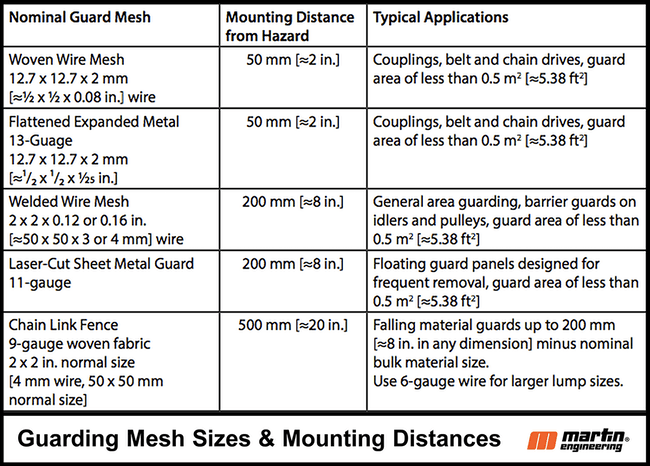
      Mesh sizes and mounting distances.

      Put an End to the Myth

      Despite its nearly global acceptance as a concept in industrial safety, the practice of guarding by location remains a particular problem for overhead conveyor applications.  It’s time to accept that as far as conveyors are concerned, ‘guarding by location’ is a myth.  As such, it’s a concept that should be abandoned in order to make conveyors — and those who work on and around the equipment — safer.

      conveyor
      Engineering
      equipment
      Martin Engineering
      safety

      Enjoyed this story?

      Every Monday, our subscribers get their hands on a digest of the most trending agriculture news. You can join them too!

      Sign me up
      Check the example

      Discussion0 comments

      Спасибо за комментарий, он будет опубликован на сайте после проверки модератором. Хотите, чтобы ваши комментарии появлялись на сайте мгновенно? Достаточно пройти регистрацию.
      Congratulations, you can be the first to start the conversation.
      Do you have a question or suggestion? Please leave your comment to ignite conversation.
      What’s on your mind?
      Cancel Log in and comment
      Or continue without registration
      Get notified about new comments by email.
      Advertisement
      In focus
      How to get here?
      Stock quotes
      Bayer
      10.44
      0.38
      Bayer Crop Science
      36.31
      0.33
      CF Industries
      106.9
      2.36
      Corteva Agriscience
      75.71
      0.56
      ICL Group
      5.75
      0.35
      Intrepid Potash
      35.86
      0.8
      Mosaic
      22.52
      0.75
      Nutrien
      66.13
      2.2
      Yara International
      24.71
      2.79
      See all
      Most read
      IPL finalizes 1.346mt DAP purchase from 14 global suppliers at $930–935/t CFR
      IPL finalizes 1.346mt DAP purchase from 14 global suppliers at $930–935/t CFR
      Holganix bets on soil biology and carbon markets to reshape regenerative agriculture
      Holganix bets on soil biology and carbon markets to reshape regenerative agriculture
      China reopens urea exports with $660/t price floor
      China reopens urea exports with $660/t price floor
      OCP warns Hormuz disruption has evolved into global fertilizer supply shock
      OCP warns Hormuz disruption has evolved into global fertilizer supply shock
      Sulphuric acid tops $500 per tonne as Hormuz closure tightens phosphate fertilizer production inputs globally
      Sulphuric acid tops $500 per tonne as Hormuz closure tightens phosphate fertilizer production inputs globally
      Events
      Agriculture & Organic Farming Summit
      Paris, France
      Jun 17 — 18, 2026
      International Crop-Science Conference & Expo
      New Delhi, India
      Jun 25 — 26, 2026
      IFA Annual Conference
      Monaco
      Jun 29 — Jul 1, 2026
      Agrovolga
      Kazan, Russia
      Jul 8 — 10, 2026
      Southwestern Fertilizer Conference
      New Orleans (LA), USA
      Jul 12 — 16, 2026
      See all
      Live
      Stefan Petko
      May 6, 06:48 pm
      It is alarming to see these developments in California. As a vineyard grower, I have faced significant challenges this year, with fertilizer costs rising sharply while market conditions have made it difficult to sell the harvest.
      California peach growers forced to remove 420,000 trees after bankruptcy of Del Monte Foods canneries
      Estebel
      April 23, 10:26 pm
      Sounds like magic ))
      MIT study: rice seeds germinate faster when exposed to rainfall sounds
      Isabelita Barreiro
      December 11, 2025, 01:54 am
      Excellent management of water resources and effective use of water-soluble fertilizers!
      Argentine nano-fertilizer firm AKO Agro expands to Brazil
      Meripa Corson
      August 4, 2025, 01:18 pm
      Where does the money actually go? As a timber land owner, how do I benefit from the legislation?
      USDA commits $80 million to expand timber markets and improve forest resilience
      Patonkas Luksompulus
      January 21, 2025, 12:36 pm
      Greece meeds biological fertilizers! Great news about De sangosse.
      DE SANGOSSE expands operations with Greek subsidiary
      About
      Sections
      Trade & Policy  ·  Markets  ·  AgTech & Research  ·  Corporate  ·  Sustainability  ·  Interviews  ·  Rankings
      Support
      About  ·  Team  ·  Advertise  ·  Contacts  ·  Submit a Tip  ·  Privacy Policy  ·  Terms of Service  ·  Site Map
      Copyright © 2014-2026 DigitalTree LLC. All rights reserved.
      We deliver content lightning-fast thanks to the managed cloud WordPress hosting with CDN.
      16+
      More to read
      Case Study: Safe Conveyor Equipment Design by Martin Engineering
      Case Study: Safe Conveyor Equipment Design by Martin Engineering
      Causes and prevention of belt conveyor fires
      Causes and prevention of belt conveyor fires
      Martin Engineering unveils new conveyor belt tracker that raises safety standards
      Martin Engineering unveils new conveyor belt tracker that raises safety standards
      Advertising that helps us do quality reporting