

U.S. Christmas tree sector faces labor risk as migrant wage rules shift

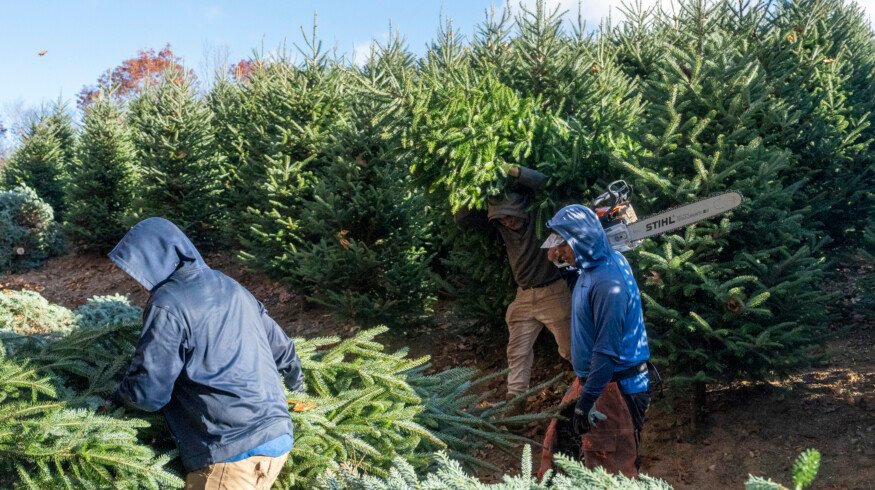

North Carolina, the leading producer of Christmas trees in the United States, is facing renewed labor uncertainty as changes to federal wage rules for temporary agricultural workers raise concerns about future workforce availability and production costs.
The sector relies heavily on migrant labor under the H-2A visa program, which allows US growers to hire foreign workers for seasonal agricultural jobs. Industry participants say recent adjustments to wage guidelines—introduced under the Trump administration—could reduce hourly pay for some workers by $5 to $7, potentially discouraging experienced crews from returning for future seasons.
The issue extends beyond a single crop. Nearly one in four Christmas trees sold in the US is grown in North Carolina, according to the North Carolina Christmas Tree Association. The trees, primarily Fraser firs, require year-round care and take eight to nine years to reach market size, making labor continuity critical. In 2022, sales of more than 3 million trees generated over $144 million for the state economy.
While Christmas trees are a niche product, the labor dynamics mirror those seen across high-value specialty crops, including fruits, vegetables, nurseries, and horticulture. These sectors are typically labor-intensive, regionally concentrated, and highly sensitive to regulatory shifts affecting migrant workers.
The H-2A program has grown rapidly in recent years, issuing visas to about 318,000 workers in the 2024 fiscal year, making it the largest temporary worker program in US agriculture. Despite political rhetoric around reducing reliance on foreign labor, federal agencies have also taken steps to streamline visa processing, reflecting what many analysts describe as a recognition that domestic labor alone cannot meet agricultural demand.
Growers say local workers rarely stay long in physically demanding farm jobs, particularly those requiring long hours during peak harvest periods. As a result, experienced migrant crews play a central role in maintaining productivity and quality standards. Industry participants warn that if wages fall too far, farms may struggle to retain skilled workers, increasing training costs and operational risk.
Labor uncertainty comes as growers already face rising equipment costs, competition from artificial trees, and lingering impacts from extreme weather events, including Hurricane Helene, which damaged parts of western North Carolina in 2024. A reduced workforce could compound these pressures, with potential ripple effects across regional supply chains. Some North Carolina producers ship trees as far as Texas and Idaho.
For agribusiness investors and operators, the situation underscores a broader challenge: agricultural supply chains remain highly exposed to labor policy decisions. As governments balance immigration enforcement with economic realities, shifts in migrant labor rules can quickly translate into cost volatility, production risk, and market disruption.
Industry groups say the Christmas tree sector offers a case study in how labor policy intersects with long-cycle agricultural production—where workforce instability today can affect output years down the line.
Source: The Guardian

Enjoyed this story?
Every Monday, our subscribers get their hands on a digest of the most trending agriculture news. You can join them too!








Discussion0 comments