Skip to content
  • Professionals
  • Gardeners
 
Search
Log in
EN
RU
  • Trade & Policy
  • Markets
  • AgTech & Research
  • Corporate
  • Sustainability
  • Interviews
  • Rankings
  • Events
  • Stock Quotes
  • Business Directory
Trending topic:

Strait of Hormuz

Featured company:
 
RU
  • Professionals
  • Gardeners
Sections
    Events
    Stock Quotes
    Business Directory
    Trending topic:

    Strait of Hormuz

    Featured company:
    Follow us...
    Helpful information
    • About
    • Team
    • Advertise
    • Contacts
    • Submit a Tip
    • Privacy Policy
    • Terms of Service
    • Site Map
    Sections
      Seasonal tips
      • Spring
      • Summer
      • Autumn
      • Winter
      Trending topics
      • compost
        25
      • garlic
        2
      • lemon
        1
      • potato
        15
      Follow us...
      Helpful information
      • About
      • Team
      • Advertise
      • Contacts
      • Submit a Tip
      • Privacy Policy
      • Terms of Service
      • Site Map
      Copyright © 2014-2026 DigitalTree LLC. All rights reserved.
      We deliver content lightning-fast thanks to the managed cloud WordPress hosting with CDN.
      16+

      Home / Sustainability

      ‘Water Bears’ offer new insight into whether Martian soil could block Earth microbes

      Timothy Bueno avatar Timothy Bueno
      March 2, 2026, 2:00 pm
      March 2, 2026, 2:00 pm
      [esi post-views ttl=0]
      Sustainability
      AgTech & Research
      ‘Water Bears’ offer new insight into whether Martian soil could block Earth microbes
      Save for later
      Share
      Never miss important fertilizer news

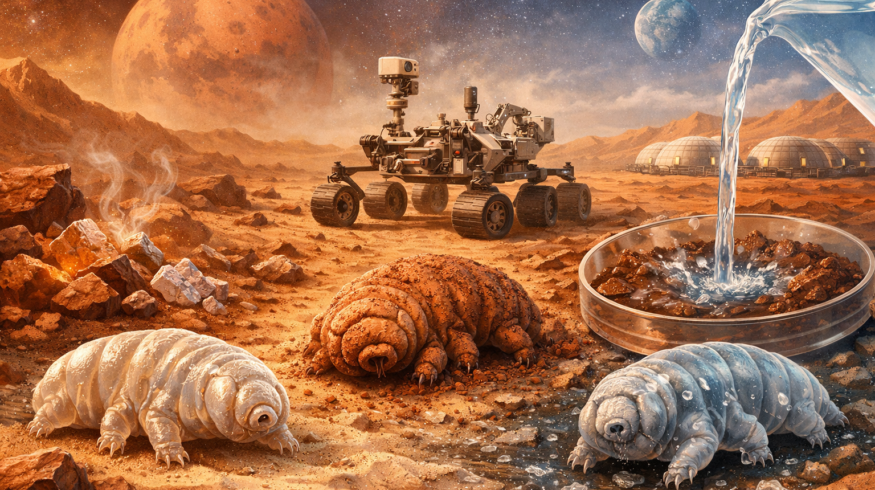
      Microscopic animals known as tardigrades—often called water bears—are helping scientists assess a central question for future Mars missions: could Martian soil naturally suppress Earth-based life, and if so, at what cost to human exploration?

      A study led by Penn State Altoona microbiologist Corien Bakermans found that tardigrades exposed to simulated Martian regolith showed sharply reduced activity, particularly in one widely used soil analog. The findings, published in the International Journal of Astrobiology, suggest that certain components of Mars-like soil may inhibit biological activity—potentially aiding planetary protection efforts—but could also complicate plans to use local materials to grow food or sustain human habitats.

      A test of life in simulated Martian soil

      A space shuttle is flying past a red planet. The shuttle is in the foreground and the planet is in the background. Concept of adventure and exploration as the shuttle travels through space

      Tardigrades are microscopic animals known for their extreme resilience. In a dehydrated, dormant state, they can survive the vacuum of space, intense radiation, and freezing temperatures. When rehydrated and active, they remain hardy compared with most organisms, though more vulnerable than in dormancy.

      ADVERTISEMENT

      Bakermans and colleagues used two Martian regolith simulants—laboratory-produced materials designed to replicate the mineral and chemical composition of soil sampled on Mars. Both simulants are modeled on material collected by NASA’s Curiosity Rover from the Rocknest deposit in Gale Crater.

      One simulant, known as MGS-1, was developed as a “global” representation of Martian surface material. The other, OUCM-1, was designed to more closely mimic the specific chemical composition of the Rocknest sampling site.

      When active tardigrades were introduced into the two materials and observed under a microscope over several days, the results diverged. In MGS-1, activity dropped sharply within two days, with many specimens becoming inactive. OUCM-1 also reduced activity, but to a lesser degree.

      The findings point to differences in chemical composition—not just mineral structure—as critical factors influencing biological survival.

      Planetary protection and resource trade-offs

      The results intersect with a longstanding principle of space exploration known as planetary protection. International agreements and agencies including NASA aim to prevent contamination of extraterrestrial bodies by Earth life, while also protecting Earth from potential extraterrestrial material.

      If Martian regolith contains compounds that naturally inhibit terrestrial organisms, that could reduce the risk that microbes inadvertently transported by astronauts would take hold on Mars. However, such inhibitory properties could also hinder efforts to cultivate crops using local soil or expose astronauts to harmful substances.

      The study therefore addresses two related questions: how Mars-like environments affect Earth organisms, and how human activity might alter extraterrestrial environments. Understanding both is essential for long-term missions that rely on in-situ resource utilization—using materials found on Mars rather than transporting everything from Earth.

      Washing away the damage
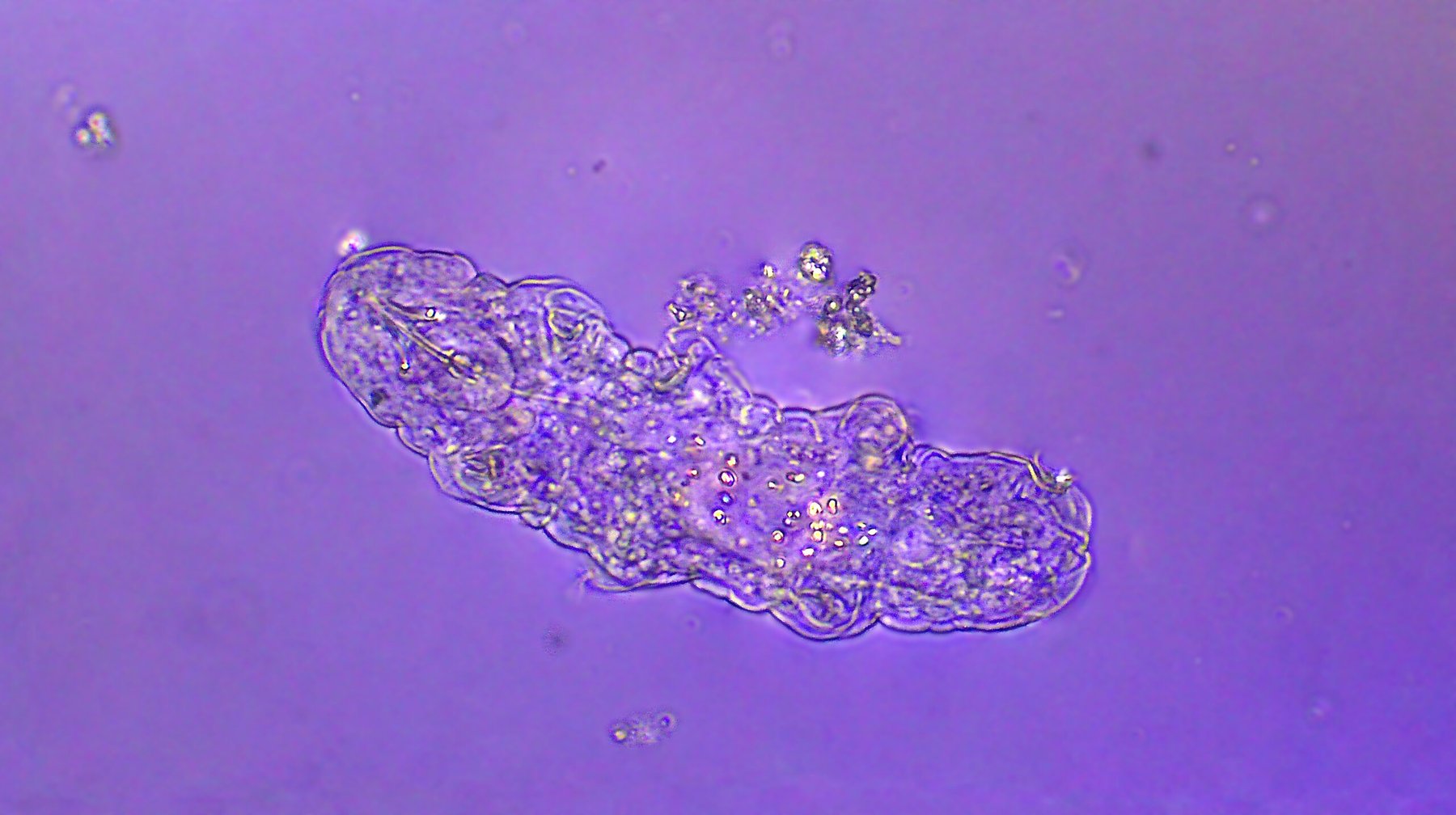
      Micro organism - Tardigrade (water bear), polarized light, magnification 40x

      In a follow-up experiment, researchers rinsed the MGS-1 simulant with water before introducing fresh tardigrades. After washing, the previously damaging material had little effect on tardigrade activity.

      The outcome suggests that a water-soluble component—potentially salts or other reactive compounds—may be responsible for the inhibitory effect. While further chemical analysis is underway, the discovery has practical implications.

      Water is scarce and costly to transport or extract in space, making large-scale soil washing challenging. Yet the fact that harmful effects can be mitigated offers a possible pathway for adapting regolith for agricultural or habitat use. At the same time, the presence of a soluble “defense” component implies that untreated regolith could help limit biological contamination.

      Beyond soil chemistry

      The researchers emphasize that regolith composition is only one variable in a complex system. Mars’ low atmospheric pressure, extreme temperature swings, and radiation levels also shape habitability and contamination risks.

      Future work will examine how specific chemical constituents interact with biological systems, as well as how environmental factors such as pressure and temperature influence survival. While much prior research has focused on bacteria and fungi in simulated Martian soil, relatively little has explored effects on animals—even microscopic ones.

      By using tardigrades as a biological model, the team has taken an incremental step toward understanding how terrestrial life might fare in Martian conditions. For planners of future missions, the results underscore a dual reality: the same soil that could help shield Mars from Earth microbes may require careful treatment before it can sustain human life.

      Source: Phys.org

      exploration
      Mars
      research
      soil analysis
      space
      study

      Enjoyed this story?

      Every Monday, our subscribers get their hands on a digest of the most trending agriculture news. You can join them too!

      Sign me up
      Check the example

      Discussion0 comments

      Спасибо за комментарий, он будет опубликован на сайте после проверки модератором. Хотите, чтобы ваши комментарии появлялись на сайте мгновенно? Достаточно пройти регистрацию.
      Congratulations, you can be the first to start the conversation.
      Do you have a question or suggestion? Please leave your comment to ignite conversation.
      What’s on your mind?
      Cancel Log in and comment
      Or continue without registration
      Get notified about new comments by email.
      Advertisement
      In focus
      How to get here?
      Stock quotes
      Bayer
      10.43
      0.1
      Bayer Crop Science
      36.19
      1.12
      CF Industries
      109.48
      2.74
      Corteva Agriscience
      76.14
      1.71
      ICL Group
      5.73
      1.06
      Intrepid Potash
      36.15
      5.21
      Mosaic
      22.69
      7.59
      Nutrien
      67.62
      3.14
      Yara International
      24.68
      2.91
      See all
      Most read
      IPL finalizes 1.346mt DAP purchase from 14 global suppliers at $930–935/t CFR
      IPL finalizes 1.346mt DAP purchase from 14 global suppliers at $930–935/t CFR
      Holganix bets on soil biology and carbon markets to reshape regenerative agriculture
      Holganix bets on soil biology and carbon markets to reshape regenerative agriculture
      OCP warns Hormuz disruption has evolved into global fertilizer supply shock
      OCP warns Hormuz disruption has evolved into global fertilizer supply shock
      China reopens urea exports with $660/t price floor
      China reopens urea exports with $660/t price floor
      Sulphuric acid tops $500 per tonne as Hormuz closure tightens phosphate fertilizer production inputs globally
      Sulphuric acid tops $500 per tonne as Hormuz closure tightens phosphate fertilizer production inputs globally
      Events
      Agriculture & Organic Farming Summit
      Paris, France
      Jun 17 — 18, 2026
      International Crop-Science Conference & Expo
      New Delhi, India
      Jun 25 — 26, 2026
      IFA Annual Conference
      Monaco
      Jun 29 — Jul 1, 2026
      Agrovolga
      Kazan, Russia
      Jul 8 — 10, 2026
      Southwestern Fertilizer Conference
      New Orleans (LA), USA
      Jul 12 — 16, 2026
      See all
      Live
      Stefan Petko
      May 6, 06:48 pm
      It is alarming to see these developments in California. As a vineyard grower, I have faced significant challenges this year, with fertilizer costs rising sharply while market conditions have made it difficult to sell the harvest.
      California peach growers forced to remove 420,000 trees after bankruptcy of Del Monte Foods canneries
      Estebel
      April 23, 10:26 pm
      Sounds like magic ))
      MIT study: rice seeds germinate faster when exposed to rainfall sounds
      Isabelita Barreiro
      December 11, 2025, 01:54 am
      Excellent management of water resources and effective use of water-soluble fertilizers!
      Argentine nano-fertilizer firm AKO Agro expands to Brazil
      Meripa Corson
      August 4, 2025, 01:18 pm
      Where does the money actually go? As a timber land owner, how do I benefit from the legislation?
      USDA commits $80 million to expand timber markets and improve forest resilience
      Patonkas Luksompulus
      January 21, 2025, 12:36 pm
      Greece meeds biological fertilizers! Great news about De sangosse.
      DE SANGOSSE expands operations with Greek subsidiary
      About
      Sections
      Trade & Policy  ·  Markets  ·  AgTech & Research  ·  Corporate  ·  Sustainability  ·  Interviews  ·  Rankings
      Support
      About  ·  Team  ·  Advertise  ·  Contacts  ·  Submit a Tip  ·  Privacy Policy  ·  Terms of Service  ·  Site Map
      Copyright © 2014-2026 DigitalTree LLC. All rights reserved.
      We deliver content lightning-fast thanks to the managed cloud WordPress hosting with CDN.
      16+
      More to read
      Ancient Maya agricultural practices could be the key to growing vegetables on Mars
      Ancient Maya agricultural practices could be the key to growing vegetables on Mars
      Mars, Incorporated Invests $1 Billion in Comprehensive Climate Action Plan
      Mars, Incorporated Invests $1 Billion in Comprehensive Climate Action Plan
      Mars strengthens supply chain with climate-smart farming practices across North America
      Mars strengthens supply chain with climate-smart farming practices across North America
      Advertising that helps us do quality reporting