

USDA Says New Federal Action on Fertilizer Competition Is Coming Within Weeks

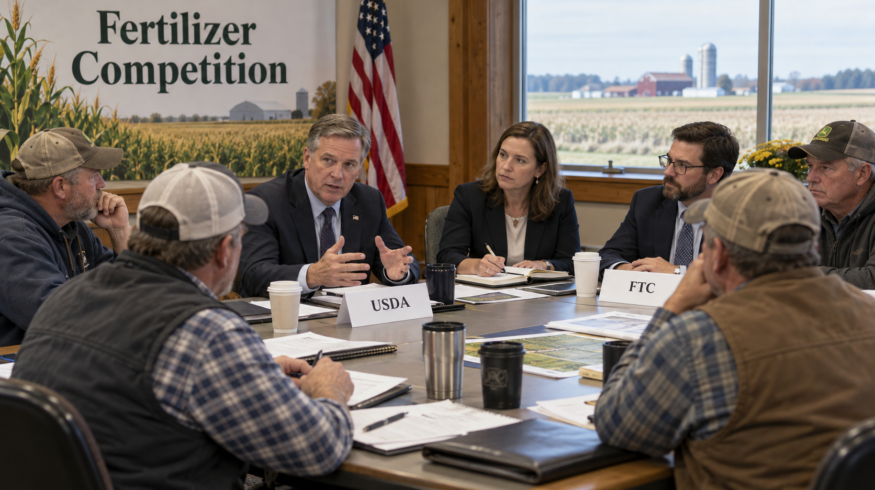

U.S. federal officials are preparing additional action aimed at competition in the fertilizer market, with new announcements expected within the coming weeks, according to Deputy Agriculture Secretary Stephen Vaden.
Vaden said the Department of Agriculture is working alongside the Federal Trade Commission and Department of Justice after farmers provided additional testimony about fertilizer pricing, market concentration and alleged barriers facing potential new competitors.
The comments mark the latest escalation in a federal review of the U.S. fertilizer industry that now includes an FTC industry-wide investigation, Justice Department scrutiny, expanded USDA-DOJ cooperation and federal funding intended to bring new fertilizer production into the market.
USDA says fertilizer action could come within weeks
Vaden told RFD-TV that additional announcements involving fertilizer competition are expected in the coming weeks.
He did not identify specific companies, enforcement actions or policy changes that may be announced.
The comments therefore should not be interpreted as confirmation that federal agencies have decided to file an antitrust case or impose penalties on fertilizer producers.
They do, however, indicate that fertilizer competition remains an active federal enforcement and agricultural-policy priority rather than an investigation that has stalled.
FTC already has a formal fertilizer investigation underway
The Federal Trade Commission opened an industry-wide investigation into fertilizer prices and market concentration in May 2026.
FTC Chairman Andrew Ferguson announced the investigation during a Texas Corn Producers Association field hearing on May 28.
Ferguson said fertilizer represented the largest increase in U.S. farm input costs since 2020 and that the Commission would examine whether sustained price increases were partly the result of anticompetitive conduct.
He also stressed that high fertilizer prices alone do not prove an antitrust violation.
The investigation therefore focuses on whether companies violated competition law, not simply on whether fertilizer became expensive.
Farmers supplied additional evidence at Iowa hearing
The latest USDA comments follow a September 11 meeting in Ogden, Iowa, where more than 170 farmers from 13 states met with Vaden to discuss fertilizer pricing and competition.
The event brought together corn and wheat grower organizations from multiple states and focused on farmer experiences buying nitrogen, phosphate and other fertilizer products.
Fertilizer Daily previously reported on the Iowa fertilizer hearing and the evidence farmers were asked to provide federal investigators.
Vaden has since said the meeting gave federal antitrust officials additional information about practices that farmers and prospective competitors believe may restrict competition.
Claims include barriers facing new fertilizer suppliers
One area receiving particular attention is whether companies attempting to enter fertilizer markets face commercial barriers beyond the high capital cost of building production facilities.
At the Iowa meeting, representatives of proposed new fertilizer businesses described difficulties obtaining customer commitments needed to finance new projects.
Greenfield Nitrogen co-founder Linda Thrasher said her farmer-backed company had spent years attempting to develop a planned 300,000-ton-per-year ammonia facility in Iowa.
She alleged that some retailers and cooperatives were reluctant to sign agreements with the proposed supplier because they feared damaging relationships with larger incumbent fertilizer companies.
These claims remain allegations and have not been established by a court or federal enforcement action.
Why customer contracts matter for new fertilizer plants
Large fertilizer plants require substantial upfront capital and usually need evidence of future demand before lenders or investors will finance construction.
Long-term sales agreements or other customer commitments can therefore be important to project financing.
If a prospective producer cannot secure those commitments, the project may struggle to raise capital even if the underlying technology and economics are viable.
Federal investigators are interested in whether those barriers result from ordinary commercial risk or potentially exclusionary conduct by established market participants.
DOJ and USDA expanded their competition partnership in October
The fertilizer investigation is also taking place within a broader federal push to increase competition across agricultural inputs.
On October 6, the Department of Justice and USDA announced an expanded memorandum of understanding covering agricultural products including fertilizer, seed, feed, fuel, equipment and pesticides.
The agencies said the agreement strengthens cooperation on investigations and enforcement involving conduct that may harm farmers or consumers.
The October agreement updates a USDA-DOJ framework originally established in September 2025.
Fertilizer is explicitly included in the new USDA-DOJ agreement
The Department of Justice specifically listed fertilizer among the agricultural inputs covered by the expanded partnership.
DOJ said it intends to investigate and take appropriate action against anticompetitive conduct where evidence supports enforcement.
The new memorandum does not itself accuse any fertilizer company of violating antitrust law.
Instead, it creates a framework through which USDA market knowledge and farmer complaints can be shared with federal competition authorities.
Three federal competition tracks are now running simultaneously
| Federal body | Current fertilizer-related role |
|---|---|
| Federal Trade Commission | Industry-wide investigation into fertilizer pricing and market concentration |
| Department of Justice | Antitrust scrutiny and expanded agricultural-input cooperation with USDA |
| USDA | Farmer evidence gathering, competition policy and support for new domestic fertilizer capacity |
The agencies have overlapping but different powers.
The FTC and DOJ can pursue antitrust enforcement, while USDA has a broader agricultural mandate that includes market monitoring, farm policy and programs intended to expand domestic fertilizer supply.
The federal strategy also includes more fertilizer production
Competition policy is only one part of the administration’s approach.
USDA is also attempting to increase the number of fertilizer suppliers by supporting new domestic production capacity.
In July, USDA opened applications for the Fertilizer Investment & Expansion for Long-term Domestic Supply program, known as FIELDS.
The program makes up to $500 million available for projects that expand, upgrade or construct fertilizer production facilities.
USDA says one goal is to increase market competition by supporting facilities outside dominant fertilizer suppliers.
FIELDS could reduce barriers to new fertilizer capacity
Building a new ammonia, urea or phosphate fertilizer plant can require hundreds of millions or billions of dollars.
Projects can also face long permitting schedules, infrastructure requirements, gas or raw-material contracts and difficulty securing financing.
Federal support cannot eliminate those barriers, but it can improve the economics of projects that otherwise struggle to compete with established producers.
The policy therefore represents a supply-side complement to antitrust enforcement:
- investigate potentially anticompetitive conduct;
- reduce barriers to new market entrants;
- increase domestic fertilizer capacity;
- increase the number of suppliers competing for farmer purchases.
The FTC investigation began after fertilizer costs surged

Fertilizer prices rose sharply after 2020 as natural-gas prices, global supply disruptions, Russia’s invasion of Ukraine, trade restrictions and other market shocks affected nitrogen, phosphate and potash markets.
Prices later declined from their 2022 peaks but remained a major cost pressure for U.S. crop producers.
FTC Chairman Ferguson said in May that fertilizer had produced the single largest increase in U.S. farm input costs since 2020.
That economic pressure is especially important when corn, soybean and other crop prices are weak because farmers have less revenue available to absorb high input costs.
Market concentration is not the same across all fertilizers
One difficulty with the federal investigation is that “fertilizer” is not one uniform market.
Nitrogen, phosphate and potash have different feedstocks, producers and international trade structures.
| Segment | Key production inputs | Major North American companies |
|---|---|---|
| Nitrogen | Natural gas, ammonia | CF Industries, Nutrien, Koch, Yara and others |
| Phosphate | Phosphate rock, sulfur, ammonia | Mosaic, Nutrien and import suppliers |
| Potash | Potassium-bearing mineral deposits | Nutrien, Mosaic and international suppliers |
Competition authorities therefore need to examine specific products and geographic markets rather than treat all fertilizer as a single commodity.
What fertilizer producers say
The fertilizer industry disputes the argument that current market structure means U.S. fertilizer prices are the result of inadequate competition.
The Fertilizer Institute told Congress earlier this year that U.S. fertilizer companies compete with each other and with hundreds of international suppliers in a global market.
The industry group also noted that the United States is a net fertilizer importer and that producers face competition from major manufacturing regions including China, Russia, Morocco, Canada and Belarus.
TFI argues that global feedstock costs, trade restrictions, logistics, government policies and international supply disruptions play major roles in fertilizer pricing.
High concentration does not automatically prove collusion
A concentrated market can attract antitrust scrutiny, but concentration itself is not proof that companies coordinated prices or production.
Investigators would need evidence of conduct that violates U.S. competition law.
Possible areas of inquiry could include:
- price coordination;
- production coordination;
- information sharing;
- contracts that restrict competitors;
- pressure on distributors or customers;
- other exclusionary business practices.
Whether any of these occurred in fertilizer markets is the subject of investigation and allegations, not an established finding.
Private fertilizer antitrust lawsuits are also moving through federal court
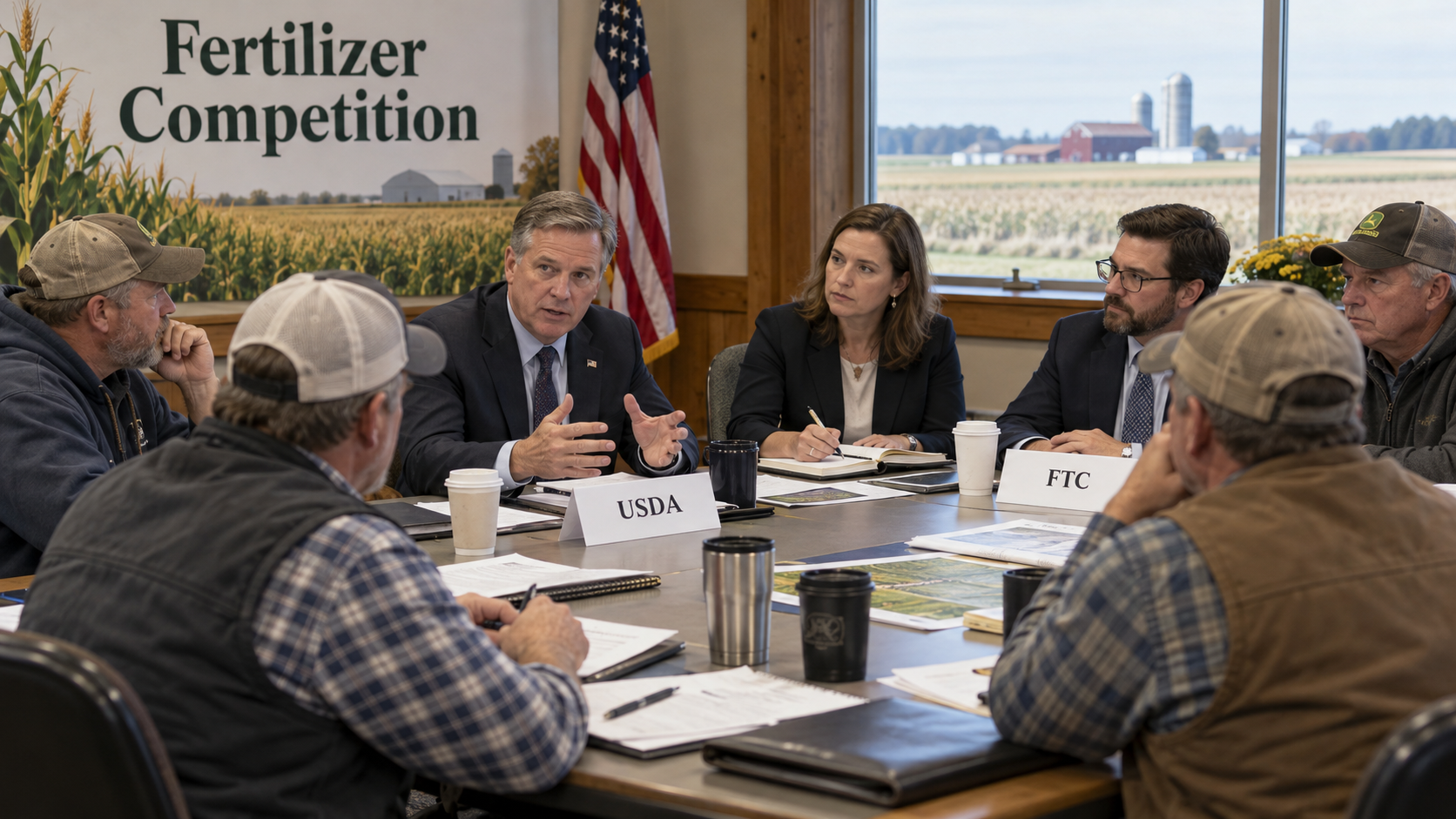
Federal government scrutiny is separate from private lawsuits filed by farmers and fertilizer purchasers.
Related NPK fertilizer antitrust cases have been centralized in the U.S. District Court for the District of Kansas under MDL No. 3187.
The litigation involves allegations against companies including Nutrien, Mosaic, CF Industries, Koch, Yara and Canpotex.
Fertilizer Daily has examined the consolidated U.S. fertilizer antitrust litigation and the companies involved.
The defendants dispute allegations of illegal coordination, and the claims have not been proven in court.
FTC’s investigation remains separate from the private cases
The existence of private class actions does not mean the FTC or Justice Department will necessarily reach the same conclusions.
Government investigators have their own evidence-gathering powers and legal standards.
Possible outcomes include:
- no enforcement action;
- civil enforcement;
- negotiated settlements;
- changes to commercial practices;
- additional investigation;
- other competition-policy measures.
Vaden has not disclosed which type of action may be announced in the coming weeks.
Farmers are being asked to provide evidence
Federal officials and farm organizations have encouraged farmers and agricultural businesses to document specific experiences involving fertilizer sales, pricing and supply.
At the Iowa hearing, Vaden said patterns across many individual accounts could help investigators determine whether alleged practices are isolated commercial disputes or evidence of broader market behavior.
Farm groups have created a confidential submission channel for producers who say they fear retaliation for publicly describing commercial relationships.
What kind of evidence could matter?
For competition investigators, specific commercial evidence is generally more useful than broad complaints about high prices.
Relevant information could include:
- contracts;
- price quotations;
- communications with suppliers or distributors;
- changes in purchasing conditions;
- refusals to supply;
- restrictions associated with buying from competitors;
- evidence involving financing or customer agreements for new suppliers.
The central question is whether observed behavior reflects ordinary market conditions or conduct prohibited under antitrust law.
Why fertilizer price transparency is another policy issue
Farm groups have also argued that limited fertilizer price reporting makes it difficult for growers to know whether a local offer reflects broader market conditions.
Unlike major grain markets, where benchmark prices are continuously visible, retail fertilizer markets can be fragmented and locally negotiated.
Proposed federal legislation has sought to increase USDA fertilizer-price reporting and improve market transparency.
More transparent pricing would not automatically lower fertilizer costs, but supporters argue that it could improve farmers’ ability to compare offers and negotiate purchases.
New supply could take years to affect farmer prices
Even if USDA successfully supports additional fertilizer plants, the physical supply response will not be immediate.
Large fertilizer projects require:
- permitting;
- engineering;
- financing;
- construction;
- feedstock agreements;
- transport infrastructure;
- commissioning.
That means antitrust enforcement, import policy and price transparency could affect competition sooner than construction of entirely new production facilities.
Imports remain part of the competition strategy
The United States imports substantial volumes of fertilizer and fertilizer raw materials.
Foreign supply can therefore increase competitive pressure on domestic producers when trade routes remain open and tariffs or duties do not make imports uneconomic.
Earlier in 2026, the administration temporarily suspended countervailing duties on Moroccan phosphate fertilizer, increasing the potential availability of imported phosphate products in the U.S. market.
The decision was another example of policymakers using supply policy alongside antitrust enforcement to address fertilizer costs.
What could USDA announce next?
Vaden has not provided enough information to identify the forthcoming action.
Based on the agencies currently involved, possible areas of federal action could include further investigative steps, competition-policy announcements, new supply initiatives or enforcement measures.
Those possibilities remain speculative until USDA, FTC or DOJ publishes an official announcement.
The only confirmed development is that Vaden says additional fertilizer-related federal announcements are expected within weeks.
What farmers should watch
The next several weeks could clarify whether Washington’s fertilizer initiative remains primarily an investigation or moves toward formal enforcement or structural market reforms.
Key developments include:
- new announcements from USDA, FTC or DOJ;
- the status of the FTC fertilizer investigation;
- any subpoenas, complaints or settlements made public;
- new FIELDS program awards;
- progress on new domestic fertilizer projects;
- fertilizer price-transparency legislation;
- developments in MDL No. 3187;
- fall and spring fertilizer prices facing U.S. growers.
Frequently asked questions
Yes. The Federal Trade Commission opened a formal industry-wide investigation into fertilizer pricing and market concentration in May 2026. Fertilizer markets are also receiving scrutiny from the Department of Justice and USDA.
Deputy Agriculture Secretary Stephen Vaden said additional federal action involving fertilizer competition is expected within the coming weeks. He did not specify what that action will be.
No. Federal investigations and private lawsuits involve allegations and questions about market conduct. No industry-wide finding of illegal fertilizer price fixing has been established.
The FTC cited rising farm input costs and concentration in parts of the fertilizer industry as reasons to examine whether anticompetitive practices contributed to price increases.
In addition to supporting federal competition investigations, USDA has launched the $500 million FIELDS program to support new or expanded domestic fertilizer production.
Vaden said announcements are expected within the coming weeks, but no exact date has been provided.
Sources: Federal Trade Commission, U.S. Department of Justice, U.S. Department of Agriculture, Iowa Corn Growers Association, The Fertilizer Institute, RFD-TV

Enjoyed this story?
Every Monday, our subscribers get their hands on a digest of the most trending agriculture news. You can join them too!






Discussion0 comments