Skip to content
  • Professionals
  • Gardeners
 
Search
Log in
EN
RU
  • Markets
  • Business
  • Politics
  • Technologies
  • Interviews
  • Rankings
  • Environment
  • Events
  • Stock Quotes
  • Business Directory
Trending topic:
Featured company:
 
RU
  • Professionals
  • Gardeners
Sections
    Events
    Stock Quotes
    Business Directory
    Trending topic:
    Featured company:
    Follow us...
    Helpful information
    • About
    • Team
    • Advertise
    • Contacts
    • Submit a Tip
    • Privacy Policy
    • Terms of Service
    • Site Map
    Sections
      Seasonal tips
      • Spring
      • Summer
      • Autumn
      • Winter
      Trending topics
      • compost
        24
      • garlic
        2
      • lemon
        1
      • potato
        14
      Follow us...
      Helpful information
      • About
      • Team
      • Advertise
      • Contacts
      • Submit a Tip
      • Privacy Policy
      • Terms of Service
      • Site Map
      Copyright © 2014-2026 DigitalTree LLC. All rights reserved.
      We deliver content lightning-fast thanks to the managed cloud WordPress hosting with CDN.
      16+

      Home / Environment

      Crops becoming less nutritious due to rise of CO₂ levels

      Timothy Bueno avatar Timothy Bueno
      May 5, 2026, 2:00 pm
      May 5, 2026, 2:00 pm
      [esi post-views ttl=0]
      Environment
      Crops becoming less nutritious due to rise of CO₂ levels

      Save for later
      Share

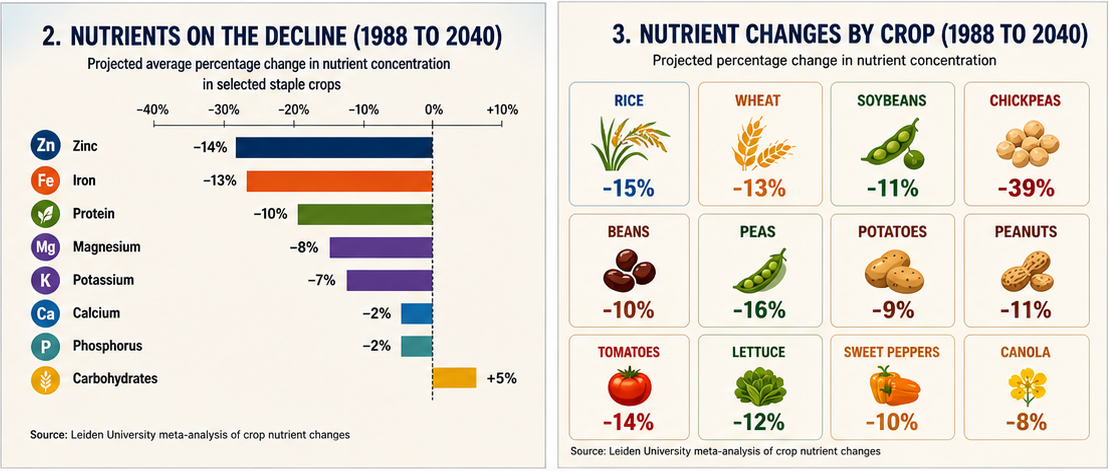
      The nutritional quality of staple foods is declining as rising atmospheric carbon dioxide alters plant biology, with potentially far-reaching consequences for global health and food systems. Research synthesized by scientists at Leiden University shows that crops such as wheat, rice, beans, and chickpeas now contain fewer essential nutrients than they did several decades ago, a trend expected to continue through 2040 and beyond.
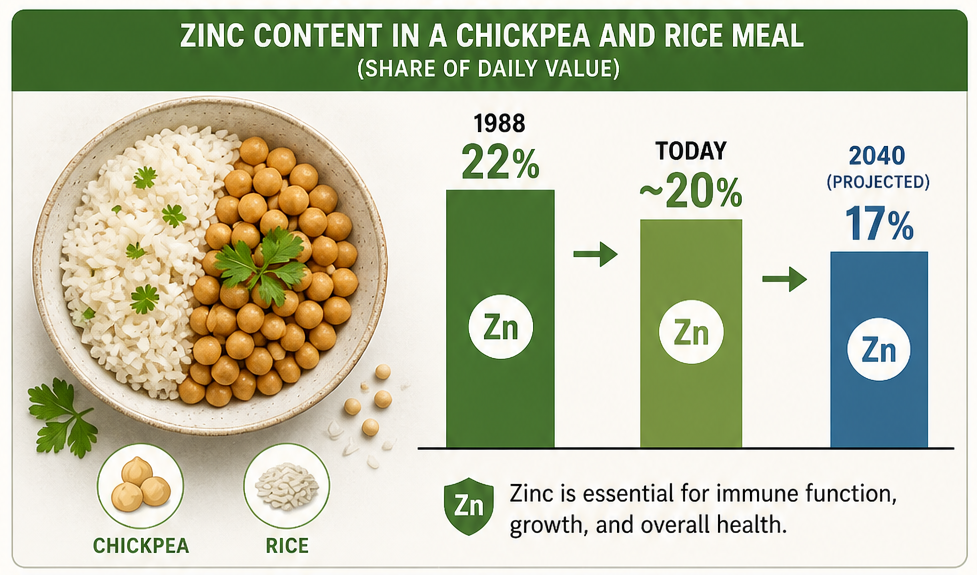
      A typical meal of chickpeas and rice, for example, provided roughly 22% of daily zinc requirements in the late 1980s but now delivers closer to 20%, with projections suggesting a decline to around 17% by 2040. While the changes appear incremental, scientists warn that even small reductions in nutrient density could significantly increase the prevalence of “hidden hunger,” particularly in regions heavily dependent on plant-based staples.
      ADVERTISEMENT

      The “carbon dilution” effect

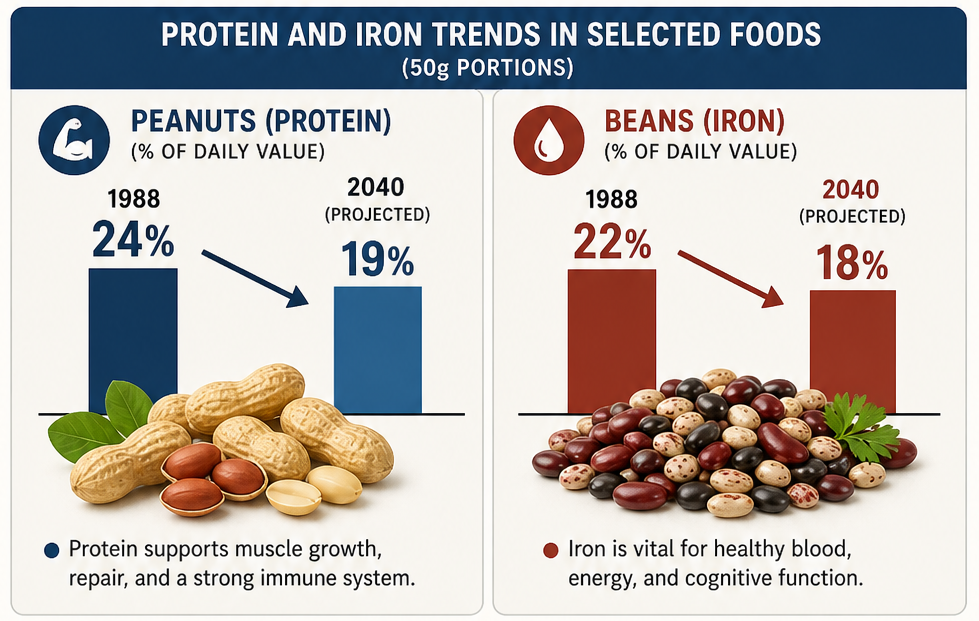
      Scientists attribute much of this decline to what is known as the “dilution effect.” Elevated CO₂ concentrations stimulate photosynthesis, increasing carbohydrate production in plants. However, this accelerated growth is not matched by a proportional uptake of minerals such as zinc, iron, and magnesium.

      As a result, crops may grow larger and yield more biomass, but their nutritional value per serving declines. “The diets we eat today have less nutritional density than those of previous generations,” said Kristie Ebi, highlighting the systemic nature of the shift.

      Plant physiology under rising CO₂

      Higher CO₂ concentrations also affect plant water use. Crops absorb carbon dioxide through microscopic leaf pores known as stomata. When CO₂ levels rise, plants partially close these pores, reducing water loss—but also limiting the uptake of waterborne nutrients from the soil.

      According to Lewis Ziska, this increased efficiency comes at a nutritional cost. Reduced water flow through plants leads to lower transport of dissolved minerals, compounding the dilution effect.

      Additional climate-related factors further complicate nutrient uptake. Warmer soils can alter microbial activity, reducing nitrogen availability, while increased temperatures may raise concentrations of harmful substances such as arsenic in crops like rice.
      Health risks and global exposure

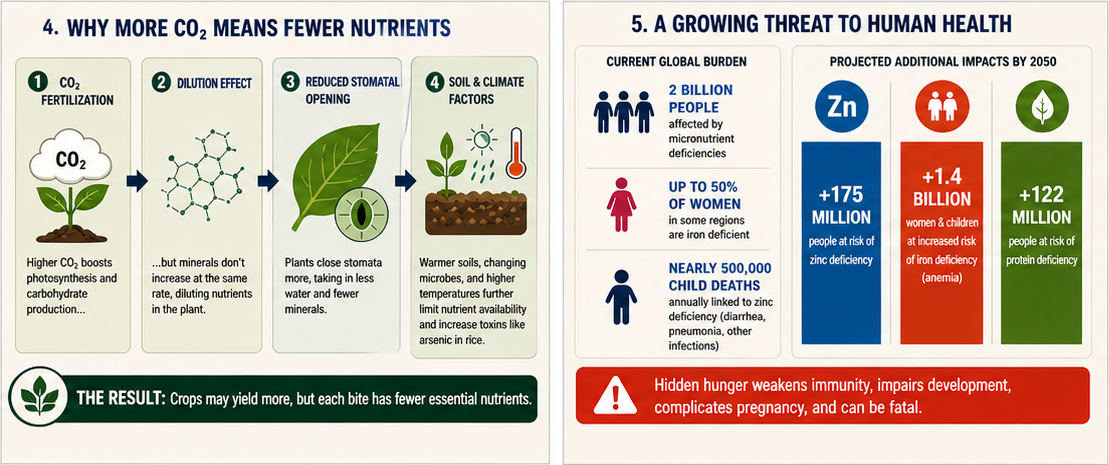
      The decline in nutrient density is expected to exacerbate existing deficiencies worldwide. Estimates suggest that by mid-century:

      • An additional 175 million people could become zinc-deficient
      • 122 million more may face protein deficiency
      • Up to 1.4 billion women and children could experience worsening iron intake

      According to World Health Organization, between 30% and more than half of the global population already suffers from inadequate micronutrient intake.

      Iron deficiency, in particular, poses severe risks. In countries such as Nigeria, anemia among women of reproductive age contributes to complications during childbirth, including increased mortality risk.
      Limited mitigation options

      While high-income countries may offset nutrient losses through dietary diversification, supplementation, and fortified foods, lower-income regions face structural constraints. Diets in these areas often rely heavily on a narrow set of staples, limiting the ability to compensate for declining nutrient content.

      Policy interventions such as food fortification and crop diversification have shown partial success but remain insufficient to counteract ongoing nutrient dilution. Research also suggests that agricultural policies emphasizing high-yield crops over nutrient-rich varieties may worsen the problem.

      Outlook for agriculture and food systems

      Experts emphasize that reducing greenhouse gas emissions remains the most effective long-term solution. While elevated CO₂ can enhance plant growth, its broader impacts—including nutrient dilution, extreme weather, and declining yields—are expected to outweigh any benefits.

      Without intervention, the combination of lower nutrient density and climate-related yield losses could significantly strain global food systems, particularly in vulnerable regions.

      Source: The Washington Post

      climate change
      CO2 emission
      crop nutrient
      ecology
      food security
      nutrients
      research

      Enjoyed this story?

      Every Monday, our subscribers get their hands on a digest of the most trending agriculture news. You can join them too!

      Sign me up
      Check the example

      Discussion0 comments

      Спасибо за комментарий, он будет опубликован на сайте после проверки модератором. Хотите, чтобы ваши комментарии появлялись на сайте мгновенно? Достаточно пройти регистрацию.
      Congratulations, you can be the first to start the conversation.
      Do you have a question or suggestion? Please leave your comment to ignite conversation.
      What’s on your mind?
      Cancel Log in and comment
      Or continue without registration
      Get notified about new comments by email.
      Advertisement
      In focus
      How to get here?
      Stock quotes
      Bayer
      10.83
      2.52
      Bayer Crop Science
      37.9
      1.34
      CF Industries
      128.04
      1.71
      Corteva Agriscience
      83.9
      2.71
      ICL Group
      5.6
      1.27
      Intrepid Potash
      40.11
      1.96
      Mosaic
      23.26
      1.26
      Nutrien
      77.24
      1.87
      Yara International
      29.02
      0.14
      See all
      Most read
      BASF acquires AgBiTech to expand biological insect control portfolio
      BASF acquires AgBiTech to expand biological insect control portfolio
      Mosaic suspends two phosphate facilities in Brazil considering their potential sale
      Mosaic suspends two phosphate facilities in Brazil considering their potential sale
      China limits fertilizer exports as the country prioritizes domestic market
      China limits fertilizer exports as the country prioritizes domestic market
      Russia limits fertilizer exports to 20 million tons through November 2026
      Russia limits fertilizer exports to 20 million tons through November 2026
      Indonesia will supply 250,000 tonnes of urea to Australia to mitigate global shortages
      Indonesia will supply 250,000 tonnes of urea to Australia to mitigate global shortages
      Events
      CaspianAgro
      Baku, Azerbaijan
      May 5 — 8, 2026
      Fertilizer Summit
      Chicago (IL), USA
      Jun 1 — 2, 2026
      Argus Clean Ammonia Asia
      Tokyo, Japan
      Jun 2 — 4, 2026
      Wood Mackenzie Hydrogen Hydrogen Conference
      London, UK
      Jun 4, 2026
      Agriculture & Organic Farming Summit
      Paris, France
      Jun 17 — 18, 2026
      See all
      Live
      Estebel
      April 23, 10:26 pm
      Sounds like magic ))
      MIT study: rice seeds germinate faster when exposed to rainfall sounds
      Isabelita Barreiro
      December 11, 2025, 01:54 am
      Excellent management of water resources and effective use of water-soluble fertilizers!
      Argentine nano-fertilizer firm AKO Agro expands to Brazil
      Meripa Corson
      August 4, 2025, 01:18 pm
      Where does the money actually go? As a timber land owner, how do I benefit from the legislation?
      USDA commits $80 million to expand timber markets and improve forest resilience
      Patonkas Luksompulus
      January 21, 2025, 12:36 pm
      Greece meeds biological fertilizers! Great news about De sangosse.
      DE SANGOSSE expands operations with Greek subsidiary
      Pedro Diaz
      November 20, 2024, 08:42 pm
      Is it a Roundup lawsuit or more about bad financials? I think the market reacted only to announced financial results.
      Bayer’s shares are pressed down by ongoing Roundup cancer lawsuit
      About
      Sections
      Markets  ·  Business  ·  Politics  ·  Technologies  ·  Interviews  ·  Rankings  ·  Environment
      Support
      About  ·  Team  ·  Advertise  ·  Contacts  ·  Submit a Tip  ·  Privacy Policy  ·  Terms of Service  ·  Site Map
      Copyright © 2014-2026 DigitalTree LLC. All rights reserved.
      We deliver content lightning-fast thanks to the managed cloud WordPress hosting with CDN.
      16+
      More to read
      Researchers discovered a zinc-sensing protein that regulates nitrogen fixation in legumes
      Researchers discovered a zinc-sensing protein that regulates nitrogen fixation in legumes
      Researchers say rising CO₂ levels make food more caloric but less nutritious
      Researchers say rising CO₂ levels make food more caloric but less nutritious
      Indonesia faces record-high rice prices as El Niño intensifies
      Indonesia faces record-high rice prices as El Niño intensifies
      Advertising that helps us do quality reporting