

Gene controlling potato’s daylight response also suppresses nitrogen uptake, study finds

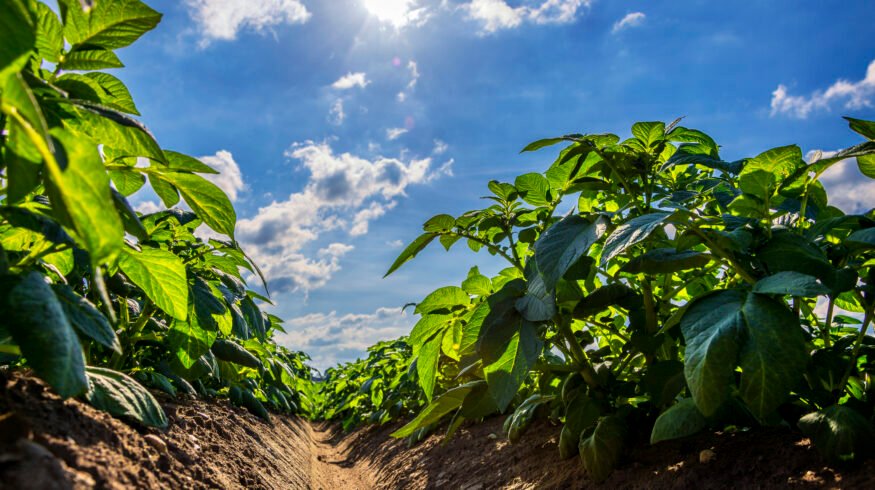

Researchers at the Centre for Research in Agricultural Genomics in Barcelona have identified a gene in potatoes that inadvertently limits the crop’s ability to absorb nitrogen — a discovery that, if translated into new varieties through gene editing or traditional breeding, could significantly reduce the nitrogen fertilizer requirements of the world’s fourth most-grown staple food.
The findings, published in the journal New Phytologist in November 2024, center on a gene called StCDF1, which regulates how potato plants respond to day length. Potatoes evolved this genetic control when the crop spread from its Andean origins into the shorter-day growing seasons of Northern Europe — one of the key adaptations that made the plant a globally versatile food source. But when researchers began studying StCDF1 more closely, they found it does more than set the plant’s seasonal clock.
A dual-function gene with an unintended side effect
StCDF1 operates as a molecular switch, activating some genes and suppressing others in response to seasonal signals. Lead researcher Maroof Ahmed Shaikh, a plant molecular biologist at the Centre for Research in Agricultural Genomics, found that StCDF1 also suppresses production of an enzyme called nitrate reductase — the protein responsible for breaking down nitrate molecules in the soil into a form the plant can use to grow.
In other words, the genetic adaptation that made potatoes thrive across Northern Europe also made them dependent on heavier nitrogen applications. Without full nitrate reductase activity, the plant cannot efficiently extract available nitrogen from the soil and must receive larger external doses to achieve the same yield.
To test this, the team grew potato plants with a disabled StCDF1 gene in soil containing roughly 400 times less nitrogen than typical commercial conditions. Those plants grew normally. Control plants with an intact StCDF1 gene showed pronounced nitrogen stress at the same low concentrations.
What is nitrate reductase?
Nitrate reductase is the enzyme that converts nitrate — the predominant nitrogen form absorbed by plant roots from soil water — into nitrite, the first step in the biosynthetic chain that produces amino acids and nucleic acids essential for plant growth. Most staple crops express this enzyme freely and continuously. In potatoes with an active StCDF1 gene, production is suppressed, reducing the efficiency with which applied nitrogen is converted into plant biomass. Higher fertilizer application rates compensate for this inefficiency.
Path to commercial varieties
The research team is exploring two routes to applying the finding. The first is gene editing — specifically, using precision techniques to disable or modify StCDF1 so it no longer represses nitrate reductase. The second is traditional breeding: crossing existing cultivated varieties with wild or traditional Andean relatives that naturally carry altered nitrate reductase gene sequences, without any genetic modification.
Both paths face different timelines and regulatory requirements. Gene-edited crops require regulatory approval in most markets, though the frameworks vary. The U.K. passed a Precision Breeding Act in 2023 that allows gene-edited crops without full GMO review. Brazil has moved in a similar direction. The European Union is still finalizing revised rules for new genomic techniques. In the U.S., USDA has granted non-regulatory status to certain gene-edited crops on a case-by-case basis.
“Nitrogen uptake is one of the major obstacles in agriculture,” said Stephan Pollmann, a plant biologist at the Centro de Biotecnología y Genómica de Plantas in Madrid who was not involved in the study. The finding, he said, opens a realistic path to varieties that require meaningfully less fertilizer without sacrificing yield.
Market context: why timing matters
Potatoes receive among the heaviest nitrogen fertilizer applications of any food crop — typically 100 to 200 kilograms of nitrogen per hectare in commercial production. Global potato cultivation covers approximately 16 million hectares, with major production in China, India, Russia, Ukraine and the European Union.
Even a modest reduction in per-hectare nitrogen needs would represent a substantial aggregate saving, both in cost and environmental impact. At current elevated prices — urea trading roughly 40% above year-ago levels in many markets, driven by the Strait of Hormuz closure — varieties requiring 20–30% less applied nitrogen could provide significant margin relief to growers in Europe, North America and South Asia. Beyond input cost savings, reduced nitrogen application also cuts nitrous oxide emissions from agricultural soils, one of the most potent greenhouse gases.
The research team’s next step is field trials under commercial soil conditions, where nitrogen dynamics and microbial activity are significantly more complex than in controlled greenhouse experiments.
Source: Science News
Key facts about the potato StCDF1 study
StCDF1 is a gene in potatoes that controls the plant’s response to day length, acting as a seasonal clock that regulates tuber formation. When day length shortens in autumn, StCDF1 triggers the developmental shift from vegetative growth to tuber development. It evolved as potatoes spread from their high-altitude Andean origins into the shorter-day growing seasons of Northern Europe, making the crop viable at higher latitudes. The discovery that it also regulates nitrogen uptake was unexpected and was made while researchers were studying its broader role in metabolic gene regulation.
StCDF1 represses the production of nitrate reductase, the enzyme that converts soil nitrate into nitrite — the first step in the chain that allows plants to synthesize amino acids and nucleic acids from inorganic nitrogen. Without adequate nitrate reductase activity, potatoes cannot efficiently convert available soil nitrogen into plant biomass. The plant compensates by requiring larger external nitrogen inputs to achieve commercial yields. This mechanism is not present in most other staple crops, which express nitrate reductase more freely.
The research team grew potato plants with a disabled StCDF1 gene in soil with nitrogen concentrations roughly 400 times lower than those used in normal commercial cultivation. Those plants grew and developed normally. Control plants with an intact, functioning StCDF1 gene showed visible nitrogen stress under the same low-nitrogen conditions. The experiment was conducted under greenhouse conditions. The team has also run theoretical experiments confirming that modifying related genes involved in nitrate reductase production could achieve a similar result.
Two routes are being explored. The first is gene editing — disabling or modifying StCDF1 using precision techniques so it no longer suppresses nitrate reductase. The second is traditional breeding: crossing commercial potato varieties with wild or traditional Andean relatives that naturally carry altered nitrate reductase gene sequences, without any genetic modification. The traditional breeding route is slower but avoids regulatory constraints on gene-edited crops in markets such as the European Union. The research team is planning field trials as the next step before any commercial application could be considered.
Commercial potatoes typically receive 100 to 200 kilograms of nitrogen fertilizer per hectare — among the highest application rates of any food crop. Global potato cultivation covers approximately 16 million hectares. If gene-edited or traditionally bred low-input varieties reduced per-hectare nitrogen requirements by 20–30%, the aggregate saving would represent several hundred thousand tonnes of nitrogen fertilizer annually at global scale. At current elevated urea prices, roughly 40% above year-ago levels in many markets, this would translate to hundreds of dollars per hectare in input cost savings for growers. The study’s authors have not yet published specific agronomic yield data for the modified varieties under field conditions.

Enjoyed this story?
Every Monday, our subscribers get their hands on a digest of the most trending agriculture news. You can join them too!






Discussion0 comments