Skip to content
  • Professionals
  • Gardeners
 
Search
Log in
EN
RU
  • Trade & Policy
  • Markets
  • AgTech & Research
  • Corporate
  • Sustainability
  • Interviews
  • Rankings
  • Events
  • Stock Quotes
  • Business Directory
Trending topic:

Strait of Hormuz

Featured company:
 
RU
  • Professionals
  • Gardeners
Sections
    Events
    Stock Quotes
    Business Directory
    Trending topic:

    Strait of Hormuz

    Featured company:
    Follow us...
    Helpful information
    • About
    • Team
    • Advertise
    • Contacts
    • Submit a Tip
    • Privacy Policy
    • Terms of Service
    • Site Map
    Sections
      Seasonal tips
      • Spring
      • Summer
      • Autumn
      • Winter
      Trending topics
      • compost
        25
      • garlic
        2
      • lemon
        1
      • potato
        15
      Follow us...
      Helpful information
      • About
      • Team
      • Advertise
      • Contacts
      • Submit a Tip
      • Privacy Policy
      • Terms of Service
      • Site Map
      Copyright © 2014-2026 DigitalTree LLC. All rights reserved.
      We deliver content lightning-fast thanks to the managed cloud WordPress hosting with CDN.
      16+

      Home / AgTech & Research

      Nanocoated nitrogen-fixing bacteria help increase rice yields and bring foliar biofertilizers a step closer to practical use

      Timothy Bueno avatar Timothy Bueno
      June 24, 2026, 2:00 pm
      June 24, 2026, 2:00 pm
      [esi post-views ttl=0]
      AgTech & Research
      Specialty
      Sustainability
      Nanocoated nitrogen-fixing bacteria help increase rice yields and bring foliar biofertilizers a step closer to practical use
      Save for later
      Share
      Never miss important fertilizer news

      A study in Nature Food found that a protective nanocoating helped bacteria colonize rice leaves 3.3 times more than before. These microbes supplied almost 28% of the crop’s nitrogen and improved plant growth.

      A protective nanocoating helped nitrogen-fixing bacteria survive better on rice leaves by shielding them from environmental stress. As a result, the microbes provided almost one-third of the crop’s nitrogen needs and increased plant growth, according to a study in Nature Food.

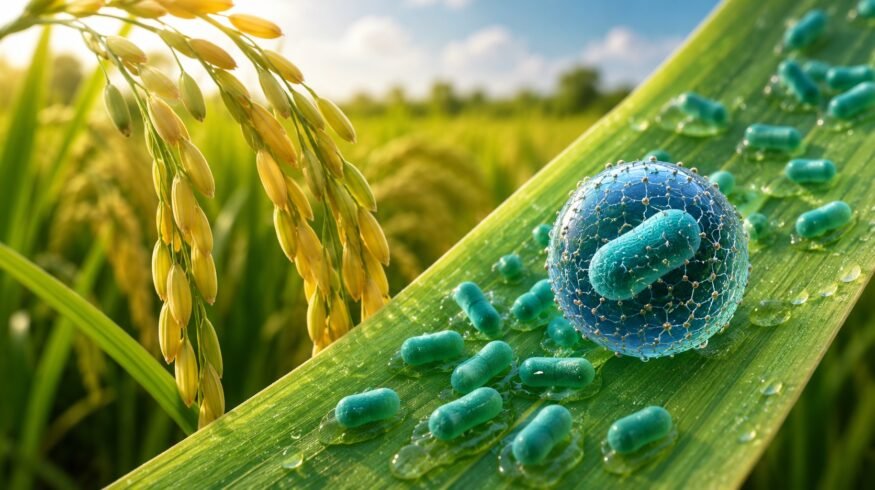
      Researchers from the Chinese Academy of Sciences and their partners covered the nitrogen-fixing bacterium Klebsiella variicola W12 with a two-layer nanocoating made from tannic acid, ferric ions, and sodium alginate. This coating protected the bacteria from ultraviolet light, drought, oxidative stress, and temperature changes, which usually make it hard for microbes to survive on leaves. In greenhouse tests, the coated bacteria colonized rice leaves 3.3 times better than uncoated ones, supplied 27.89% of the plants’ total nitrogen—more than twice as much as untreated bacteria—and increased fresh plant weight by 1.4 times after 54 days.

      These results help solve a major challenge for foliar biofertilization. Although nitrogen-fixing bacteria could replace synthetic nitrogen fertilizers, most commercial products are used on seeds or in the root zone because microbes do not usually survive long enough on leaves to fix nitrogen effectively. Field trials with Meiliangyou rice showed higher seed dry weight and biomass compared to untreated plants. However, the researchers noted that more work is needed to improve the coating for different crops and conditions before it can be used commercially. A commentary in Nature Biotechnology called this technology an important step toward practical foliar biofertilization.

      ADVERTISEMENT

      This research shows that the fertilizer industry is making progress in reducing the need for synthetic nitrogen by using biological alternatives. Current commercial microbial products, such as those from Pivot Bio, usually replace about 20 to 25% of a corn crop’s nitrogen needs through root-zone colonization. The new foliar method could add to these technologies by delivering biological nitrogen later in the season and for more types of crops. However, it will likely take years of further research, regulatory approval, and large-scale testing before it becomes widely available.

      Source: Nature Food


      What to know about nanocoated biofertilizers

      Nitrogen-fixing bacteria naturally convert atmospheric nitrogen — which plants cannot use directly — into ammonia, a form crops can absorb. Most commercial applications involve coating seeds with these bacteria so they colonize plant roots. Applying them to leaves instead is theoretically attractive because it would work for any crop at any growth stage, not just at planting. The problem is that leaves are harsh environments: UV radiation, drought, temperature swings, and the lack of a protective root zone kill most bacteria within hours or days of application.

      The researchers wrapped Klebsiella variicola W12 in a two-layer shell. The outer layer uses metal-phenolic networks — a structure formed when tannic acid coordinates with ferric iron ions — which is known for its antioxidant and UV-blocking properties. A second layer of sodium alginate, a natural polymer derived from seaweed, improves moisture retention and biofilm formation. Together, the coating lets the bacteria adhere to leaf surfaces and remain metabolically active long enough to fix nitrogen into the plant, without being killed by environmental stress.

      In hydroponic cultivation, nanocoated bacteria colonized rice leaf surfaces 3.3 times more effectively than uncoated bacteria at 14 days post-application. The coated treatment contributed 27.89% of total plant nitrogen — more than twice the contribution of uncoated bacteria — and produced a 1.4-fold increase in fresh plant weight after 54 days. In field trials with Meiliangyou rice, seed dry weight and total biomass both increased in coated versus water-only control plots, though full quantitative data for field conditions were not disclosed in the abstract.

      This is laboratory and preliminary field research. Significant work remains before any commercial product could reach farmers. Challenges include optimizing coating formulations for different crops and climates, ensuring the nanocoating materials are safe for soil and human health at agricultural scale, developing cost-effective manufacturing processes, and obtaining regulatory approval in key markets. The research demonstrates proof of concept in rice; application to wheat, corn, and other major cereals will require additional development. Commercial deployment is likely at least a decade away.

      The leading commercial biofertilizer for corn is Pivot Bio’s PROVEN product, which engineers soil microbes to fix nitrogen from the atmosphere and deliver it to plant roots. Pivot Bio estimates its products can replace 20–25% of a corn crop’s nitrogen needs. Foliar delivery, if it can be made reliable, would offer a fundamentally different application window — after planting and potentially multiple times during the growing season — and would not depend on root-zone colonization. However, existing root-zone products have the advantage of years of field trials and regulatory approval. The nanocoating approach is complementary rather than competitive at this stage.

      agriscience
      bacteria
      biofertilizer
      China
      crop nutrition
      nanotechnology
      nitrogen fertilizers
      nitrogen fixation
      rice

      Enjoyed this story?

      Every Monday, our subscribers get their hands on a digest of the most trending agriculture news. You can join them too!

      Sign me up
      Check the example

      Discussion0 comments

      Спасибо за комментарий, он будет опубликован на сайте после проверки модератором. Хотите, чтобы ваши комментарии появлялись на сайте мгновенно? Достаточно пройти регистрацию.
      Congratulations, you can be the first to start the conversation.
      Do you have a question or suggestion? Please leave your comment to ignite conversation.
      What’s on your mind?
      Cancel Log in and comment
      Or continue without registration
      Get notified about new comments by email.
      Advertisement
      In focus
      How to get here?
      Stock quotes
      Bayer
      10.81
      2.37
      Bayer Crop Science
      38.6
      1.1
      CF Industries
      102.17
      1.38
      Corteva Agriscience
      79.11
      0.32
      ICL Group
      5
      1.38
      Intrepid Potash
      33.22
      3.37
      Mosaic
      21.25
      3.41
      Nutrien
      61.54
      1.14
      Yara International
      22.33
      1.93
      See all
      Most read
      China reopens urea exports with $660/t price floor
      China reopens urea exports with $660/t price floor
      Holganix bets on soil biology and carbon markets to reshape regenerative agriculture
      Holganix bets on soil biology and carbon markets to reshape regenerative agriculture
      OCP warns Hormuz disruption has evolved into global fertilizer supply shock
      OCP warns Hormuz disruption has evolved into global fertilizer supply shock
      Urea futures slide to $416/t, down 28% on the month as oversupply weighs
      Urea futures slide to $416/t, down 28% on the month as oversupply weighs
      Sulphuric acid tops $500 per tonne as Hormuz closure tightens phosphate fertilizer production inputs globally
      Sulphuric acid tops $500 per tonne as Hormuz closure tightens phosphate fertilizer production inputs globally
      Events
      International Crop-Science Conference & Expo
      New Delhi, India
      Jun 25 — 26, 2026
      IFA Annual Conference
      Monaco
      Jun 29 — Jul 1, 2026
      Agrovolga
      Kazan, Russia
      Jul 8 — 10, 2026
      Southwestern Fertilizer Conference
      New Orleans (LA), USA
      Jul 12 — 16, 2026
      AgriBusiness Global Trade Summit
      Las Vegas (NV), USA
      Aug 5 — 6, 2026
      See all
      Live
      Stefan Petko
      May 6, 06:48 pm
      It is alarming to see these developments in California. As a vineyard grower, I have faced significant challenges this year, with fertilizer costs rising sharply while market conditions have made it difficult to sell the harvest.
      California peach growers forced to remove 420,000 trees after bankruptcy of Del Monte Foods canneries
      Estebel
      April 23, 10:26 pm
      Sounds like magic ))
      MIT study: rice seeds germinate faster when exposed to rainfall sounds
      Isabelita Barreiro
      December 11, 2025, 01:54 am
      Excellent management of water resources and effective use of water-soluble fertilizers!
      Argentine nano-fertilizer firm AKO Agro expands to Brazil
      Meripa Corson
      August 4, 2025, 01:18 pm
      Where does the money actually go? As a timber land owner, how do I benefit from the legislation?
      USDA commits $80 million to expand timber markets and improve forest resilience
      Patonkas Luksompulus
      January 21, 2025, 12:36 pm
      Greece meeds biological fertilizers! Great news about De sangosse.
      DE SANGOSSE expands operations with Greek subsidiary
      About
      Sections
      Trade & Policy  ·  Markets  ·  AgTech & Research  ·  Corporate  ·  Sustainability  ·  Interviews  ·  Rankings
      Support
      About  ·  Team  ·  Advertise  ·  Contacts  ·  Submit a Tip  ·  Privacy Policy  ·  Terms of Service  ·  Site Map
      Copyright © 2014-2026 DigitalTree LLC. All rights reserved.
      We deliver content lightning-fast thanks to the managed cloud WordPress hosting with CDN.
      16+
      More to read
      European scientists are close to creating self-fertilizing crops
      European scientists are close to creating self-fertilizing crops
      Nitrogen-fixing genes transferred into new bacterial strains, advancing quest to reduce fertilizer dependence
      Nitrogen-fixing genes transferred into new bacterial strains, advancing quest to reduce fertilizer dependence
      Microbes can be a sustainable alternative to chemical fertilizers – MIT study
      Microbes can be a sustainable alternative to chemical fertilizers – MIT study
      Advertising that helps us do quality reporting