Skip to content
  • Professionals
  • Gardeners
 
Search
Log in
EN
RU
  • Trade & Policy
  • Markets
  • AgTech & Research
  • Corporate
  • Sustainability
  • Interviews
  • Rankings
  • Events
  • Stock Quotes
  • Business Directory
Trending topic:

Strait of Hormuz

Featured company:
 
RU
  • Professionals
  • Gardeners
Sections
    Events
    Stock Quotes
    Business Directory
    Trending topic:

    Strait of Hormuz

    Featured company:
    Follow us...
    Helpful information
    • About
    • Team
    • Advertise
    • Contacts
    • Submit a Tip
    • Privacy Policy
    • Terms of Service
    • Site Map
    Sections
      Seasonal tips
      • Spring
      • Summer
      • Autumn
      • Winter
      Trending topics
      • compost
        25
      • garlic
        2
      • lemon
        1
      • potato
        15
      Follow us...
      Helpful information
      • About
      • Team
      • Advertise
      • Contacts
      • Submit a Tip
      • Privacy Policy
      • Terms of Service
      • Site Map
      Copyright © 2014-2026 DigitalTree LLC. All rights reserved.
      We deliver content lightning-fast thanks to the managed cloud WordPress hosting with CDN.
      16+

      Home / AgTech & Research

      Researchers chart a roadmap to a bio-solar nitrogen economy that could cut synthetic fertilizer demand


      Timothy Bueno avatar Timothy Bueno
      June 30, 2026, 9:00 am
      June 30, 2026, 9:00 am
      [esi post-views ttl=0]
      AgTech & Research
      Regenerative Agriculture
      Sustainability
      Researchers chart a roadmap to a bio-solar nitrogen economy that could cut synthetic fertilizer demand
      Image Credits: iStock Photo
      Save for later
      Share
      Never miss important fertilizer news

      A comprehensive review published in a June 2026 edition of Current Research in Biotechnology has mapped what researchers call a “bio-solar nitrogen economy” — a research roadmap that integrates recent breakthroughs across synthetic biology, microbial ecology, and plant genetics to chart a credible path toward dramatically reducing dependence on Haber-Bosch synthetic nitrogen fertilizers.

      What is a bio-solar nitrogen economy?
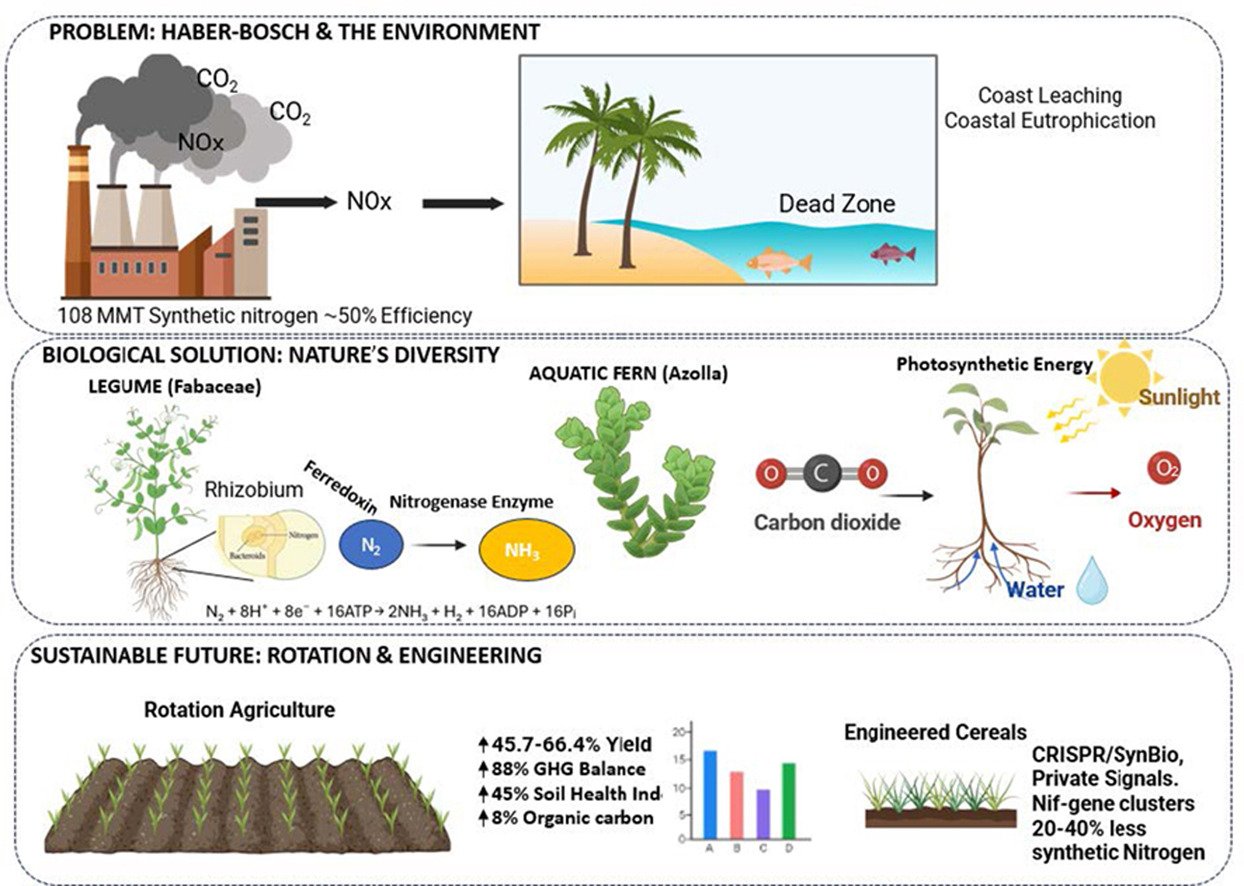
      The concept replaces fossil-fuel-driven ammonia synthesis with a system where atmospheric nitrogen is fixed into plant-usable forms directly within agricultural settings, powered by solar energy captured through photosynthesis and renewable electricity. The Haber-Bosch process, which has underpinned global food production for more than a century, converts nitrogen and hydrogen into ammonia at high temperature and pressure, consuming roughly 1–2% of global energy and releasing substantial greenhouse gas emissions. A bio-solar alternative would eliminate those inputs at the production stage.

      The review identifies four principal axes that define current research progress: host and microbial genetics, evolutionary dynamics, environmental and ecological conditions, and metabolic regulation. Each axis presents distinct engineering challenges — oxygen irreversibly inactivates nitrogenase enzymes, energy demand is high, and natural nitrogen-fixing systems are tightly regulated to prevent over-production.

      SynComs and engineered microbial consortia

      Among the most promising near-term strategies identified by the authors is the design of synthetic microbial communities, or SynComs, in which nitrogen fixation functions are distributed across multiple organisms rather than concentrated in a single strain. This approach improves robustness and scalability, according to research by Panchal et al. published in 2026. Rather than engineering a single bacterium to perform the complete nitrogen fixation task — which creates fragile single points of failure — SynComs spread the metabolic load, allowing consortia to persist under variable field conditions including fluctuating moisture, temperature and soil chemistry.

      ADVERTISEMENT

      Synthetic biology has also enabled the refactoring and modular engineering of nif gene clusters — the genetic machinery encoding nitrogenase and its associated enzymes — in heterologous hosts. Recent work has demonstrated that reconstructing these clusters in non-native bacteria is feasible, though successful engineering still requires coordinated control of oxygen protection, electron delivery, and metabolic balance rather than simply transferring the genes.

      Near-term targets and long-term possibilities

      The review distinguishes between near-term feasible targets and longer-horizon goals. Engineering soil bacteria to colonize the rhizosphere of non-legume crops such as corn, wheat and rice — the three most nitrogen-intensive staple crops — is considered achievable within five to ten years if existing regulatory and ecological barriers can be managed. Companies including Pivot Bio have already commercialized microbial products that colonize corn roots and fix modest but meaningful quantities of nitrogen under field conditions.

      Longer-range goals — reprogramming plants themselves to host nitrogen-fixing organelles, or transferring functional nodule-forming genetics into non-legume crops — face more fundamental obstacles. Progress toward transferring nodule formation from legumes to cereals has advanced significantly in controlled research settings, but a commercially viable crop variety achieving meaningful rates of self-fertilization through endogenous nitrogen fixation remains at least a decade away by most estimates.

      The authors also highlight the role of AI and multi-omics approaches in accelerating discovery. Machine learning tools can now scan large datasets of plant-microbe interaction data to identify promising associations for engineering, compressing what would historically have been multi-year screening programs into months. Genome editing via CRISPR has similarly shortened timelines for testing candidate gene combinations.

      Industry context: why this research matters now

      The review arrives at a moment of acute relevance to fertilizer markets. The Strait of Hormuz crisis, which began February 28, has disrupted roughly a third of globally traded nitrogen fertilizer and pushed urea prices to near-record highs before a partial correction following the June 15 ceasefire. The crisis has sharpened policy interest in reducing import dependency on concentrated nitrogen supply chains — an argument that makes biological nitrogen fixation research more commercially compelling, not just environmentally desirable.

      Legumes and diversified crop rotations already demonstrate the concept at scale: the best-documented evidence from long-term field trials shows that legumes can raise yields and reduce synthetic nitrogen use in low-input systems. The bio-solar economy framework extends that logic into a technology-intensive program suited to high-yield commodity agriculture.

      Commercially available biological nitrogen products occupy roughly 15% of agtech deals by count in 2026, according to venture capital tracking data, but a disproportionately small share of capital — suggesting the market views the sector as earlier and riskier than robotics or digital agronomy platforms. The current Hormuz shock may accelerate both research investment and farmer adoption of existing biofertilizer products as risk management tools against supply disruption.

      Source: ScienceDirect

      biofertilizer
      decarbonization
      Haber-Bosch
      nitrogen fertilizers
      nitrogen fixation
      research
      soil microbiome
      sustainability
      synthetic biology

      Enjoyed this story?

      Every Monday, our subscribers get their hands on a digest of the most trending agriculture news. You can join them too!


      Sign me up
      Check the example

      Discussion0 comments

      Спасибо за комментарий, он будет опубликован на сайте после проверки модератором. Хотите, чтобы ваши комментарии появлялись на сайте мгновенно? Достаточно пройти регистрацию.
      Congratulations, you can be the first to start the conversation.
      Do you have a question or suggestion? Please leave your comment to ignite conversation.
      What’s on your mind?
      Cancel Log in and comment
      Or continue without registration
      Get notified about new comments by email.
      Advertisement
      In focus
      How to get here?
      Stock quotes
      Bayer
      13.06
      1.66
      Bayer Crop Science
      46.03
      2.06
      CF Industries
      105.4
      0.28
      Corteva Agriscience
      83.37
      0.91
      ICL Group
      5.01
      0.2
      Intrepid Potash
      33.42
      3.38
      Mosaic
      22.44
      0.27
      Nutrien
      61.18
      0.33
      Yara International
      21.76
      1.09
      See all
      Most read
      China reopens urea exports with $660/t price floor
      China reopens urea exports with $660/t price floor
      Holganix bets on soil biology and carbon markets to reshape regenerative agriculture
      Holganix bets on soil biology and carbon markets to reshape regenerative agriculture
      Urea futures slide to $416/t, down 28% on the month as oversupply weighs
      Urea futures slide to $416/t, down 28% on the month as oversupply weighs
      India’s NFL urea tender draws bids near $449/t CFR, half the April level
      India’s NFL urea tender draws bids near $449/t CFR, half the April level
      Uralchem doubles fertilizer shipments to APEC countries as Asia-Pacific demand rises
      Uralchem doubles fertilizer shipments to APEC countries as Asia-Pacific demand rises
      Events
      IFA Annual Conference
      Monaco
      Jun 29 — Jul 1, 2026
      Agrovolga
      Kazan, Russia
      Jul 8 — 10, 2026
      Southwestern Fertilizer Conference
      New Orleans (LA), USA
      Jul 12 — 16, 2026
      AgriBusiness Global Trade Summit
      Las Vegas (NV), USA
      Aug 5 — 6, 2026
      Agronomy Conference and Expo
      Indianapolis (IN), USA
      Aug 24 — 26, 2026
      See all
      Live
      Stefan Petko
      May 6, 06:48 pm
      It is alarming to see these developments in California. As a vineyard grower, I have faced significant challenges this year, with fertilizer costs rising sharply while market conditions have made it difficult to sell the harvest.
      California peach growers forced to remove 420,000 trees after bankruptcy of Del Monte Foods canneries
      Estebel
      April 23, 10:26 pm
      Sounds like magic ))
      MIT study: rice seeds germinate faster when exposed to rainfall sounds
      Isabelita Barreiro
      December 11, 2025, 01:54 am
      Excellent management of water resources and effective use of water-soluble fertilizers!
      Argentine nano-fertilizer firm AKO Agro expands to Brazil
      Meripa Corson
      August 4, 2025, 01:18 pm
      Where does the money actually go? As a timber land owner, how do I benefit from the legislation?
      USDA commits $80 million to expand timber markets and improve forest resilience
      Patonkas Luksompulus
      January 21, 2025, 12:36 pm
      Greece meeds biological fertilizers! Great news about De sangosse.
      DE SANGOSSE expands operations with Greek subsidiary
      About
      Sections
      Trade & Policy  ·  Markets  ·  AgTech & Research  ·  Corporate  ·  Sustainability  ·  Interviews  ·  Rankings
      Support
      About  ·  Team  ·  Advertise  ·  Contacts  ·  Submit a Tip  ·  Privacy Policy  ·  Terms of Service  ·  Site Map
      Copyright © 2014-2026 DigitalTree LLC. All rights reserved.
      We deliver content lightning-fast thanks to the managed cloud WordPress hosting with CDN.
      16+
      More to read
      Nitrogen-fixing genes transferred into new bacterial strains, advancing quest to reduce fertilizer dependence
      Nitrogen-fixing genes transferred into new bacterial strains, advancing quest to reduce fertilizer dependence
      European scientists are close to creating self-fertilizing crops
      European scientists are close to creating self-fertilizing crops
      Regenerative agriculture deserves system-wide deployment, scientists argue
      Regenerative agriculture deserves system-wide deployment, scientists argue
      Advertising that helps us do quality reporting