

Israel Innovation Authority identifies five technology areas to combat desertification

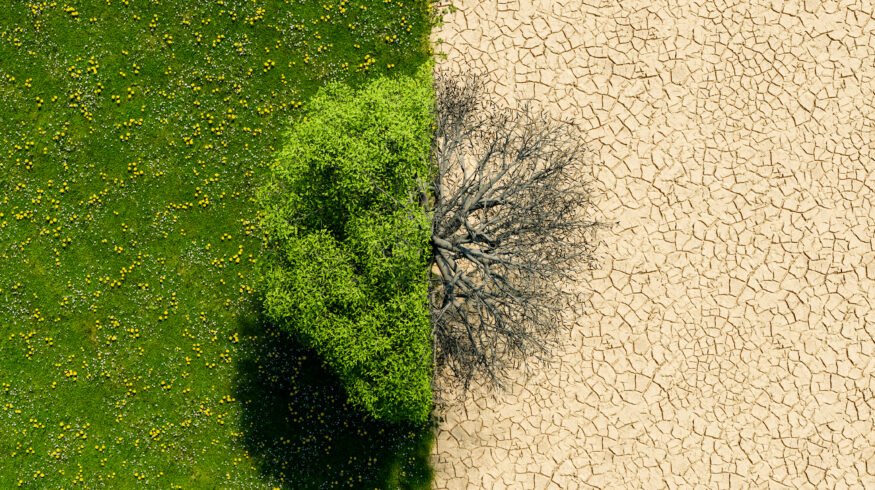

The Israel Innovation Authority and C4IR Israel have identified five technology areas that could help countries address desertification, while calling for a shift from isolated pilot projects toward integrated systems tested and deployed under real-world conditions. In the recently released report, they focus on water systems, climate-resilient agriculture, soil restoration, environmental intelligence, and renewable and distributed energy.
The organizations estimate that desertification affects more than 170 countries, directly impacting about 250 million people and threatening the livelihoods of roughly 1 billion people. The report argues that the challenge extends beyond the expansion of deserts, encompassing the degradation of land in arid and semi-arid regions through factors including over-cultivation, overgrazing, deforestation, poor irrigation practices and climate change.
From individual technologies to resilience systems
The report’s central argument is that individual technologies will have limited impact unless they are connected into systems that address several resource constraints simultaneously.
Water technology, for example, can support agriculture through wastewater reuse and more efficient irrigation, while distributed renewable energy can provide power for water treatment and pumping. Satellite imagery, sensors and artificial intelligence can then monitor soil and water conditions and help determine where resources should be deployed.
The report identifies water systems for arid regions as one of the five priority areas. Rather than focusing solely on increasing water supplies, it recommends integrated approaches combining demand management, water reuse, non-conventional sources and digital optimization.
The second area is climate-resilient agriculture, where technology can help farmers produce food with less water and on increasingly stressed land. The report points to precision irrigation, drought-resistant crops, biological approaches to soil improvement and advanced decision-support systems.
Soil health and land restoration form the third area. The report describes healthy soil as a core component of climate resilience because it supports water regulation, carbon storage, nutrient cycling, biodiversity and agricultural productivity. Sensors, Earth observation and AI-based systems can increasingly be used to detect degradation earlier and support more targeted restoration.
The fourth area, environmental intelligence, covers the technologies needed to understand environmental conditions and respond before degradation becomes difficult or expensive to reverse. These include satellite monitoring, soil and water sensors, digital soil mapping, drought early-warning systems and AI-based analysis.
The fifth area is renewable and distributed energy. According to the report, reliable low-carbon energy is closely linked to resilience in arid regions because it can power irrigation, water treatment and other infrastructure needed to maintain agricultural and environmental systems.
Water and agriculture at the center of the challenge
The report’s focus on water has particular significance for agriculture, which is both highly exposed to water scarcity and increasingly dependent on technologies that can improve water-use efficiency.
It projects that between 1.7 billion and 2.4 billion people could live in urban areas facing water scarcity by 2050. At the same time, the report notes that demand for reliable water and energy supplies is also increasing as populations grow and water-intensive industries and digital infrastructure expand.
For agriculture, this creates a need to move beyond conventional irrigation expansion toward systems that combine water recycling, precision application, crop selection, soil management and digital monitoring.
The report also stresses that soil degradation and climate change can reinforce each other. Degraded soils can lose their ability to retain water and support vegetation, potentially increasing vulnerability to drought and reducing agricultural productivity. Restoring soil therefore becomes both an agricultural and climate-resilience measure.
Israel’s Negev serves as a testing ground
Israel and the Negev region are presented in the report as a case study in how resource constraints can drive technology development and field testing.
The Negev covers more than half of Israel’s territory and is characterized by high temperatures, limited rainfall, water scarcity, salinity and other environmental constraints. The report describes the region as a national-scale “living laboratory” where technologies can be tested under conditions that increasingly resemble those faced by other climate-vulnerable regions.
Agriculture, water, energy, industry and infrastructure projects operate alongside research institutions, companies, farmers, government bodies and local authorities. Ben-Gurion University of the Negev is among the research institutions involved in the regional ecosystem.
The report argues that Israel’s experience is relevant not simply because of individual technologies but because of the institutional framework connecting research, infrastructure, policy and deployment.
The country’s water sector is cited as an example. Desalination and water reuse expanded through a combination of government policy, infrastructure investment and demand creation, helping establish conditions for technology adoption.
The report says the Negev’s value as a testing environment comes from the ability to evaluate technologies under prolonged drought, extreme temperatures, salinity and resource constraints before adapting them for other markets.
About 100 Israeli companies identified
The report also maps the Israeli technology ecosystem relevant to desertification resilience. The analysis identifies approximately 100 Israeli companies working in areas including data, sensing, artificial intelligence and decision-support systems.
According to the report, Israel stands out among the countries examined for the density of companies founded since 2015 relative to population size and for capital invested in those companies on a per-capita basis.
The report cautions that the mapping indicates the concentration of activity rather than a comprehensive assessment of the entire market. Nevertheless, it highlights the breadth of Israel’s technology ecosystem in environmental monitoring and decision support.
Dror Bin, CEO of the Israel Innovation Authority, said the challenge now is to connect technologies across sectors and move them from research and pilot projects to implementation at meaningful scale.
“The innovation we need is already being developed across a range of fields, from water and agriculture to artificial intelligence, soil and energy,” Bin said. “The major challenge now is to connect these solutions and enable them to move from research and pilots to implementation at a meaningful scale.”
Financing and skills remain barriers to deployment
Beyond technology development, the report identifies three conditions it considers necessary for broader deployment: policy and governance, financing and investment, and human capital and knowledge transfer.
The authors call for financing mechanisms that follow technologies through the full development cycle, from laboratory research and field trials to demonstration projects and first commercial deployments. They also propose greater use of blended finance and risk-sharing mechanisms involving public and private capital.
The report recommends tying financing to measurable outcomes, including water savings, improvements in soil health, prevention of land degradation and higher agricultural productivity.
Workforce development is another priority. The growing use of precision agriculture, remote sensing, advanced water systems and AI-based environmental monitoring is changing the skills required in climate-vulnerable regions. The report calls for greater investment in training in digital agronomy, water infrastructure, soil science, restoration ecology, data and artificial intelligence.
International research networks, exchange programs and cross-border demonstration projects could also help transfer knowledge between regions and adapt technologies to local environmental and economic conditions.
Living labs could bridge the gap between pilots and markets
A major recommendation is the expansion of living labs, regulatory sandboxes and demonstration sites where technologies can be evaluated outside laboratory conditions.
Such facilities can provide investors, farmers, governments and industrial customers with evidence on performance, cost and local suitability before large-scale deployment. They can also help address one of the persistent challenges facing climate and agricultural technologies: the gap between demonstrating technical feasibility and achieving commercial adoption.
Lior Yafe, Director of International Organizations at the Israel Innovation Authority, described desertification as a systemic risk affecting water security, food production, soil health, energy systems, economic development and regional stability.
The report therefore recommends treating environmental data as shared infrastructure and creating stronger connections between governments, research institutions, companies, investors and local communities.
International cooperation becomes increasingly important
The report argues that desertification cannot be addressed effectively within individual national borders. Countries facing similar combinations of drought, water scarcity, land degradation and agricultural pressure could benefit from shared demonstration networks, technology transfer and knowledge-sharing platforms.
At the same time, the authors caution against simply replicating the Israeli model elsewhere. Technologies and deployment strategies need to be adapted to local climate, economic, social and institutional conditions.
The report was developed by the Israel Innovation Authority and C4IR Israel with partners including Ben-Gurion University of the Negev, The DeserTech & Climate Innovation Center, Stanford Doerr School of Sustainability, C4IR India, C4IR Azerbaijan, Nura Global, Jewish Climate Trust and Evergreen Innovation Platform. C4IR Israel is an affiliate center within the World Economic Forum’s global Centres for the Fourth Industrial Revolution network.
The organizations are presenting the report during Climate Week NYC through events involving the World Economic Forum, ADAMA, Israel’s Ministry of Economy and Industry’s Economic Mission to the U.S. East Coast and Evergreen Innovation Platform. The discussions are expected to focus on the Israeli technology ecosystem and international cooperation on deploying resilience technologies in arid and climate-vulnerable regions.

Enjoyed this story?
Every Monday, our subscribers get their hands on a digest of the most trending agriculture news. You can join them too!



Discussion0 comments