

Arevo reports higher corn yields with up to 30% less nitrogen in European and Brazilian trials



Agtech company Arevo has reported new field-trial results for its Arginex Corn seed treatment, saying the product delivered up to 4.3% higher grain yields when standard nitrogen fertilizer rates were reduced by 30%. The trials were conducted by independent contract research organizations across France, Germany, Italy, Spain, Poland and Brazil in 2024 and 2025.
The results also included trials in which Arginex maintained yields at reduced fertilizer rates. In South American trials, Arevo said the full fertilizer program was matched with 40% less nitrogen and phosphorus, with the differences reported as statistically significant at all three sites at p<0.001. When used alongside full standard fertilizer rates, Arginex produced an average 3.4% increase in grain yield, with up to 3.8% at an individual site.
Yield gains under lower nitrogen rates
According to Arevo, one European trial in 2025 recorded a 4.3% grain-yield increase compared with full-rate standard practice despite a 30% reduction in standard nitrogen fertilizer. The company said the result was statistically significant.
Other trials showed that corn treated with Arginex could achieve yields comparable with full-rate standard practice while receiving 30% less nitrogen. The company also reported results for silage corn, with whole-plant biomass increasing by up to 4.7% when nitrogen application was reduced by 25%.
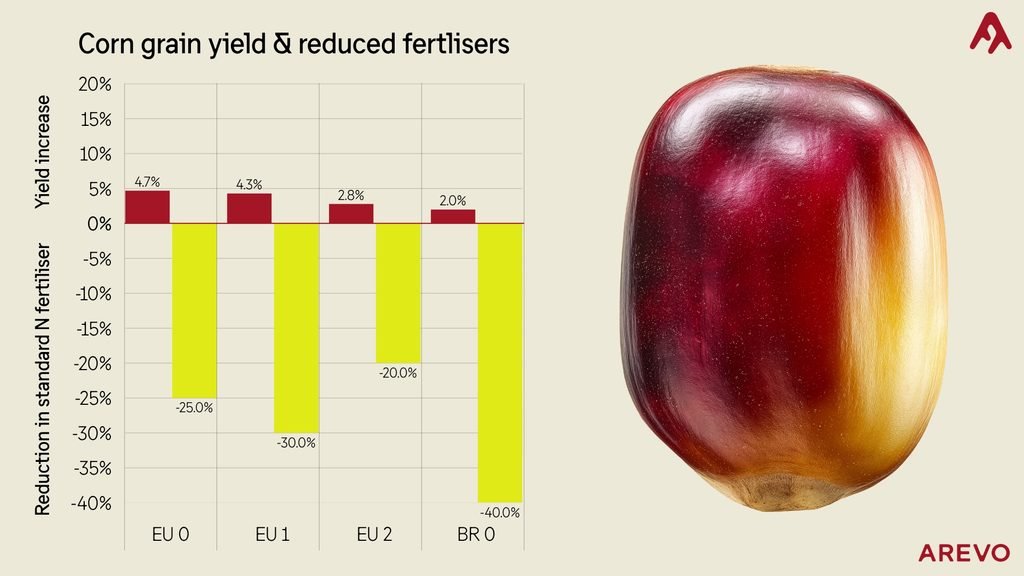
The trials covered different soil pH levels and soil textures and used replicated, multi-treatment factorial designs. Arevo said statistical analysis was used to assess the treatment effects.
The company reported no negative effect on germination and said plant height increased by as much as 8% in some trials.
The findings are relevant to fertilizer-efficiency strategies as growers and input companies face pressure to maintain crop productivity while reducing nutrient use. Nitrogen is among the largest variable input costs for many corn producers, while improving nitrogen-use efficiency is also a focus of efforts to reduce nutrient losses and the environmental impact of fertilizer application.
Non-microbial seed treatment
Arginex Corn is based on arginine combined with phosphate in what Arevo describes as a stable, slow-release complex. According to the company, plants can take up the compound intact without prior mineralization.
The formulation differs from microbial seed treatments because it does not contain living organisms. Arevo said the single-compound formulation is designed to provide consistent composition between batches, while also offering long shelf life, seed stability and compatibility with conventional seed-treatment programs.
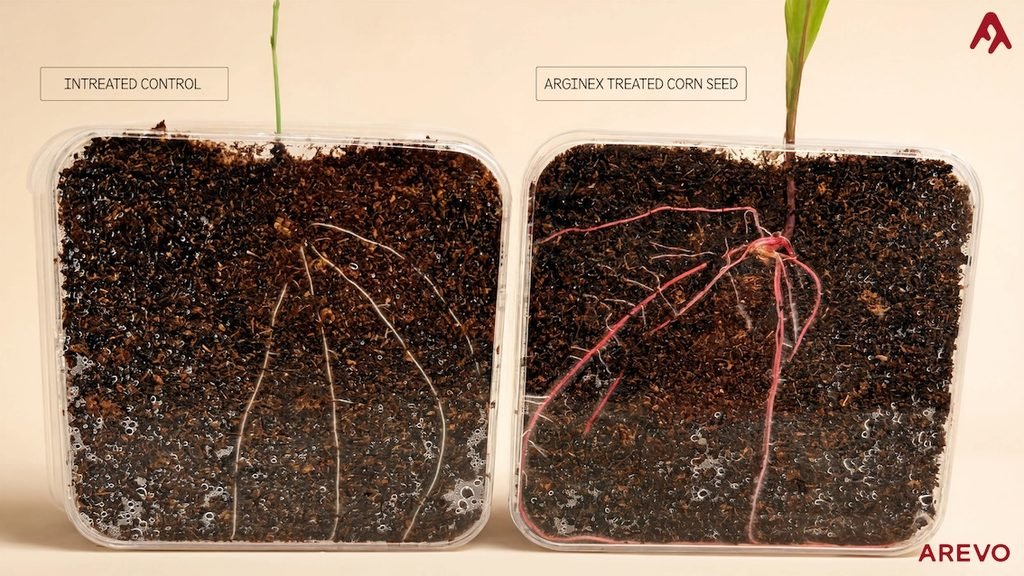
The company also says the arginine can support soil biology by attracting mycorrhizal fungi and promoting root development. These claims are part of Arevo’s explanation for the yield and plant-growth effects observed in its trials.
The company’s CEO, Niklas Åström, said the trial results indicate that the technology can improve nitrogen-use efficiency under different field conditions.
“The data show it consistently improves yield and nitrogen use efficiency — more crop per unit of nitrogen, season after season,” Åström said.
Arevo linked the results to growing concerns over weather variability, including heatwaves, droughts, heavy rainfall and flooding affecting agricultural production in Europe and South America. The company said its trials were designed across multiple environments rather than under a single set of growing conditions.
Arevo targets seed-treatment partnerships
Arevo is seeking commercial partners for corn products and for upcoming wheat seed-coating products. The company plans to present the full set of trial results at the Euroseeds Congress 2026 in Valencia, Spain, on Oct. 25–28.
The company said its Arginex technology is protected by more than 70 patents and has received CE marking. Arevo is developing the technology for applications in agriculture, forestry and horticulture, with the stated goal of reducing reliance on synthetic fertilizers and improving nutrient and water uptake.
The latest results are based on company-reported trials, and the full methodology, individual site data and statistical results are expected to provide additional context when Arevo presents the complete dataset at the Euroseeds Congress.

Enjoyed this story?
Every Monday, our subscribers get their hands on a digest of the most trending agriculture news. You can join them too!





Discussion0 comments