

Nitricity’s California fertilizer plant advances amid organic status dispute

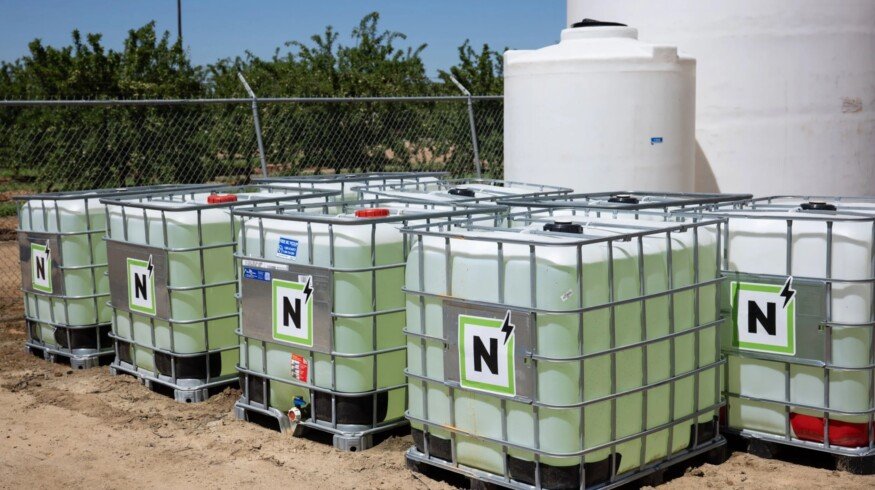

Nitricity is moving ahead with its first commercial-scale fertilizer facility in Delhi, California, while the regulatory status of its flagship Ash Tea fertilizer has become a more important part of the company’s story in 2026.
The California startup raised $50 million in Series B funding in September 2025 to expand production of its plant-based nitrogen fertilizer made from almond shells, air, water and clean energy. Days later, the company broke ground on its Delhi facility, which Nitricity says is designed to increase production capacity roughly 100-fold compared with its pilot operation.
Since then, the project has moved from a fundraising story toward a broader question of commercial scale-up, field performance and regulatory classification in California.
Nitricity’s Delhi fertilizer project
The facility is located in Delhi in Merced County, one of California’s major agricultural regions. Nitricity plans to use recycled almond shells and an electrified production process to manufacture liquid nitrogen fertilizer for growers.
Official project documents from the California Alternative Energy and Advanced Transportation Financing Authority describe the site as a new almond-shell fertilizer production facility and list $8.7 million in qualifying equipment for the project.
| Project detail | Current information |
|---|---|
| Location | Delhi, Merced County, California |
| Primary product | Ash Tea liquid nitrogen fertilizer |
| Main feedstock | Recycled almond shells |
| Qualified project equipment | $8.7 million |
| Estimated California sales tax exclusion | $737,760 |
| Federal 48C tax credit awarded | $2.5 million |
| Planned scale increase | Approximately 100x versus pilot production |
| Original commercial schedule | 2026 |
The California financing authority said Nitricity’s original project schedule called for construction during the second half of 2025, commissioning around the end of 2025 and early 2026, and an operational ramp-up during the first half of 2026.
Nitricity said at the time of the groundbreaking that the plant’s planned output had already been committed through 2028 under binding offtake agreements with organic growers in Central California.
However, Nitricity has not publicly confirmed on its main news page that the Delhi facility has reached full commercial operation. The distinction is important because the project was originally scheduled to enter service during 2026, but construction schedules for first-of-a-kind industrial facilities can change.
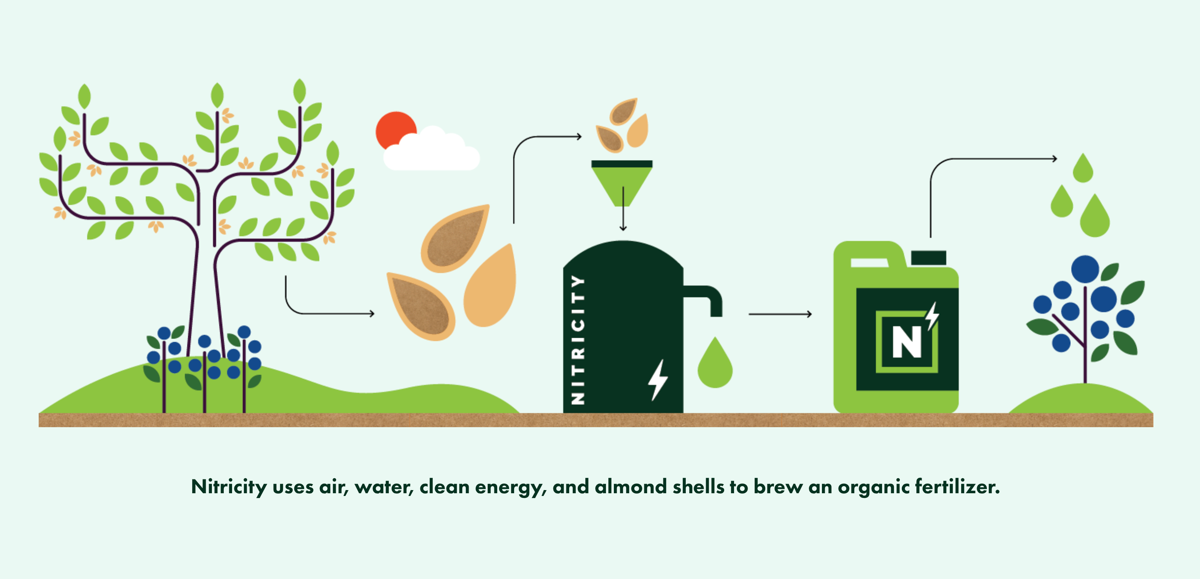
How Nitricity makes fertilizer from almond shells
Nitricity’s process uses agricultural waste that is already widely available in California’s almond-producing regions.
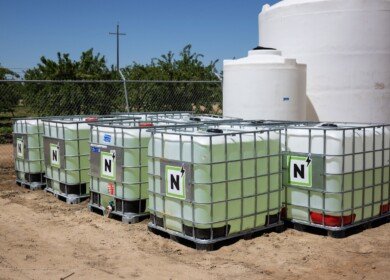
According to the California project assessment, the company processes almond shells at high temperature and captures nutrients in water to produce an irrigable fertilizer. The resulting products include Ash Tea and Calcium-Fortified Ash Tea, which contain approximately 2.9% to 3% nitrogen.
The basic production model combines:
- recycled almond shells;
- air;
- water;
- electricity;
- nutrient recovery from processed biomass.
The company positions the process as an alternative to conventional nitrogen fertilizer production and to some organic fertilizers derived from animal byproducts.
California project documents state that Nitricity estimates its process can produce fertilizer with a 70% to 80% lower carbon footprint than traditional nitrogen fertilizers. Nitricity has separately published higher emissions-reduction estimates for some product comparisons, so the figures depend on the baseline and methodology used.
A regulatory dispute has emerged over Ash Tea’s organic status
The most significant change since Fertilizer Daily’s original 2025 coverage is the regulatory dispute involving Nitricity’s Organic Input Material registration in California.
On its current product page, Nitricity states that the provisional Organic Input Material registration issued by the California Department of Food and Agriculture remains in effect pursuant to a court-ordered preliminary injunction.
The company also discloses that the California Department of Food and Agriculture has determined that the fertilizing material contains a prohibited synthetic form of nitrogen and therefore does not currently comply with National Organic Program standards for organic crop production.
Nitricity disputes that determination and says the matter remains subject to ongoing litigation.
| Issue | Current position |
|---|---|
| California OIM registration | Provisional registration remains in effect under a preliminary injunction |
| CDFA position | Product contains a prohibited synthetic form of nitrogen |
| Nitricity position | Company disputes CDFA’s determination |
| Legal status | Ongoing litigation |
The dispute is commercially important because Nitricity’s growth strategy is closely connected to organic agriculture, particularly high-value specialty crops in California.
The CDFA Organic Input Material Program is responsible for registering fertilizer materials marketed for use in organic crop production in California and verifying compliance with state fertilizer rules and USDA National Organic Program requirements.
CDFA’s current published list of registered Organic Input Materials continues to include both Nitricity’s Ash Tea 2.9-0-0 Liquid Fertilizer and Nitricity’s Calcium-Fortified Ash Tea 2.9-0-0 Liquid Fertilizer. The company’s disclosure makes clear, however, that the California registration currently remains in force because of the preliminary injunction.
Why the regulatory issue matters
The distinction between an organic fertilizer and a fertilizer approved for use in certified organic production can have major commercial consequences.
For Nitricity, the key issues include:
- whether Ash Tea can continue to be marketed for organic production in California;
- whether the product’s manufacturing process meets National Organic Program requirements;
- how a final regulatory or court decision could affect existing growers and supply agreements;
- whether similar classification questions emerge in other U.S. states;
- how the dispute affects commercialization of the new Delhi facility.
The preliminary injunction means the dispute has not yet resulted in the immediate loss of the California registration, but the final outcome remains relevant to customers planning long-term organic fertilizer programs.
Field trials continued in California during 2026
At the same time that Nitricity is scaling manufacturing, the company has continued publishing results from commercial field trials in California.
In a 2026 cilantro trial in Hollister, Nitricity reported that a treatment using Calcium-Fortified Ash Tea achieved a yield of 10,887 pounds per acre, compared with 10,500 pounds per acre under the grower’s standard organic fertilizer program.
The Nitricity treatment received 24% less total nitrogen than the standard treatment, according to the company’s field-trial report.
| Cilantro trial indicator | Nitricity treatment | Grower standard |
|---|---|---|
| Yield | 10,887 lb/acre | 10,500 lb/acre |
| Relative yield difference | About +3% | Baseline |
| Total nitrogen applied | 24% less | Baseline |
| Application method | Sprinkler fertigation | Conventional organic program |
These results were reported by Nitricity rather than by an independent peer-reviewed research program, so they should be interpreted as company field-trial data rather than definitive evidence of performance across all crops and growing conditions.
The company also reported 2026 trials involving lettuce and other specialty crops in California, including sites growing celery, raspberries and leafy greens.
California is an important test market for alternative nitrogen fertilizers
The Delhi project is strategically located because California combines a large specialty-crop sector with significant organic acreage and a major almond-processing industry.
That creates both sides of Nitricity’s business model in the same region:
- almond processing produces biomass that can be used as feedstock;
- specialty-crop growers create demand for liquid fertilizer;
- irrigation infrastructure allows fertilizer to be delivered through fertigation systems;
- organic growers typically pay more for approved nitrogen sources than conventional growers;
- local production can reduce dependence on long-distance fertilizer supply chains.
California regulators are also putting continued emphasis on nitrogen-use efficiency and nutrient-loss reduction. The California Department of Food and Agriculture’s Fertilizer Research and Education Program supports research into nutrient management, organic inputs and strategies to reduce nitrogen losses from agricultural systems.
The project has received state and federal support
Nitricity’s scale-up is supported not only by private capital but also by public incentives.
The California financing authority approved the company to purchase up to $8.7 million in qualifying manufacturing equipment under the state’s Sales and Use Tax Exclusion Program, with an estimated tax benefit of approximately $737,760.
The same state review states that Nitricity received a $2.5 million federal 48C tax credit, which becomes available after the project is built and certified.
| Funding / support | Amount |
|---|---|
| Series B equity financing | $50 million |
| FOAK project funding announced in 2025 | $10 million |
| California qualifying equipment | $8.7 million |
| Estimated California sales tax benefit | $737,760 |
| Federal 48C tax credit | $2.5 million |
The $50 million Series B was co-led by World Fund and Khosla Ventures, with additional participation from investors including Chipotle’s Cultivate Next fund, Energy Impact Partners and other climate-focused investors.
How the story has changed since 2025
Fertilizer Daily’s original September 2025 report focused primarily on Nitricity’s $50 million funding round and its plan to scale production in California.
One year later, the investment remains important, but the story has developed in several directions.
| September 2025 | 2026 update |
|---|---|
| $50 million Series B announced | Scale-up project remains central to commercialization |
| Delhi plant preparing for groundbreaking | Groundbreaking completed and project moved into construction phase |
| Commercial production planned for 2026 | Original schedule targeted service during 2026 |
| Ash Tea marketed for organic agriculture | California organic-input status is now subject to an active regulatory dispute |
| Early field-trial claims | Additional commercial field trials reported during 2026 |
What to watch next
The next stage of Nitricity’s development will depend on more than simply completing a fertilizer plant.
The main issues to follow are:
- confirmation that the Delhi facility has entered full commercial operation;
- commercial production volumes and plant utilization;
- the outcome of Nitricity’s dispute with CDFA;
- whether California Organic Input Material registration remains in place;
- performance of Ash Tea across additional commercial crops;
- whether long-term offtake agreements translate into repeat commercial demand;
- expansion of the production model beyond California.
What this means for the U.S. fertilizer market
Nitricity is an example of a broader trend toward smaller, distributed fertilizer production systems that use electricity and locally available raw materials instead of relying entirely on conventional large-scale nitrogen manufacturing.
The model could be particularly relevant for specialty and organic agriculture, where growers often need liquid, immediately available nitrogen sources and may be willing to pay more for products that meet organic-production standards.
At the same time, Nitricity’s regulatory dispute illustrates that lower-emission production alone does not determine whether a fertilizer qualifies for certified organic agriculture. The chemical form of nutrients and the production process remain critical regulatory questions.
For that reason, the company’s next phase will be defined by two parallel tests: whether the Delhi plant can operate economically at commercial scale, and whether Ash Tea ultimately retains the regulatory status needed to serve the organic market that has been central to Nitricity’s growth strategy.
Sources: Nitricity, CDFA, California State Treasurer, Merced County

Enjoyed this story?
Every Monday, our subscribers get their hands on a digest of the most trending agriculture news. You can join them too!





Discussion0 comments