

Sulfur Above $1,000/t Keeps Mosaic Phosphate Plants Curtailed Ahead of Q3 Results

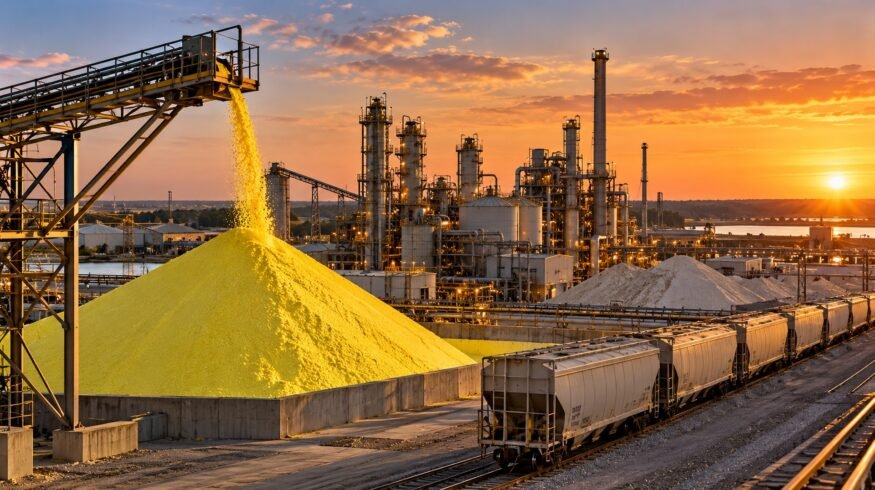

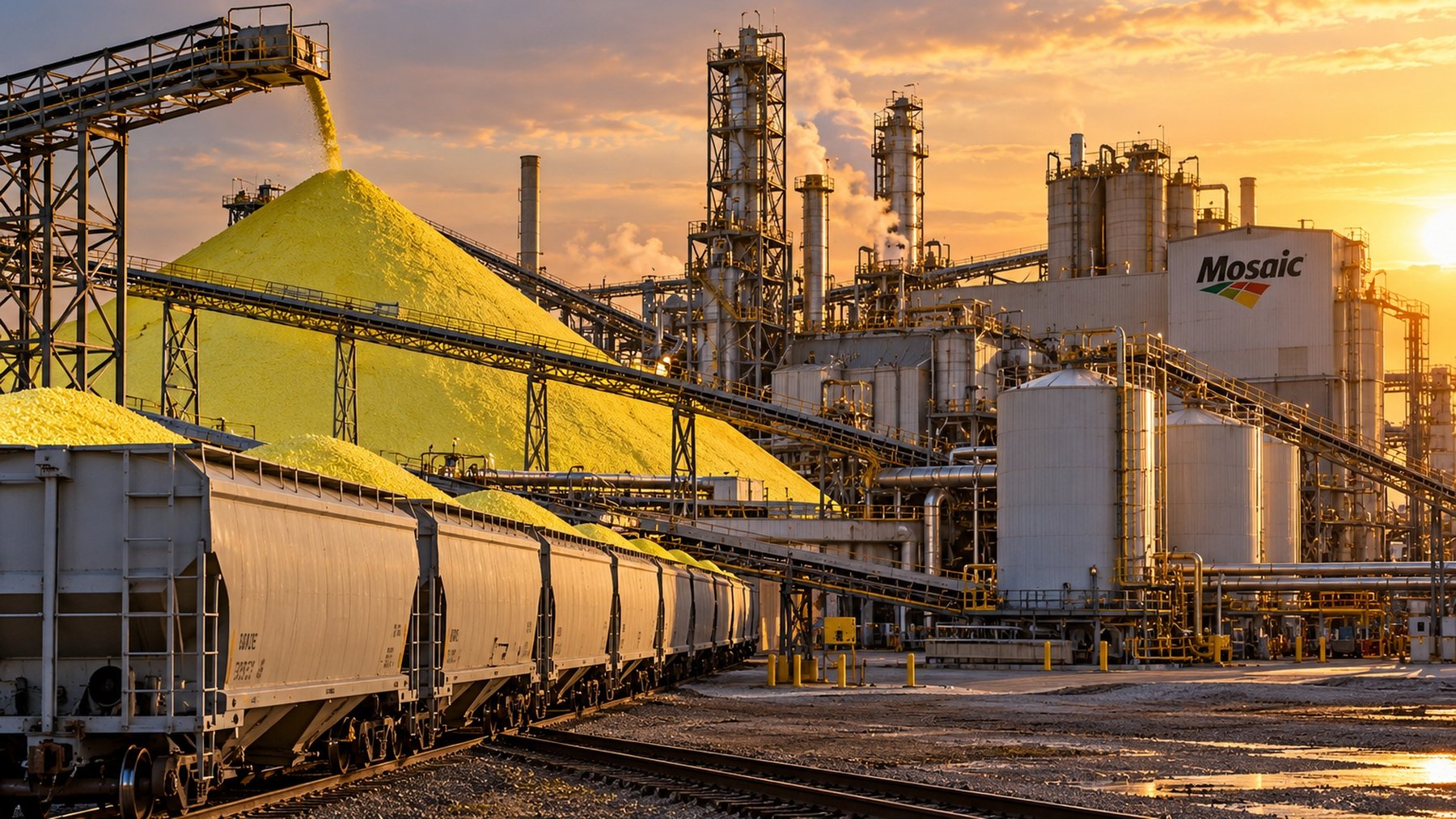
Mosaic is keeping part of its U.S. phosphate production system idled or operating below normal rates as exceptionally high sulfur costs continue to pressure the economics of MAP and DAP manufacturing.
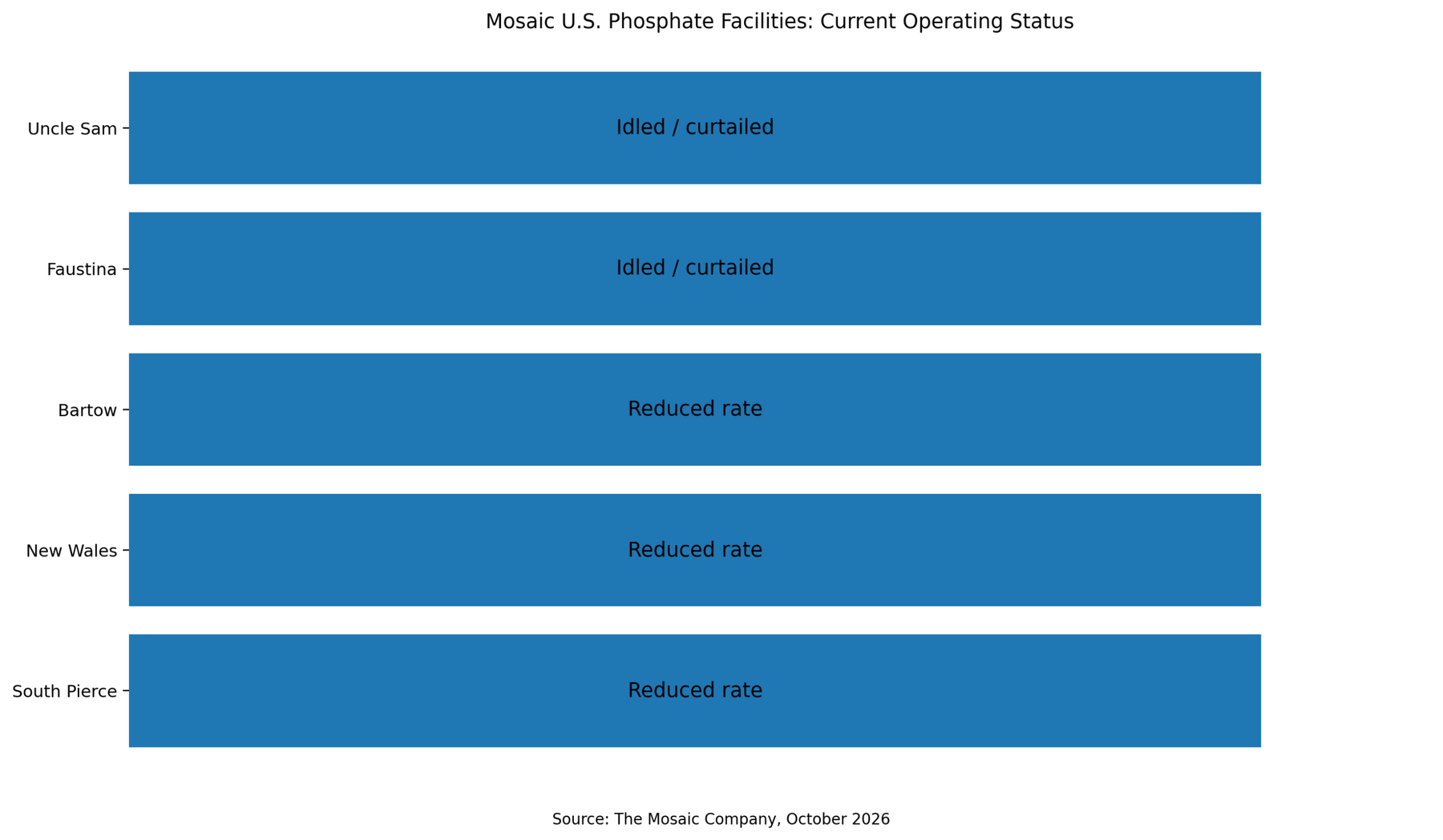
The company currently lists its Uncle Sam and Faustina phosphate facilities in Louisiana as temporarily idled or curtailed, while Bartow, New Wales and South Pierce in Florida are operating at reduced production rates.
The production cuts come as sulfur, one of the critical raw materials used to manufacture phosphate fertilizer, has traded at historically elevated levels during 2026. Global spot prices exceeded $1,000 per metric ton during the year, with industry representatives reporting peaks near $1,300 per ton.
The situation has become increasingly important for U.S. farmers because reduced domestic phosphate production could keep MAP and DAP supplies tight heading toward the 2027 planting season even if weak crop economics limit fertilizer demand.
Mosaic confirms multiple U.S. phosphate production cuts
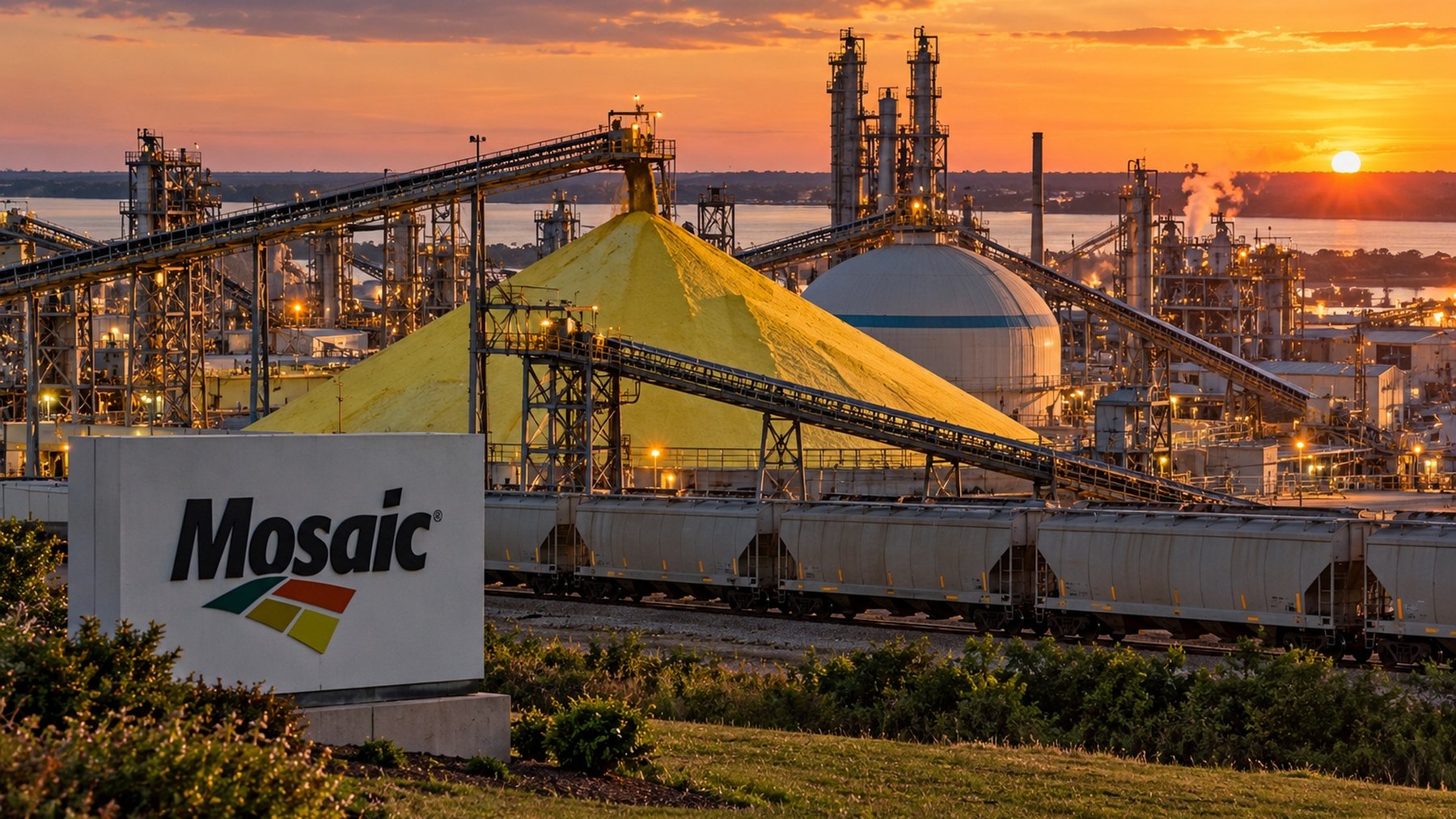
Mosaic says sulfur availability and affordability have forced temporary operating changes across its phosphate business.
| Facility | Location | Current status |
|---|---|---|
| Uncle Sam | Louisiana | Temporarily idled or curtailed |
| Faustina | Louisiana | Temporarily idled or curtailed |
| Bartow | Florida | Operating at reduced rate |
| New Wales | Florida | Operating at reduced rate |
| South Pierce | Florida | Operating at reduced rate |
Mosaic says employees at the Louisiana facilities have been furloughed with notice of dismissal, while only an idle crew and staff associated with the River Sulfur and Ammonia Plant remain.
The company says the production changes are temporary responses to extraordinary raw-material conditions rather than a change in its long-term phosphate strategy.
“Mosaic is navigating an unexpected challenge related to the availability and affordability of sulfur.”
— The Mosaic Company
Why sulfur matters so much for MAP and DAP
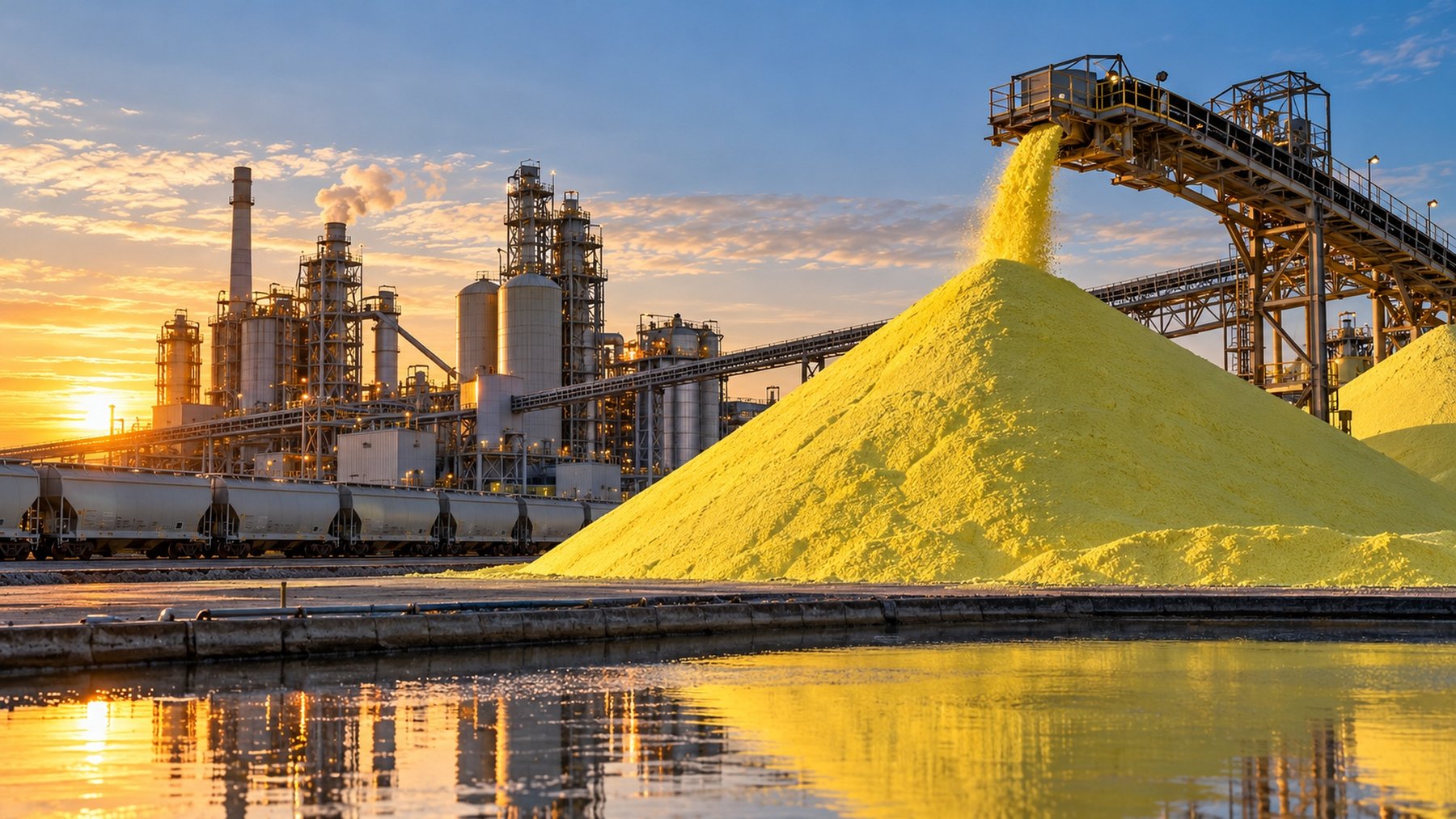
Sulfur is not simply an optional nutrient used in fertilizer blends.
For the phosphate industry, sulfur is a major industrial feedstock.
Most phosphate fertilizer production begins with phosphate rock. The rock must be chemically processed to make phosphorus available in concentrated fertilizer products.
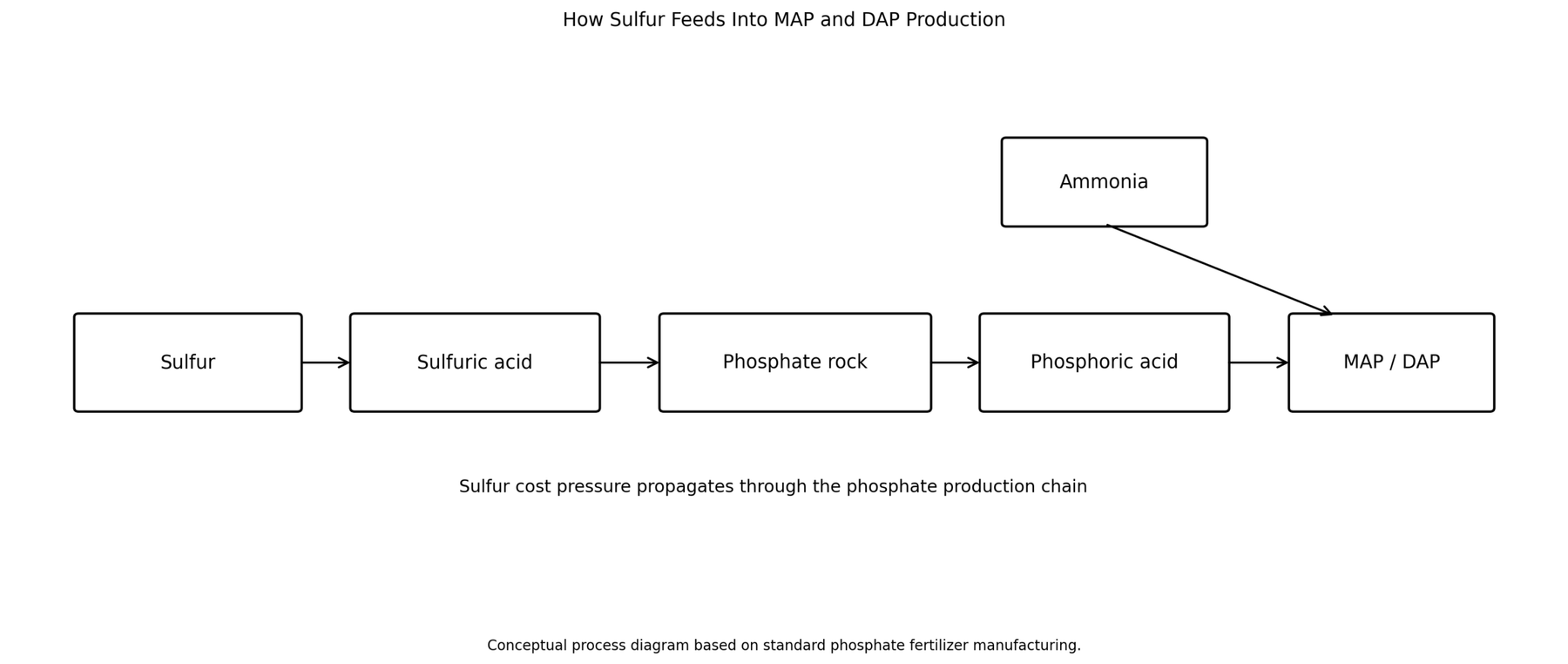
The basic manufacturing chain is:
Sulfur → sulfuric acid → phosphate rock processing → phosphoric acid → MAP and DAP
Sulfuric acid reacts with phosphate rock to produce phosphoric acid, which is then combined with ammonia to manufacture monoammonium phosphate, or MAP, and diammonium phosphate, or DAP.
That means a large increase in sulfur cost flows directly into the production cost of phosphate fertilizer.
About 60% of sulfuric acid is used in phosphate fertilizer production
The Fertilizer Institute estimates that roughly 90% of global sulfur is converted into sulfuric acid.
Approximately 60% of that sulfuric acid is then used in phosphate fertilizer manufacturing.
This makes phosphate producers one of the world’s largest industrial consumers of sulfur.
Unlike phosphate rock, however, sulfur supply is closely linked to the oil and natural-gas industry because most elemental sulfur is recovered as a byproduct during hydrocarbon processing.
The Strait of Hormuz became a major sulfur bottleneck
Middle Eastern supply disruptions have played a major role in the 2026 sulfur shock.
The Fertilizer Institute estimates that countries highly exposed to Strait of Hormuz disruption accounted for approximately 41% of global sulfur exports in 2025.
Iran contributed another 4%, while additional countries considered at risk accounted for roughly 1%.
Taken together, almost half of internationally traded sulfur was linked to countries exposed to disruption around the Strait of Hormuz.
That concentration created an immediate vulnerability when shipping and hydrocarbon production in the region were disrupted.
Sulfur prices climbed from around $280 to above $1,000
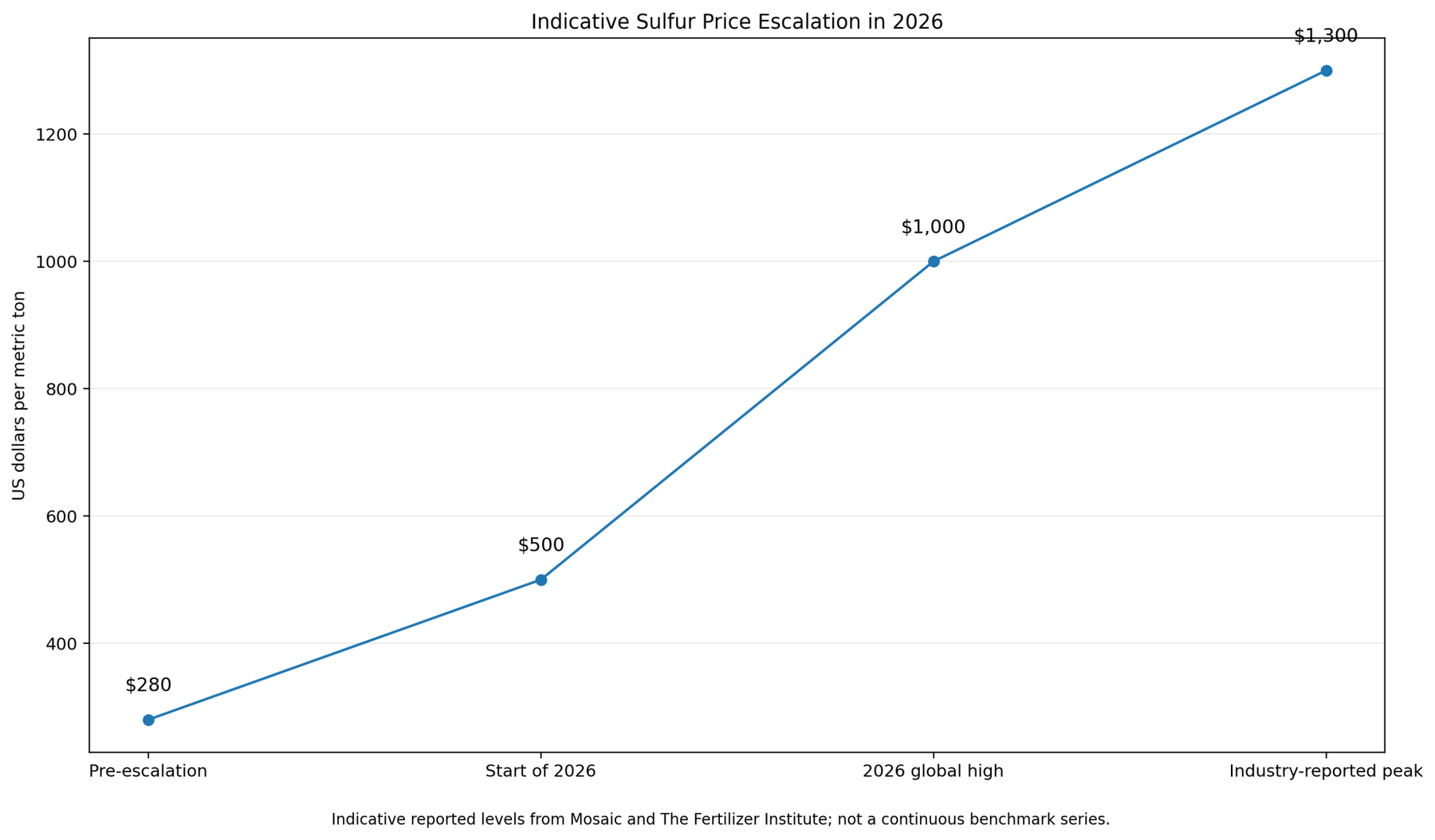
Mosaic says U.S. sulfur prices were already around $280 per metric ton before the latest escalation in geopolitical disruption.
At the beginning of 2026, the company was seeing sulfur prices around $500 per ton.
During the Middle East disruption, sulfur prices moved above $1,000 per ton in global markets.
Industry representatives have reported temporary peaks close to $1,300 per metric ton.
That represents a several-fold increase in one of the largest variable inputs used to manufacture phosphate fertilizer.
At $1,300 sulfur, MAP and DAP economics become difficult
Corey Rosenbusch, President and CEO of The Fertilizer Institute, has described the situation as primarily a production-cost problem.
“It doesn’t make sense for $1,300 sulfur to make MAP and DAP at $700.”
— Corey Rosenbusch, President and CEO, The Fertilizer Institute
The comment illustrates the problem facing phosphate producers.
If the raw materials required to manufacture a ton of phosphate fertilizer rise faster than the fertilizer’s selling price, producers can reach the point where reducing output is economically preferable to operating at full capacity.
The industry says this is not simply a physical sulfur shortage
Rosenbusch has also cautioned against describing the current situation only as a lack of sulfur.
“This is not a supply issue. It is a cost of production issue.”
— Corey Rosenbusch, The Fertilizer Institute
There is still sulfur available in the global market.
The problem is that competition for available material, disrupted trade routes, high freight and insurance costs and reduced output from key hydrocarbon-producing regions have pushed the delivered cost to levels that can make phosphate production uneconomic.
Mosaic says sulfur and ammonia are both squeezing phosphate margins
Sulfur is not the company’s only expensive raw material.
Ammonia is also required to produce MAP and DAP.
Mosaic says ammonia prices have increased significantly and remain linked to the global nitrogen market.
This creates a double cost exposure for phosphate producers:
- higher sulfur costs;
- higher ammonia costs;
- high freight and logistics costs;
- reduced farmer affordability;
- difficulty passing all production costs through to fertilizer prices.
Nutrien’s phosphate business shows how severe the margin squeeze became
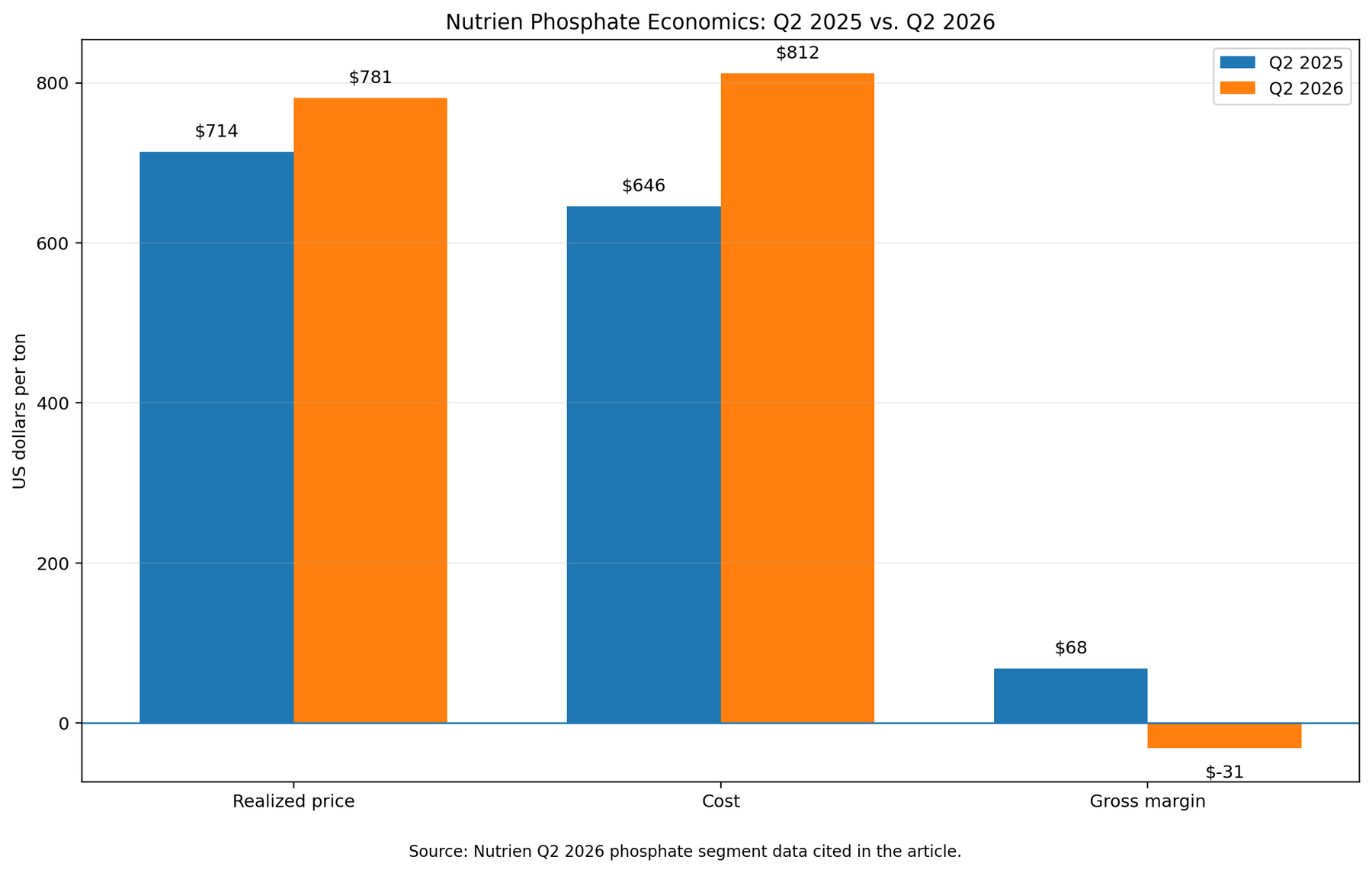
The pressure is visible beyond Mosaic.
Nutrien reported that its average realized price for fertilizer, industrial and feed phosphate products was approximately $781 per ton during the second quarter of 2026, up from $714 a year earlier.
However, costs increased much faster.
Average phosphate cost reached approximately $812 per ton compared with $646 per ton in the same period of 2025.
| Nutrien phosphate metric | Q2 2025 | Q2 2026 |
|---|---|---|
| Average realized price | $714/t | $781/t |
| Average cost | $646/t | $812/t |
| Approx. gross margin | +$68/t | −$31/t |
The figures demonstrate why high phosphate selling prices do not automatically mean strong profitability for producers.
Higher fertilizer prices can coexist with producer losses
This is one of the unusual features of the current phosphate market.
Farmers see MAP and DAP prices that remain historically expensive.
At the same time, producers can lose money manufacturing those products because raw-material costs have increased even faster.
That creates an economic environment where reducing output can support producer economics but also risks tightening supply further.
Production cuts can create their own price floor
Normally, weak farmer demand should place downward pressure on phosphate fertilizer prices.
But when producers respond to weak margins by cutting production, supply also falls.
That can prevent MAP and DAP prices from falling as quickly as farm economics would otherwise suggest.
This dynamic is one reason analysts remain divided over the phosphate price outlook.
Analysts disagree on where phosphate prices go next
Some analysts expect phosphate prices to weaken as farmers reduce purchases and global demand slows.
Others argue that high sulfur costs and continued production curtailments will maintain a price floor.
Josh Linville, vice president of fertilizer at StoneX, recently argued that phosphate prices are unlikely to fall dramatically while traffic through the Strait of Hormuz remains constrained.
His view is that lower prices would simply trigger additional producer curtailments if manufacturing economics remain unattractive.
China is another major uncertainty
China remains one of the most important variables in the global phosphate market.
The country is one of the world’s largest producers of phosphate fertilizer, but exports of MAP and DAP have remained tightly controlled.
A meaningful return of Chinese phosphate exports could increase global supply and pressure prices lower.
However, analysts currently disagree over when China will return to the international phosphate market at scale.
Some forecasts point to 2027, while others expect China to prioritize rebuilding domestic fertilizer inventories first.
Morocco could gain importance as U.S. phosphate production falls
Morocco is another potential source of additional phosphate fertilizer for the U.S. market.
The United States temporarily suspended certain countervailing duties on Moroccan phosphate fertilizer earlier in 2026.
That policy potentially increases the economic attractiveness of Moroccan imports.
However, Morocco is not isolated from the sulfur problem.
Its enormous phosphate rock resources still require sulfuric acid for conversion into phosphoric acid and finished phosphate fertilizers.
High sulfur prices therefore affect both domestic U.S. producers and many international competitors.
TSP is becoming more attractive in some markets
The sulfur shock is also changing the mix of phosphate fertilizer products used globally.
Triple superphosphate, or TSP, has gained market share in several countries as buyers seek alternatives to MAP and DAP.
TSP contains phosphorus but does not contain nitrogen.
Its manufacturing economics differ from ammoniated phosphates, making it an increasingly important alternative in markets where MAP prices have become difficult to justify.
Brazil, Bangladesh and India have been among the major markets increasing interest in TSP.
Brazilian MAP imports have fallen sharply
Brazil is one of the world’s largest phosphate fertilizer import markets.
High MAP prices have pushed Brazilian buyers toward lower-cost phosphate alternatives.
Industry reports indicate that Brazil’s MAP imports during 2026 are running at their lowest level in roughly a decade.
That decline illustrates how high raw-material costs can eventually change fertilizer product choice rather than simply reduce total nutrient demand.
Mosaic has also curtailed production in Brazil
The sulfur problem is not limited to Mosaic’s U.S. operations.
The company currently lists several Brazilian operations as idled, curtailed or operating at reduced production rates.
| Brazil facility | Status |
|---|---|
| Tapira | Temporarily idled or curtailed |
| Catalão | Temporarily idled or curtailed |
| Uberaba | Reduced production rate |
| Palmeirante | Reduced production rate |
| Sorriso | Reduced production rate |
| Fospar | Reduced production rate |
| Candeias blending unit | Temporarily curtailed |
| Catalão blending unit | Temporarily curtailed |
The geographic spread shows that the sulfur shock has become a global phosphate-production issue rather than a problem confined to one U.S. plant.
Mosaic has previously idled Brazilian phosphate assets
Mosaic began responding to sulfur economics before the latest U.S. curtailments.
In December 2025, the company announced that it would idle single superphosphate production at its Fospar and Araxá facilities in Brazil following a sharp increase in sulfur prices.
The curtailments were extended in January 2026.
Mosaic later announced additional restructuring and idling of Brazilian assets as it sought to improve returns and capital allocation.
Global phosphate output could decline significantly
Mosaic CEO Bruce Bodine has warned that global phosphate production could decline substantially as high sulfur costs force producers to reduce operating rates.
Industry estimates cited during 2026 suggested that global phosphate production could fall by as much as 30 million metric tons compared with previous expectations if unfavorable sulfur economics persist.
That figure is an industry estimate rather than confirmed lost production.
The actual reduction will depend on sulfur prices, shipping conditions, demand and how quickly curtailed plants resume operations.
Mosaic still wants an 8-million-ton U.S. phosphate run rate
The current curtailments do not mean Mosaic is abandoning its U.S. phosphate business.
The company’s 2026 strategic priorities include achieving and maintaining an approximately 8-million-ton run rate in U.S. phosphate production.
This highlights the temporary nature of the current operating cuts.
Mosaic’s challenge is to restore production once sulfur economics allow facilities to operate competitively.
Mosaic says it is pursuing alternative sulfur sources
The company says it is actively pursuing alternative sulfur sourcing options.
It is also working with government agencies and other stakeholders to address supply-chain constraints.
However, new sulfur supply routes cannot necessarily replace Middle Eastern trade immediately.
Shipping availability, refinery output, contracts, port infrastructure and freight economics all influence how quickly alternative supply can reach phosphate plants.
Why sulfur supply cannot simply be increased overnight
Most sulfur is not mined specifically because fertilizer companies need more sulfur.
It is recovered as a byproduct from oil and natural gas processing.
This creates a structural constraint.
Higher sulfur prices do not necessarily generate a rapid production response in the same way higher prices can encourage production of a directly mined commodity.
Additional sulfur supply depends partly on activity and operating conditions in the petroleum industry.
Russia is another complicating factor
Russia has historically been an important supplier of sulfur and sulfuric acid.
Export restrictions and disruptions affecting Russian hydrocarbon infrastructure have reduced another potential source of material for global phosphate producers.
This means the market is dealing simultaneously with problems in several major sulfur-producing regions.
Why this matters to U.S. farmers
Phosphorus is one of the three primary macronutrients required for crop production.
Unlike nitrogen, farmers cannot manufacture an alternative source from atmospheric nitrogen through industrial ammonia production.
Phosphorus ultimately comes from phosphate rock or recycled nutrient streams.
When phosphate fertilizer production declines, farmers face fewer alternatives for replacing phosphorus removed during harvest.
Farmers can postpone phosphorus applications, but only for so long
Fields with high soil-test phosphorus can sometimes go one or more seasons without additional phosphate fertilizer.
That gives farmers some flexibility during periods of high prices.
However, grain harvest continuously removes phosphorus from the soil.
Eventually, soil-test levels decline toward the point where yield response to fertilizer becomes increasingly likely.
Fertilizer Daily recently examined long-term phosphorus management research showing why high-testing soils can sometimes defer applications while low-testing soils still require fertilizer.
Weak corn prices complicate the phosphate market further
High phosphate costs are arriving during a difficult period for crop economics.
Lower corn prices reduce farmers’ ability to absorb elevated MAP and DAP prices.
This can reduce application rates and fertilizer demand.
But if producers simultaneously cut output because margins are weak, the expected reduction in fertilizer prices may be limited.
The result is a difficult equilibrium
The phosphate market is therefore caught between two opposing forces.
Demand pressure: weak crop economics encourage farmers to cut fertilizer purchases.
Supply pressure: high sulfur and ammonia costs encourage producers to reduce phosphate output.
The balance between these two forces will determine MAP and DAP prices heading into 2027.
U.S. fertilizer policy is increasingly focused on domestic supply
The production cuts also arrive as Washington is attempting to strengthen domestic fertilizer manufacturing.
USDA recently selected eight fertilizer projects representing approximately $1.34 billion in proposed investment and around $573 million in federal support.
The projects are expected to support approximately 1.08 million tons of annual fertilizer production or capacity if completed.
Fertilizer Daily has analyzed the eight USDA-supported fertilizer projects and their expected production capacity.
New U.S. capacity cannot solve the sulfur problem by itself
More domestic fertilizer plants can reduce dependence on imports, but phosphate production remains dependent on globally traded raw materials.
A U.S. phosphate plant still needs sulfur or sulfuric acid.
That means domestic manufacturing capacity alone cannot fully insulate farmers from international sulfur-market disruptions.
The same principle applies to ammonia and other globally traded fertilizer inputs.
Mosaic’s next earnings report could provide new detail
Mosaic is scheduled to release third-quarter 2026 financial results on November 3, followed by a conference call on November 4.
The report will provide the next major opportunity for investors and fertilizer buyers to assess:
- phosphate production volumes;
- sulfur costs;
- operating rates;
- phosphate margins;
- inventory levels;
- expected production recovery;
- 2027 market expectations.
The company’s guidance on sulfur sourcing and the duration of production curtailments will be particularly important.
What could bring phosphate production back?
Several developments could improve the economics of phosphate manufacturing.
- lower sulfur prices;
- improved shipping through the Strait of Hormuz;
- higher MAP and DAP prices;
- additional sulfur supply from alternative producers;
- lower ammonia costs;
- reduced freight and insurance costs;
- improved operating efficiencies.
A meaningful normalization of sulfur trade would probably have the largest immediate impact.
What could make the problem worse?
The market could tighten further if:
- Middle Eastern sulfur exports remain constrained;
- Russia maintains export restrictions;
- additional phosphate plants are curtailed;
- China keeps MAP and DAP exports restricted;
- U.S. spring demand recovers strongly;
- farmers rebuild phosphorus applications after delaying purchases.
Frequently asked questions
Mosaic says exceptionally high sulfur costs and limited sulfur availability have made phosphate production more difficult economically. Sulfur is required to manufacture sulfuric acid, which is used to process phosphate rock.
Mosaic currently lists Uncle Sam and Faustina in Louisiana as temporarily idled or curtailed. Bartow, New Wales and South Pierce in Florida are operating at reduced rates.
Global sulfur prices exceeded $1,000 per metric ton during 2026, while industry representatives reported peaks near $1,300 per ton.
Sulfur is converted into sulfuric acid, which is used to process phosphate rock into phosphoric acid. Phosphoric acid is then combined with ammonia to manufacture MAP and DAP.
Not necessarily. Raw-material costs have increased sharply. Nutrien’s second-quarter phosphate data showed average costs exceeding average realized prices, resulting in a negative gross margin per ton.
Yes, particularly if sulfur prices fall, Chinese exports return or farmer demand weakens. However, continued production cuts could limit how far prices decline.
Mosaic plans to release third-quarter 2026 results on November 3 and hold its earnings call on November 4.
Sources: The Mosaic Company, The Mosaic Company, The Fertilizer Institute, AgWeb, The Western Producer

Enjoyed this story?
Every Monday, our subscribers get their hands on a digest of the most trending agriculture news. You can join them too!







Discussion0 comments