Skip to content
  • Professionals
  • Gardeners
 
Search
Log in
EN
RU
  • Trade & Policy
  • Markets
  • AgTech & Research
  • Corporate
  • Sustainability
  • Interviews
  • Rankings
  • Events
  • Stock Quotes
  • Business Directory
Trending topic:

El Niño

Featured company:
 
RU
  • Professionals
  • Gardeners
Sections
    Events
    Stock Quotes
    Business Directory
    Trending topic:

    El Niño

    Featured company:
    Follow us...
    Helpful information
    • About
    • Team
    • Advertise
    • Contacts
    • Submit a Tip
    • Privacy Policy
    • Terms of Service
    • Site Map
    Sections
      Seasonal tips
      • Spring
      • Summer
      • Autumn
      • Winter
      Trending topics
      • compost
        25
      • garlic
        2
      • lemon
        1
      • potato
        16
      Follow us...
      Helpful information
      • About
      • Team
      • Advertise
      • Contacts
      • Submit a Tip
      • Privacy Policy
      • Terms of Service
      • Site Map
      Copyright © 2014-2026 DigitalTree LLC. All rights reserved.
      We deliver content lightning-fast thanks to the managed cloud WordPress hosting with CDN.
      16+

      Home / AgTech & Research

      Understanding Fusarium graminearum’s spread through wheat

      Elena Shalashnik avatar Elena Shalashnik
      February 18, 2025, 2:00 pm
      February 18, 2025, 2:00 pm
      [esi post-views ttl=0]
      AgTech & Research
      Understanding Fusarium graminearum’s spread through wheat
      #image_title
      Save for later
      Share
      Never miss important fertilizer news

      A recent study has identified the role of deoxynivalenol (DON), a mycotoxin produced by Fusarium graminearum, in the spread of Fusarium Head Blight (FHB), a significant disease affecting wheat. The research shows that DON facilitates the fungus’s movement through plant cell walls by targeting plasmodesmata, microscopic channels that allow the fungus to spread within the plant.

      DON is known for contaminating wheat grain and posing risks to food and animal feed safety. The study, which used advanced bioimaging techniques, found that DON plays a critical role in enabling the pathogen to move through these cellular openings, which is necessary for widespread infection.

      The research team found that deleting a specific gene, TRI5, which is responsible for producing an enzyme involved in DON production, significantly limited fungal spread. This restricted the infection to the initially affected spikelet. Attempts to restore the fungus’s ability to spread by applying external DON were unsuccessful, suggesting that DON secretion is regulated within the plant and may target plasmodesmata directly.
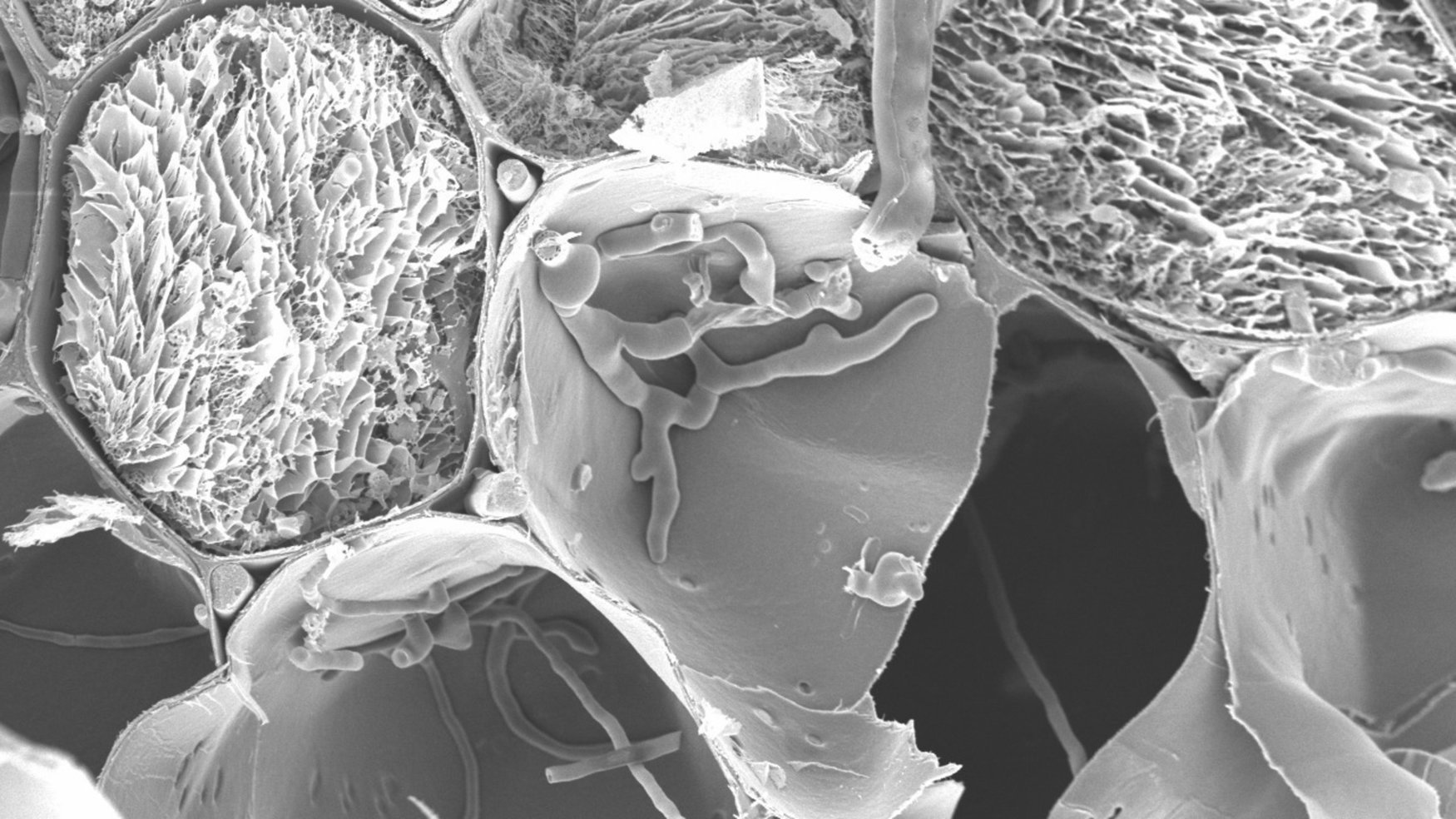
      Further analysis showed that the infection did not change the thickness of the plant’s cell walls but affected the deposition of callose, a carbohydrate that typically blocks plasmodesmata. When DON was applied externally, callose deposits increased, but fungal hyphae reduced these deposits, showing the interaction between fungal toxins and the plant’s defenses.

      Dr. Victoria Armer, the study’s lead researcher, explained, “Our research provides insights into how Fusarium graminearum spreads within the wheat spike. This could help in developing resistant crop varieties or targeted disease management strategies. With Fusarium Head Blight threatening global wheat production and food safety, understanding this process is important for protecting future harvests.”

      The study was recently awarded the Best Student Paper of 2024 by the journal Molecular Plant Pathology. Dr. Armer’s research was supported by the BBSRC-funded South-West Biosciences Doctoral Training Partnership.

      bioimaging technique
      Fusarium graminearum
      mycotoxin
      research
      resistant crop
      Rothamsted Research
      wheat

      Enjoyed this story?

      Every Monday, our subscribers get their hands on a digest of the most trending agriculture news. You can join them too!

      Sign me up
      Check the example

      Discussion0 comments

      Спасибо за комментарий, он будет опубликован на сайте после проверки модератором. Хотите, чтобы ваши комментарии появлялись на сайте мгновенно? Достаточно пройти регистрацию.
      Congratulations, you can be the first to start the conversation.
      Do you have a question or suggestion? Please leave your comment to ignite conversation.
      What’s on your mind?
      Cancel Log in and comment
      Or continue without registration
      Get notified about new comments by email.
      Advertisement
      In focus
      How to get here?
      Stock quotes
      Bayer
      14
      2.41
      Bayer Crop Science
      48.44
      1.57
      CF Industries
      127.35
      3.6
      Corteva Agriscience
      89.34
      1.29
      ICL Group
      5.1
      2.67
      Intrepid Potash
      35.46
      0.51
      Mosaic
      22.62
      1.99
      Nutrien
      70.59
      1.63
      Yara International
      23.64
      1.03
      See all
      Most read
      Mosaic cuts phosphate output at four U.S. plants as critical sulfur shortage bites
      Mosaic cuts phosphate output at four U.S. plants as critical sulfur shortage bites
      China extends phosphate export curbs through August 2026 as Russia holds fertilizer quotas
      China extends phosphate export curbs through August 2026 as Russia holds fertilizer quotas
      Koch and OCP expand 50/50 phosphate JV to 2.5 million metric tons at Jorf Lasfar
      Koch and OCP expand 50/50 phosphate JV to 2.5 million metric tons at Jorf Lasfar
      Fertilizer prices could climb 30% in 2026 as Hormuz risks bite
      Fertilizer prices could climb 30% in 2026 as Hormuz risks bite
      Green ammonia is easier to make than to sell
      Green ammonia is easier to make than to sell
      Events
      Farm Progress Show
      Boone (IA), USA
      Sep 1 — 3, 2026
      Fertilizer Canada Annual Conference
      Charlottetown, Canada
      Sep 14 — 16, 2026
      Argus Methanol & Ammonia Conference
      Houston (TX), USA
      Sep 21 — 23, 2026
      World Fertilizer Conference
      San Diego (CA), USA
      Sep 28 — 30, 2026
      Argus Fertilizer Europe
      Prague, Czechia
      Oct 20 — 22, 2026
      See all
      Live
      Trader
      July 29, 06:28 pm
      100 percent AI generated, from a company with a 100 percent AI generated website. I’m sure they have good data, but it’s hard to take it seriously wen it’s just AI church
      Green ammonia is easier to make than to sell
      Stefan Petko
      May 6, 06:48 pm
      It is alarming to see these developments in California. As a vineyard grower, I have faced significant challenges this year, with fertilizer costs rising sharply while market conditions have made it difficult to sell the harvest.
      California peach growers forced to remove 420,000 trees after bankruptcy of Del Monte Foods canneries
      Estebel
      April 23, 10:26 pm
      Sounds like magic ))
      MIT study: rice seeds germinate faster when exposed to rainfall sounds
      Isabelita Barreiro
      December 11, 2025, 01:54 am
      Excellent management of water resources and effective use of water-soluble fertilizers!
      Argentine nano-fertilizer firm AKO Agro expands to Brazil
      Meripa Corson
      August 4, 2025, 01:18 pm
      Where does the money actually go? As a timber land owner, how do I benefit from the legislation?
      USDA commits $80 million to expand timber markets and improve forest resilience
      About
      Sections
      Trade & Policy  ·  Markets  ·  AgTech & Research  ·  Corporate  ·  Sustainability  ·  Interviews  ·  Rankings
      Support
      About  ·  Team  ·  Advertise  ·  Contacts  ·  Submit a Tip  ·  Privacy Policy  ·  Terms of Service  ·  Site Map
      Copyright © 2014-2026 DigitalTree LLC. All rights reserved.
      We deliver content lightning-fast thanks to the managed cloud WordPress hosting with CDN.
      16+
      More to read
      Ecuador tests gene-editing approach to curb banana wilt
      Ecuador tests gene-editing approach to curb banana wilt
      Researchers identified twisted growth trait in plants could modify root systems for rocky, compacted or drought-prone soils
      Researchers identified twisted growth trait in plants could modify root systems for rocky, compacted or drought-prone soils
      Engineered microbial consortia show promise against soil-borne diseases
      Engineered microbial consortia show promise against soil-borne diseases
      Advertising that helps us do quality reporting