

Atmospheric Nitrogen to Ammonia: How Light-Driven Nanocrystals Could Change Fertilizer Production

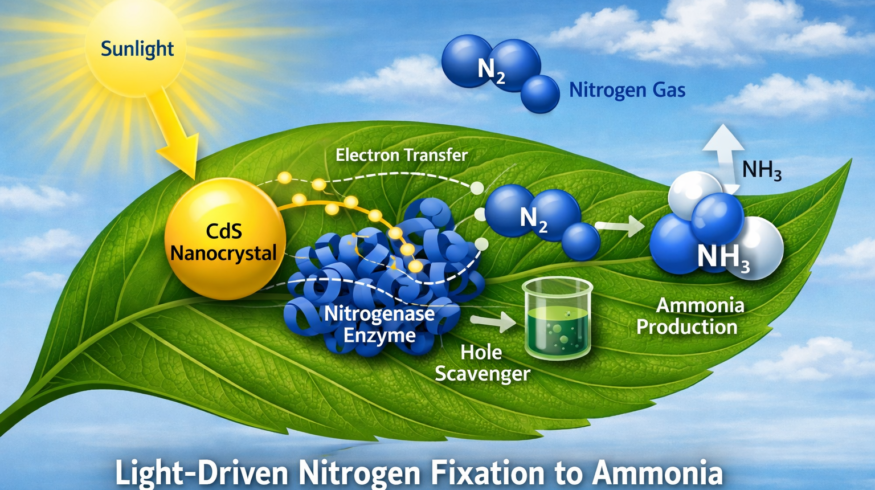

Atmospheric nitrogen makes up most of the air around us, yet plants cannot directly use molecular nitrogen gas, or N2, as a nutrient. Converting that extremely stable molecule into reactive nitrogen compounds such as ammonia is therefore one of the fundamental steps behind modern fertilizer production.
Today, industrial ammonia is produced primarily through the Haber-Bosch process, which combines nitrogen and hydrogen at elevated temperature and pressure. Researchers are now exploring an entirely different route: using light-harvesting semiconductor nanocrystals to deliver electrons directly to nitrogenase, the biological enzyme responsible for converting atmospheric nitrogen into ammonia.
The technology remains experimental, but a series of studies from researchers at the National Laboratory of the Rockies, University of Colorado Boulder, Utah State University and University of Oklahoma is providing increasingly detailed insight into how a light-driven nitrogen-fixation system could work.
What is atmospheric nitrogen?
Atmospheric nitrogen is molecular nitrogen gas, N2, which accounts for roughly 78% of Earth’s atmosphere.
Despite its abundance, atmospheric nitrogen is chemically difficult to use because the two nitrogen atoms are connected by an exceptionally strong triple bond.
Most plants cannot break that bond themselves. They depend instead on reactive nitrogen compounds such as ammonium and nitrate supplied by:
- biological nitrogen fixation;
- decomposition of organic matter;
- fertilizer;
- industrial ammonia production.
This creates an unusual agricultural situation: nitrogen is effectively unlimited in the atmosphere, yet plant-available nitrogen can still be one of the most important limitations on crop production.
Why atmospheric nitrogen must be fixed
Nitrogen fixation converts relatively inert atmospheric N2 into chemically reactive forms that organisms can use.
In natural ecosystems, specialized microorganisms perform this reaction using enzymes known as nitrogenases.
Industrial agriculture largely relies on a different route: the Haber-Bosch process produces ammonia from atmospheric nitrogen and hydrogen.
| Pathway | Nitrogen source | Main energy source | Main product |
|---|---|---|---|
| Biological nitrogen fixation | Atmospheric N2 | Cellular biochemical energy | Ammonia |
| Haber-Bosch | Atmospheric N2 | Heat, pressure and hydrogen | Ammonia |
| Nanocrystal–nitrogenase system | Atmospheric N2 | Light-driven electrons plus chemical electron donor | Ammonia |
Why ammonia matters to fertilizer production
Ammonia is the starting point for a large share of the world’s nitrogen fertilizer industry.
It can be used directly as anhydrous ammonia or converted into products including:
- urea;
- ammonium nitrate;
- urea ammonium nitrate solutions;
- ammonium sulfate;
- monoammonium phosphate;
- diammonium phosphate.
This means that alternative ammonia-production technologies could eventually affect much more than ammonia itself. They could influence the upstream production chain for many of the world’s most widely used fertilizers.
How Haber-Bosch converts atmospheric nitrogen into ammonia
The conventional Haber-Bosch process reacts nitrogen gas with hydrogen:
N2 + 3H2 → 2NH3
Breaking the nitrogen triple bond is difficult, so industrial ammonia plants use catalysts together with elevated temperatures and pressures.
The process is extraordinarily effective at large scale, which is why it remains the backbone of nitrogen fertilizer production.
Its environmental footprint depends strongly on how the hydrogen and energy are produced. Traditional ammonia plants commonly derive hydrogen from natural gas or other fossil feedstocks, generating carbon dioxide during hydrogen production.
How nitrogenase does the same job differently
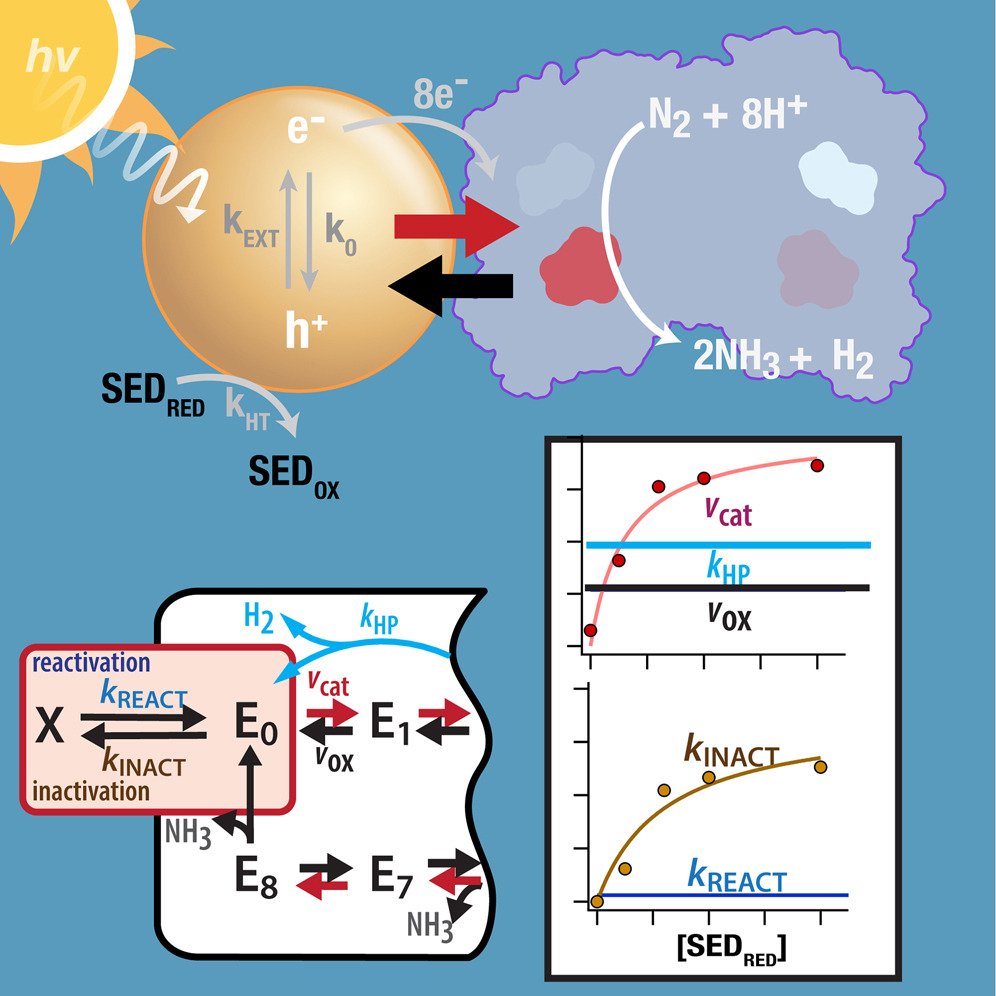
Nature converts atmospheric nitrogen under much milder conditions.
Nitrogen-fixing microorganisms use nitrogenase enzymes to reduce N2 to ammonia without the temperatures and pressures used in industrial ammonia plants.
Molybdenum nitrogenase, one of the best-studied forms, consists of two principal protein components:
- the Fe protein, which normally supplies electrons and chemical energy;
- the MoFe protein, which contains the catalytic site where N2 is reduced.
The enzyme moves through a sequence of electron- and proton-transfer states before the strong N2 bond is ultimately broken and ammonia is released.
Researchers replaced part of the biological system with nanocrystals
The experimental system developed by the research team takes a hybrid approach.
Instead of relying on the nitrogenase Fe protein to deliver electrons to the catalytic MoFe protein, the researchers use cadmium sulfide, or CdS, semiconductor nanocrystals.
When illuminated, the nanocrystals absorb photons and create energized electrons.
Those electrons can then be transferred to the MoFe protein, where they help drive the reduction of atmospheric nitrogen to ammonia.
| Natural nitrogenase | Nanocrystal biohybrid |
|---|---|
| Fe protein transfers electrons | CdS nanocrystal transfers electrons |
| ATP helps power electron transfer | Light provides photochemical energy |
| MoFe protein performs N2 reduction | MoFe protein still performs N2 reduction |
| Biological system | Biological-semiconductor hybrid |
This is not simply conventional photocatalysis
The distinction is important.
The CdS nanocrystal is not independently performing every catalytic step required to produce ammonia.
Instead, the system combines a semiconductor light absorber with the highly specialized catalytic machinery of nitrogenase.
The nanocrystal supplies photoexcited electrons while the enzyme provides the active site capable of reducing N2.
This is why researchers describe the approach as a biohybrid system.
Why electron delivery is so important
Nitrogen reduction is a multi-electron reaction. The catalytic center of nitrogenase must receive electrons at appropriate stages as it moves through intermediate states.
Researchers therefore need to understand not just whether electrons can reach the enzyme, but how quickly they arrive and whether they follow productive reaction pathways.
The team’s work used electron paramagnetic resonance spectroscopy to observe populations of reduced nitrogenase intermediates and develop kinetic models of the process.
The experiments showed that the efficiency of electron delivery is a critical control on successful N2 reduction.
What are “holes” in a semiconductor?
When a semiconductor nanocrystal absorbs light, an electron can be promoted into a higher-energy state.
The missing electron leaves behind a positively charged electronic state commonly described as a hole.
If the excited electron simply recombines with that hole, its energy is lost and cannot drive the desired chemical reaction.
Efficient photochemical systems therefore need a way to keep useful electrons available long enough to reach the catalyst.
Hole scavengers are a major part of the system
The researchers found that molecules used to neutralize photogenerated holes strongly influence the performance of the CdS–nitrogenase system.
These compounds are often called sacrificial electron donors or hole scavengers.
Previous experiments evaluated materials including:
- dithionite;
- ascorbic acid;
- triethanolamine;
- hydroquinone.
Different electron donors produced different nitrogen-reduction rates, showing that their effect cannot be predicted only from a single electrochemical property.
Why sodium dithionite mattered in the kinetic experiments
In the pre-steady-state study, sodium dithionite played a particularly important role in controlling how efficiently photogenerated holes were removed.
Changing its concentration altered electron-transfer kinetics and the populations of nitrogenase intermediates.
The results helped researchers distinguish productive electron-transfer pathways from processes in which charge was effectively wasted.
The researchers could observe reaction intermediates
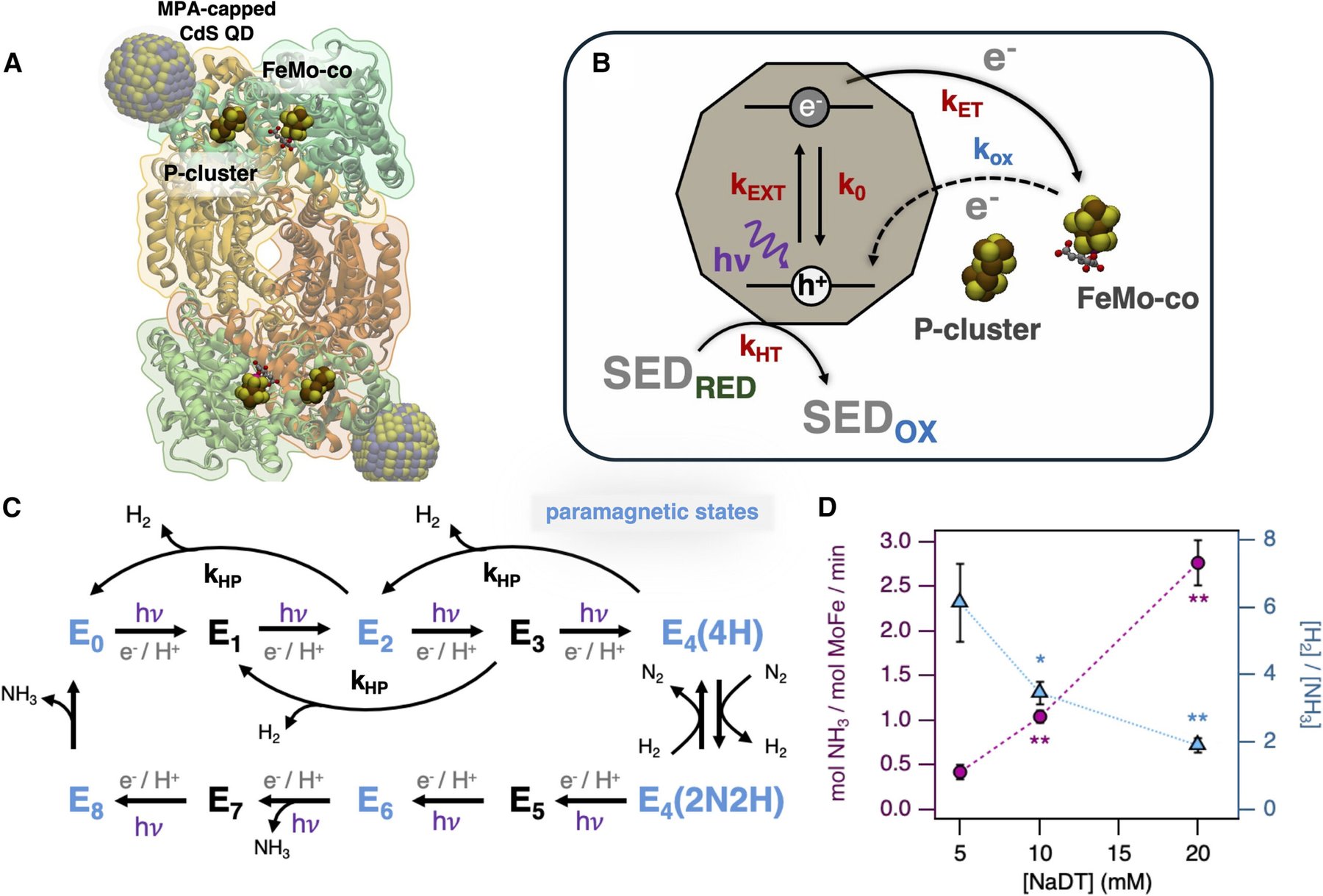
One of the most scientifically important parts of the work was the ability to examine temporary catalytic states formed while nitrogenase was reducing N2.
These intermediates are normally difficult to study because they are short-lived.
By using electron paramagnetic resonance spectroscopy and controlled low-temperature experiments, the team was able to slow the system and observe reduced states associated with the nitrogenase catalytic cycle.
This gives researchers a better picture of how photoexcited electrons move through the enzyme.
A 2026 review expanded the mechanistic picture
In April 2026, members of the same research collaboration published a broader review in Accounts of Chemical Research examining mechanistic insights from light-controlled nanocrystal–nitrogenase complexes.
The review brought together multiple generations of experiments involving semiconductor nanocrystals, nitrogenase proteins, electron transfer and catalytic intermediates.
The central research question is increasingly moving from “can light drive nitrogenase?” toward “how can light-driven electron delivery be controlled efficiently enough to create a practical catalytic system?”
The concept has roots in earlier research
The idea did not begin in 2026.
Earlier work from the research collaboration demonstrated that CdS nanocrystals could photosensitize the MoFe protein and drive N2 reduction using light.
The newer work focuses more heavily on the detailed mechanism: how charge is transferred, what intermediates form and where energy losses occur.
That progression is significant because improving an experimental catalyst requires understanding why it works, not merely demonstrating that ammonia can be detected.
Could sunlight eventually produce ammonia?
In principle, light-driven nitrogen fixation creates an attractive idea: capture solar energy and use it directly to convert atmospheric nitrogen into ammonia.
That could potentially reduce some of the energy-conversion steps required in conventional ammonia manufacturing.
However, the current CdS–nitrogenase experiments should not be confused with a commercial solar-ammonia plant.
The system remains a laboratory research platform.
Why this is not yet an alternative to Haber-Bosch
Several major hurdles separate a laboratory biohybrid from industrial fertilizer production.
| Challenge | Why it matters |
|---|---|
| Ammonia production rate | Industrial systems require very high throughput |
| Enzyme stability | Biological catalysts must remain active for long operating periods |
| Oxygen sensitivity | Nitrogenase is highly sensitive to oxygen |
| Electron-donor requirements | Sacrificial donors may reduce overall sustainability |
| CdS composition | Cadmium raises toxicity and materials-management concerns |
| Light utilization | Photons must be captured efficiently at reactor scale |
| Product separation | Ammonia must be recovered efficiently from the reaction system |
| Economics | Cost must compete with conventional and electrolytic ammonia |
Cadmium is an important limitation
Cadmium sulfide is useful in experimental photochemistry because of its semiconductor properties, but cadmium is a toxic heavy metal.
A commercial fertilizer-production technology based directly on CdS would therefore require careful containment, recycling and environmental management.
For that reason, research on light-driven nitrogen fixation also includes other semiconductor and photocatalytic materials.
The scientific importance of the CdS biohybrid lies partly in what it teaches researchers about charge transfer and nitrogenase catalysis, even if a future commercial system ultimately uses different materials.
Other researchers are also pursuing photocatalytic nitrogen fixation
The broader field of light-driven ammonia synthesis is expanding rapidly.
In 2026, separate research teams reported nitrogen-to-ammonia systems based on bismuth oxyhalides, bismuth tungstate and other engineered semiconductor materials.
These systems do not all use nitrogenase. Some attempt to adsorb and activate N2 directly on photocatalyst surfaces.
For example, a 2026 study in ACS Applied Materials & Interfaces reported visible-light nitrogen fixation using bismuth-rich oxybromide materials, while another study in Inorganic Chemistry used engineered bismuth and oxygen vacancies in Bi2WO6 to promote simultaneous activation of N2 and water.
The variety of approaches shows that there is not yet a clear winning technology for light-driven ammonia synthesis.
Biohybrid and purely photocatalytic routes are different
| Approach | How N2 is activated |
|---|---|
| Nanocrystal–nitrogenase biohybrid | Biological nitrogenase catalytic center |
| Semiconductor photocatalysis | Active sites or defects on inorganic catalyst surface |
| Electrocatalytic nitrogen reduction | Electrode catalyst driven by electricity |
| Haber-Bosch | Industrial catalyst under elevated temperature and pressure |
All of these approaches ultimately address the same difficult chemical problem: weakening and breaking the exceptionally stable N≡N bond.
Could light-driven ammonia enable decentralized fertilizer production?
One potential advantage of alternative ammonia technologies is scale.
Traditional Haber-Bosch plants benefit strongly from large centralized production because the process requires expensive equipment for hydrogen production, gas purification, compression and ammonia synthesis.
A lower-temperature technology powered directly by renewable electricity or sunlight could theoretically operate at smaller scale.
That could support localized ammonia production closer to fertilizer consumption or renewable-energy resources.
However, the nanocrystal–nitrogenase system has not yet demonstrated that such decentralized production would be technically or economically viable.
How does this compare with green ammonia?
Most commercial “green ammonia” projects do not attempt to replace the Haber-Bosch synthesis loop.
Instead, they typically produce hydrogen by water electrolysis using renewable electricity and then combine that hydrogen with atmospheric nitrogen using a conventional or modified ammonia synthesis process.
Light-driven nitrogen fixation is more radical because it attempts to change the nitrogen-reduction step itself.
| Technology | Hydrogen requirement | Nitrogen conversion | Commercial maturity |
|---|---|---|---|
| Conventional ammonia | Usually fossil-derived | Haber-Bosch | Commercial at massive scale |
| Green ammonia | Renewable electrolytic H2 | Usually Haber-Bosch | Commercial projects emerging |
| Light-driven nitrogenase | No conventional H2 feed in the same form | Enzymatic N2 reduction driven by photoelectrons | Laboratory research |
Why atmospheric nitrogen is such an attractive feedstock
The nitrogen feedstock itself is not scarce.
Air separation technology can supply N2 to ammonia plants almost anywhere.
The difficult and costly part is converting that N2 into reactive nitrogen efficiently.
This is why ammonia research focuses less on finding nitrogen and more on finding lower-energy ways to break its triple bond and form N–H bonds.
Could this reduce fertilizer emissions?
Potentially, but that has not yet been demonstrated at industrial scale.
If ammonia were produced using low-carbon energy and without fossil-derived hydrogen, upstream greenhouse-gas emissions could fall substantially.
But the full environmental impact of a biohybrid process would also depend on:
- how nanocrystals are manufactured;
- which electron donor is used;
- how long the enzyme remains active;
- reactor energy requirements;
- material recycling;
- ammonia separation and concentration;
- system scale and productivity.
A laboratory reaction therefore cannot yet be translated directly into a fertilizer carbon-footprint estimate.
What researchers need to solve next
The latest mechanistic studies point toward several clear research priorities.
- increase the rate of productive electron transfer;
- reduce charge recombination;
- replace or minimize sacrificial electron donors;
- improve nitrogenase stability;
- develop safer and more sustainable semiconductor materials;
- increase ammonia production rates;
- improve light absorption and reactor design;
- demonstrate continuous operation rather than short laboratory experiments.
The technology’s near-term value may therefore be mechanistic: it provides researchers with a precisely controllable way to study one of biology’s most difficult catalytic reactions.
Frequently asked questions
Atmospheric nitrogen is molecular nitrogen gas, N2, which makes up roughly 78% of Earth’s atmosphere. Most plants cannot use N2 directly and depend on nitrogen fixation to convert it into reactive nitrogen compounds.
Industrially, nitrogen is combined with hydrogen through the Haber-Bosch process. In nature, nitrogenase enzymes reduce atmospheric N2 to ammonia under mild conditions.
Cadmium sulfide nanocrystals absorb light and generate excited electrons that can be transferred directly to the MoFe protein component of nitrogenase, helping drive N2 reduction.
No. It produces ammonia at experimental scale. Ammonia is an important feedstock used to manufacture many nitrogen fertilizers.
Not with current technology. The system remains at laboratory scale and faces major challenges involving reaction rate, enzyme durability, materials, electron donors, reactor design and economics.
No. Most green-ammonia systems use renewable hydrogen but retain a Haber-Bosch synthesis step. Nanocrystal–nitrogenase research attempts to reduce atmospheric nitrogen through a different light-driven catalytic pathway.
The N2 molecule contains a very strong triple bond. Breaking and hydrogenating that bond requires substantial energy or a highly specialized catalyst such as nitrogenase.
Sources: National Laboratory of the Rockies, National Laboratory of the Rockies, American Chemical Society, American Chemical Society

Enjoyed this story?
Every Monday, our subscribers get their hands on a digest of the most trending agriculture news. You can join them too!




Discussion0 comments