

U.S. Nitrogen Supply Heads Into 2027 With Below-Average Inventories as Yazoo City Remains Offline

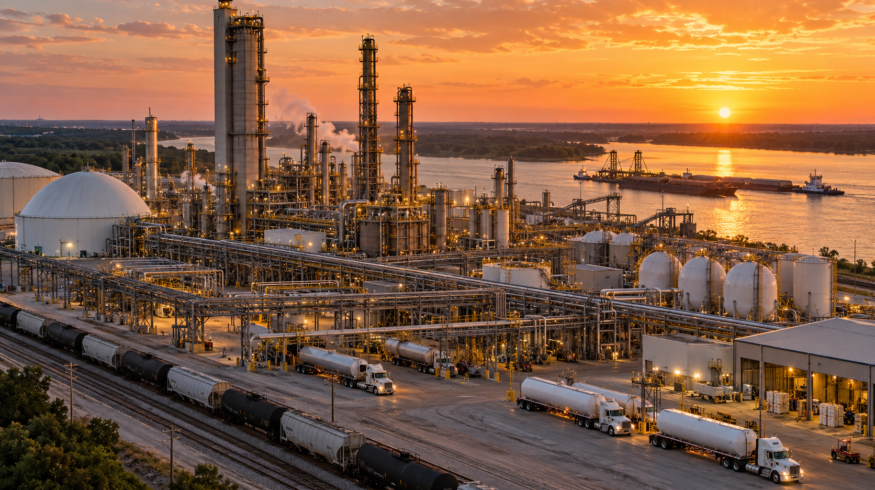

U.S. nitrogen fertilizer supply is heading toward the 2027 growing season with tighter-than-normal channel inventories while one of CF Industries’ major domestic production sites remains offline, adding another layer of risk to a market already showing renewed price volatility.
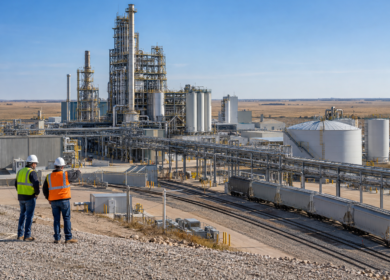
CF Industries expects nitrogen inventories in the North American distribution channel to be below average entering the 2027 season. At the same time, its Yazoo City, Mississippi, complex — capable of producing up to 1.3 million tons of nitrogen products annually — is not expected to resume production until the first half of 2027.
The timing matters because U.S. nitrogen prices are moving sharply again. Fertilizer Daily reported on October 5 that urea distributor asking prices rose 9.1% to $796.25 per short ton, even as UAN28 moved sharply lower.
The combination of lower inventories, strong seasonal demand and reduced domestic production capacity does not guarantee another broad price spike. It does, however, leave the U.S. nitrogen market with less room to absorb new supply disruptions during the winter procurement and spring application cycle.
North American nitrogen inventories are expected below average
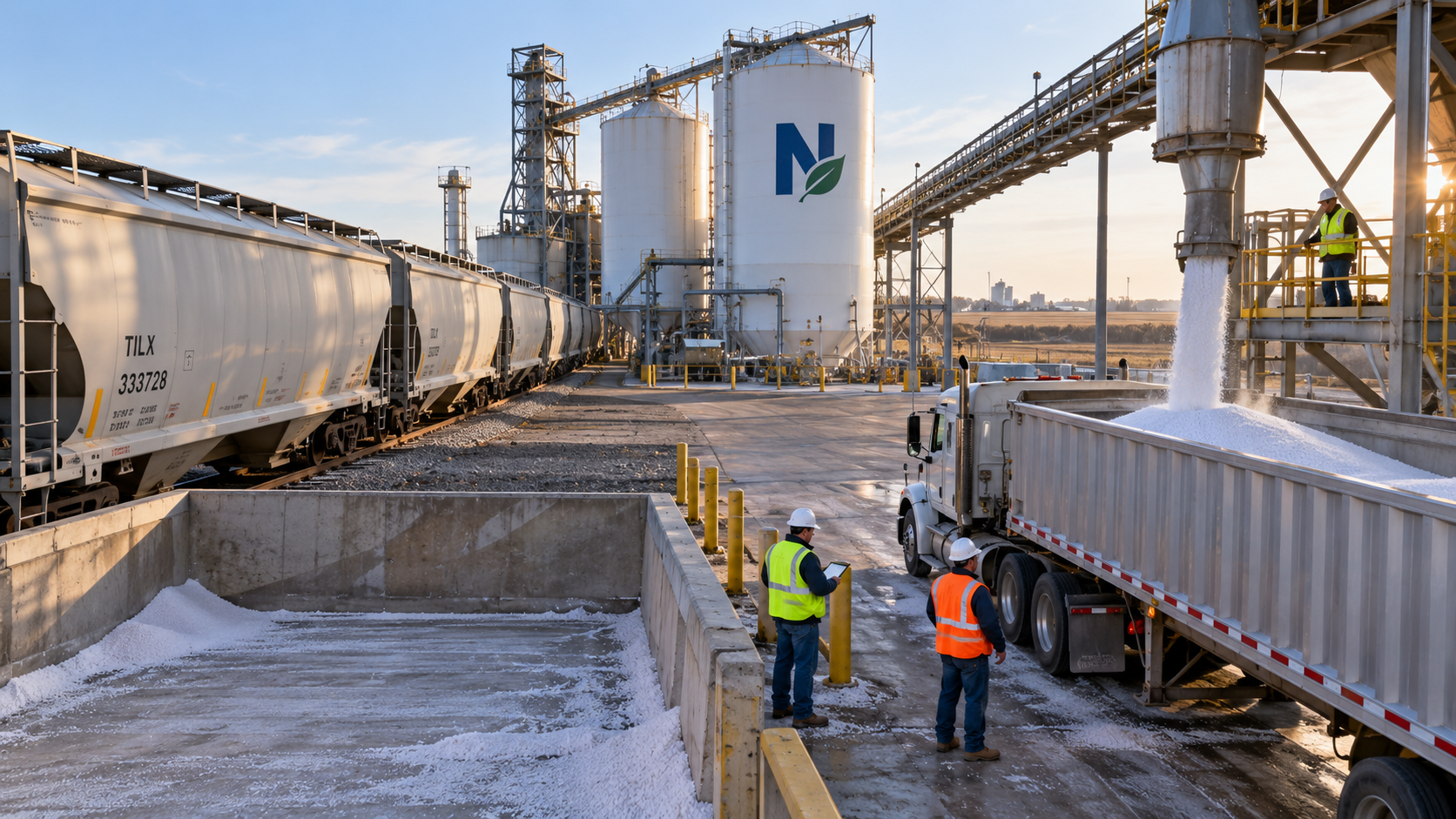
CF Industries said strong participation in its July ammonia and UAN fill programs followed a significant drawdown in North American nitrogen inventories during June.
Management now expects inventories in the North American nitrogen channel to be below average while demand for the 2027 growing season remains firm.
Bert Frost, CF Industries’ Executive Vice President and Chief Commercial Officer, said during the company’s second-quarter earnings call:
“We built a substantial UAN order book that extends into November.”
CF also expects a strong fall ammonia application season.
That outlook is important because fertilizer distribution inventories act as a buffer between production plants and farmers. When inventories are high, temporary outages or import delays can often be absorbed by existing stocks. When inventories are relatively low, disruptions can move more quickly through wholesale and retail pricing.
Yazoo City will remain offline into 2027
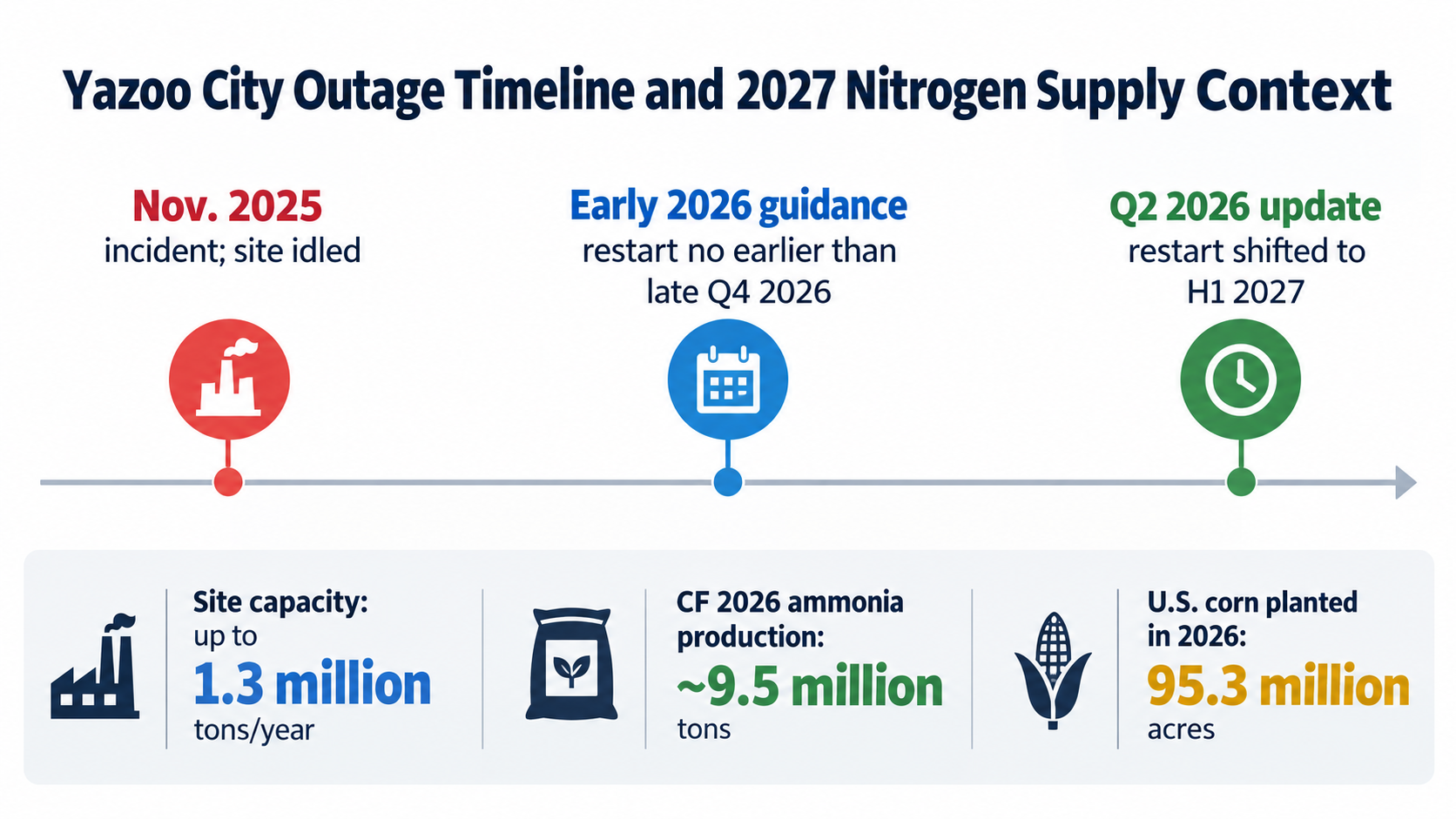
The Yazoo City complex has been idled since an incident in the ammonium nitrate upgrade area in November 2025.
CF Industries has stated that the ammonia plant itself and other upgrade units were not damaged by the incident. However, the event required the company to idle all production at the site.
The distinction is important: the current supply loss is not the result of destruction of the ammonia plant itself, but of the broader shutdown and rebuilding program required to restore safe operation of the complex.
| Yazoo City milestone | Status |
|---|---|
| November 2025 | Incident in ammonium nitrate upgrade area; entire site idled |
| Early 2026 guidance | Restart expected no earlier than late Q4 2026 |
| Q2 2026 update | Restart moved to first half of 2027 |
| Products expected to restart | Ammonia, ammonium nitrate solution, nitric acid, UAN and urea liquor |
| Carbon capture project | Still scheduled for 2028 startup |
The updated restart schedule means Yazoo City will remain out of production through the remainder of 2026.
The site represents up to 1.3 million tons of nitrogen products
CF Industries lists Yazoo City’s annual capacity at up to 1.3 million tons of nitrogen products for agricultural and industrial use.
The complex serves customers by rail, truck and barge, giving it access to both regional agricultural markets and broader inland distribution networks.
Because the facility produces multiple nitrogen products rather than a single fertilizer, its outage affects several segments simultaneously.
- Ammonia production is unavailable from the site.
- UAN availability is reduced.
- Ammonium nitrate solution and nitric acid production are also offline.
- Urea liquor used in agricultural and industrial applications is unavailable from the complex.
CF expects total gross ammonia production across its network to reach approximately 9.5 million tons in 2026, a figure that already incorporates the Yazoo City outage.
The U.S. nitrogen industry is already highly utilized
The ability of other domestic plants to compensate quickly is limited.
CF Industries operated at approximately 98% of available ammonia capacity during the first half of 2026. The company has also said that its existing North American network generally operates near maximum sustainable utilization when plants are available.
That matters because high utilization means there is relatively little idle capacity that can simply be switched on when another plant goes offline.
CF has previously noted that construction of new nitrogen capacity typically takes several years, which means short-term supply problems must generally be handled through higher utilization at existing plants, changes in product mix, inventories or additional imports.
CF shifted production toward urea earlier this year
The product mix within existing plants has also changed.
During the first half of 2026, CF Industries increased urea production at the expense of some UAN output as global urea prices strengthened and demand remained strong.
This operational flexibility helped increase granular urea availability but contributed to tighter UAN availability.
That trade-off is relevant to the current U.S. price structure. Fertilizer Daily’s latest market data show urea rising sharply while UAN28 prices declined, demonstrating that different nitrogen products can move in opposite directions even within the same broader supply environment.
Corn still creates a very large nitrogen demand base

USDA estimates that U.S. farmers planted 95.3 million acres of corn in 2026.
That was down about 3% from the previous year, but it still represents one of the largest nitrogen-consuming crop areas in the world.
USDA also expects approximately 87.4 million acres to be harvested for grain.
| U.S. corn indicator | 2026 estimate |
|---|---|
| Planted acreage | 95.3 million acres |
| Change from 2025 | -3% |
| Expected harvested area for grain | 87.4 million acres |
Corn is especially important for nitrogen demand because the crop typically receives substantially more nitrogen fertilizer than soybeans and many other major row crops.
Even a modest change in corn acreage can therefore materially affect ammonia, urea and UAN demand.
The U.S. remains exposed to global nitrogen markets
Domestic production is substantial, but U.S. fertilizer prices do not operate independently from global supply.
USGS estimates that ammonia was produced by 18 companies at 38 plants in 19 states during 2025. Approximately 88% of domestic ammonia production was used for fertilizer applications or fertilizer derivatives.
Production is heavily concentrated in regions with access to low-cost natural gas. Louisiana, Oklahoma and Texas accounted for approximately 57% of U.S. ammonia production capacity in 2025.
This concentration creates a strong domestic production base, but prices still respond to international urea and ammonia markets because fertilizer can move between regions through trade.
Earlier in 2026, disruption in the Middle East demonstrated that connection clearly. CF estimates that the conflict involving Iran removed approximately 4.0–4.5 million metric tons of traded urea and around 1 million metric tons of traded ammonia from the market at various points during the year.
Freight and import economics matter more when inventories are low
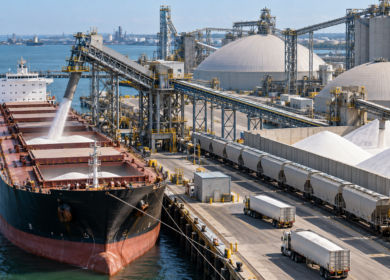
If domestic nitrogen inventories remain below average, imports become increasingly important as a balancing mechanism.
The United States regularly imports nitrogen fertilizer from several countries, and USDA maintains fertilizer trade data at both product and nutrient-equivalent levels.
But imported supply is not interchangeable with domestic production on a one-for-one basis.
Delivered cost depends on:
- international fertilizer prices;
- ocean freight;
- port capacity;
- barge and rail transportation;
- storage availability;
- insurance costs;
- and the timing of seasonal application demand.
A cargo arriving after a regional application window can have considerably less value than the same cargo arriving several weeks earlier.
Global supply is still not fully comfortable
CF Industries expects the global nitrogen supply-demand balance to remain constructive into 2027.
The company argues that several structural factors continue to constrain supply growth: geopolitical risk, higher construction costs, plant closures and limited new capacity additions.
CF also expects high liquefied natural gas prices to continue pressuring higher-cost nitrogen producers, particularly in regions where natural gas economics are less favorable than in North America.
China is expected to export more urea than during periods of tighter export restrictions, but CF does not expect those exports alone to materially loosen the global market.
This is a company outlook rather than an independent market forecast, and actual 2027 conditions will depend on energy prices, plant operating rates, trade policy and agricultural demand.
Why the latest urea price move matters
The supply outlook becomes more relevant because U.S. urea prices have begun rising again.
For the week ending October 2, distributor asking prices averaged $796.25 per short ton, up 9.1% from the previous reported level.
The move follows a large decline from the 2026 spring peak, when nitrogen markets surged during Middle Eastern supply disruptions.
Fertilizer Daily previously reported that U.S. retail urea prices fell 12% to $731 per ton in June as the spring supply shock began to unwind.
By late September, however, all eight major U.S. fertilizers tracked by DTN were once again above year-ago levels.
The October rebound therefore does not necessarily mark the start of another major rally, but it shows that nitrogen markets remain sensitive to relatively small changes in supply expectations.
Fertilizer Daily analysis: the risk is reduced flexibility, not necessarily a shortage
Fertilizer Daily analysis: the most important implication of the Yazoo City outage and lower projected inventories is not that the United States is heading toward a guaranteed nitrogen shortage.
The more significant issue is reduced flexibility.
When inventories are below average and domestic plants are already operating at high utilization rates, the market has fewer options if another disruption occurs.
A major maintenance delay, natural gas interruption, import delay or global price spike could therefore have a larger effect than it would in a well-stocked market.
Conversely, a mild winter, strong imports or lower-than-expected spring demand could rebuild inventories and reduce that risk quickly.
The distinction is important: tight inventories increase sensitivity to disruptions, but they do not prove that physical shortages will occur.
The Yazoo restart could change the picture in the first half of 2027

The planned restart of Yazoo City is therefore one of the most important domestic nitrogen supply milestones to watch next year.
If the complex returns on schedule, the restoration of ammonia, UAN and related nitrogen production would add supply during the first half of 2027.
If the restart is delayed again, the North American market could remain tighter for longer, particularly if inventories enter the spring season below normal levels.
CF has said that equipment fabrication and delivery schedules are among the factors affecting the timing of the rebuild.
What to watch next
Five indicators will determine whether the current tightness develops into a more significant 2027 supply issue:
- Yazoo City restart timing — whether production returns during the first half of 2027 as planned.
- Winter nitrogen inventories — whether distributor stocks rebuild after fall application.
- U.S. corn acreage expectations — larger corn acreage would increase nitrogen demand.
- Urea and ammonia imports — stronger imports could offset lower domestic availability.
- Global nitrogen supply — particularly Middle Eastern production, Chinese exports and natural gas economics in Europe.
The next major test will come after the fall ammonia season, when distributors begin positioning inventories for spring 2027.
Frequently asked questions
CF Industries expects North American nitrogen channel inventories to be below average entering the 2027 growing season. That is a company market assessment rather than an official USDA inventory estimate.
An incident occurred in the ammonium nitrate upgrade area in November 2025. The ammonia plant itself was not damaged, but CF Industries idled production across the site while rebuilding affected equipment.
CF Industries currently expects ammonia, ammonium nitrate solution, nitric acid, UAN and urea liquor production to resume during the first half of 2027.
CF Industries lists annual capacity at up to 1.3 million tons of nitrogen products for agricultural and industrial use.
No. The outage reduces domestic supply flexibility, but imports, production at other facilities, inventory levels and crop demand will determine whether actual shortages develop.
Corn is one of the largest nitrogen-consuming crops in the United States. USDA estimates that farmers planted 95.3 million acres of corn in 2026, so even modest changes in application rates or acreage can materially affect fertilizer demand.
Potential drivers include another production outage, delayed Yazoo City restart, low inventories, strong corn acreage, higher global urea prices, import disruptions or higher natural gas and freight costs.
Sources: CF Industries, CF Industries, USDA NASS, USGS, USDA

Enjoyed this story?
Every Monday, our subscribers get their hands on a digest of the most trending agriculture news. You can join them too!



Discussion0 comments