

EU introduces Fertilizer Action Plan in response to rising nitrogen prices and farmer concerns

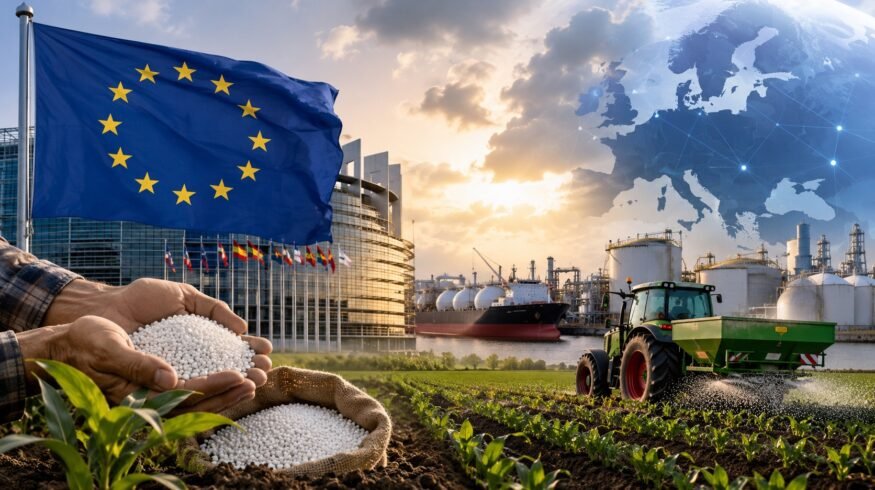

The European Commission has adopted a comprehensive Fertilizer Action Plan to help farmers manage rising input costs and reduce the EU’s long-term reliance on imported nitrogen fertilizers amid ongoing global supply disruptions.
Unveiled on May 19, the package responds to persistently high nitrogen fertilizer prices in the EU, driven by the closure of the Strait of Hormuz and instability in global ammonia and urea trade. Commission data shows that in April 2026, nitrogen fertilizer prices averaged 71% higher than in 2024, increasing pressure on European farmers.
The plan mobilizes funding through the EU’s Common Agricultural Policy (CAP), offering advance payments, flexible transfers between funding streams, and an expanded temporary state aid framework to support affected farmers. The Commission also extended duty-free tariff rate quotas on ammonia, urea, and other nitrogen fertilizers from countries other than Russia and Belarus, estimating savings of approximately €60 million ($68 million) for importers.
“Food security starts with fertilizer security,” said Christophe Hansen during remarks to the European Parliament in Strasbourg, where farmers staged protests outside the chamber. He said Europe must reduce its dependence on external suppliers for key agricultural nutrients.
Supply resilience moves to center of EU strategy
In addition to emergency relief, the Commission’s strategy focuses on strengthening long-term resilience in fertilizer supply chains and advancing the shift to low-carbon nutrient production.
Medium-term measures include establishing “green ammonia corridors” connecting the EU with suppliers in Africa and the Middle East under the EU Global Gateway initiative. The Commission will also evaluate the feasibility of strategic fertilizer storage facilities and encourage broader use of bio-based and low-carbon fertilizers.
The action plan also proposes an improved market transparency and price-monitoring framework, following Brussels’ acknowledgment of ongoing gaps in real-time fertilizer market data. Officials noted that limited transparency has hindered policymaking and increased price volatility during market disruptions.
The Commission noted that although the Middle East supplies only about 3% of EU ammonia imports, the global interconnectedness of the fertilizer market means regional supply shocks quickly affect prices across Europe.
Farmers welcome aid while producers criticize lack of structural support
Stakeholders in Europe’s agricultural and fertilizer sectors gave the plan a mixed response.
Farmers’ organizations generally welcomed the short-term support, especially the CAP funding flexibility and tariff quota extensions, stating that many producers face unsustainable fertilizer costs before the next planting season.
European fertilizer manufacturers, however, argued that the package does not address the structural challenges weakening the bloc’s domestic nitrogen production.
Fertilizers Europe called for direct support for carbon capture and storage at fertilizer plants, immediate relief from EU Emissions Trading System costs, and changes to the Carbon Border Adjustment Mechanism (CBAM), which producers say has raised import costs without improving the competitiveness of EU manufacturing.
None of those proposals were included in the final plan.
An early Commission draft cited by Agence Europe indicates that EU ammonia production capacity has fallen by about 10% in recent years, as manufacturers face higher energy costs and increased competition from producers in the United States, Trinidad and Tobago, and Russia.
Industry groups warn that without direct structural support, further production cuts may be unavoidable, which could increase Europe’s long-term dependence on imported fertilizers despite temporary tariff relief.
Review planned alongside CBAM implementation
The Commission described the action plan as a balanced approach, providing immediate support for farmers while working to strengthen the EU’s fertilizer security over time.
Officials stated that the effectiveness of the measures, including green ammonia corridor development, fertilizer storage assessments, and the new monitoring framework, will be reviewed in 2027 together with the implementation of CBAM rules for the fertilizer sector.
The debate on securing Europe’s fertilizer supply while advancing decarbonization goals is expected to intensify as policymakers balance agricultural affordability, industrial competitiveness, and climate policy.
Sources: EU Commission, Agence Europe

Enjoyed this story?
Every Monday, our subscribers get their hands on a digest of the most trending agriculture news. You can join them too!





Discussion0 comments