

USDA Selects 8 Fertilizer Projects for $573M, Adding 1.08M Tons of U.S. Capacity


The U.S. Department of Agriculture has selected eight fertilizer manufacturing projects representing more than $1.34 billion in proposed investment, including approximately $573 million in federal support, as Washington seeks to expand domestic fertilizer capacity and reduce reliance on imported agricultural inputs.
If all eight projects move forward as planned, they would support approximately 1.08 million tons of annual fertilizer production or manufacturing capacity across ammonia, nitrogen fertilizers, sulfate of potash, sulfur products, mixed nutrients and fertilizers produced from agricultural byproducts.
The selections were announced October 22 under USDA’s Fertilizer Investment & Expansion for Long-Term Domestic Supply program, or FIELDS. The projects are located across more than a dozen states and range from modular ammonia units near farming regions to a new 220,000-ton-per-year sulfate of potash facility in New Mexico.
USDA estimates that the additional supply could ultimately reduce nitrogen fertilizer prices by 4.4% and potash prices by 5.3%. Those figures are economic estimates rather than guaranteed reductions in retail fertilizer prices.
Eight projects represent $1.34 billion in fertilizer investment
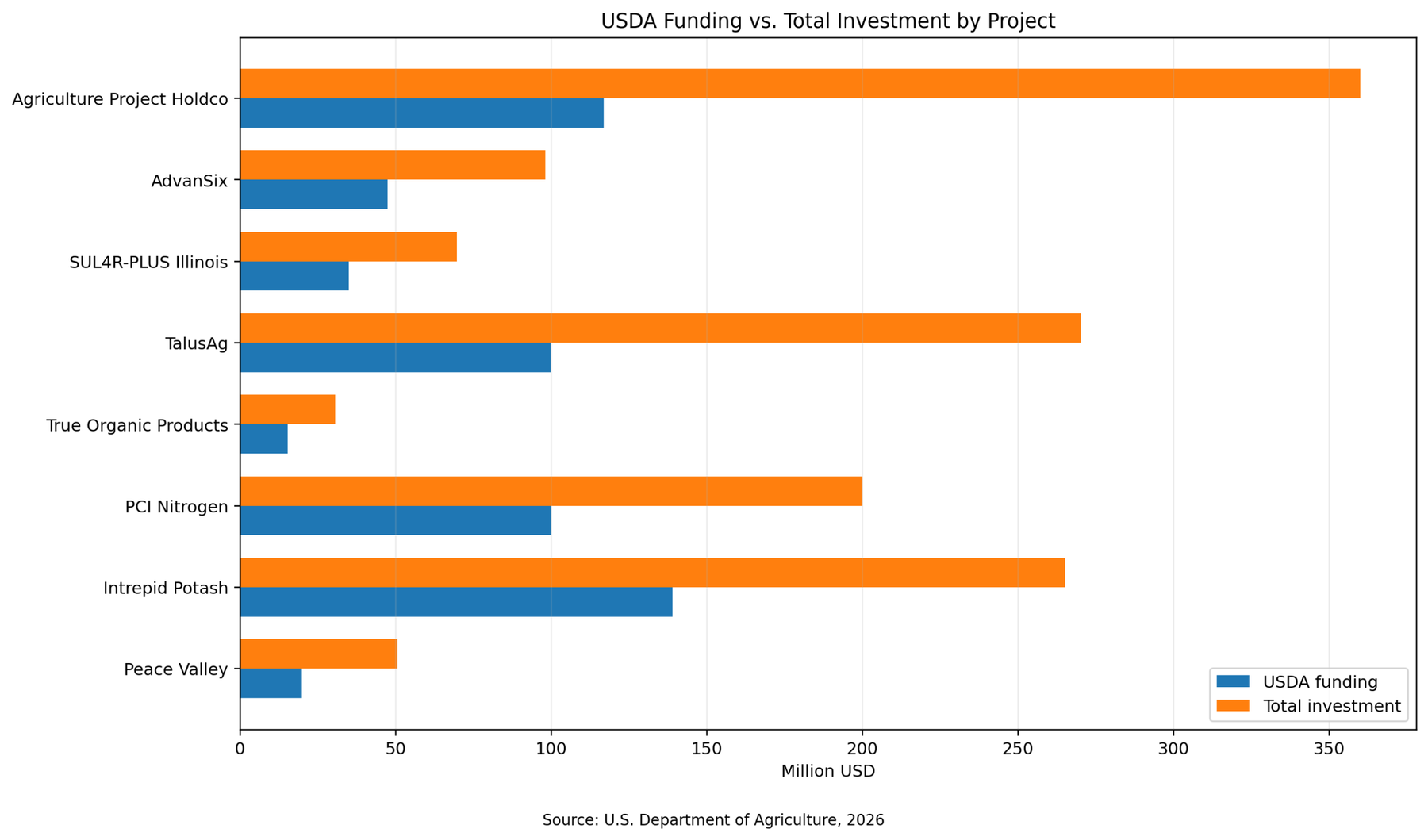
The eight selected projects represent approximately $1.344 billion in total proposed investment.
USDA funding accounts for roughly $573.2 million of that total, while approximately $771 million would come from company capital, project partners or other financing sources if the projects reach completion.
| Project | USDA funding | Total investment | Annual production or capacity | Main product |
|---|---|---|---|---|
| Intrepid Potash | $139.0M | $265.0M | 220,000 tons | Sulfate of potash |
| Agriculture Project Holdco | $116.9M | $360.0M | 4,100 tons | Liquid ammonium nitrate |
| PCI Nitrogen | $100.0M | $200.0M | 148,280 tons | Ammonium sulfate and urea |
| TalusAg | $99.8M | $270.2M | 130,000 tons | Anhydrous ammonia |
| AdvanSix | $47.4M | $98.1M | 84,000 tons | Anhydrous ammonia |
| SUL4R-PLUS Illinois | $34.9M | $69.7M | 100,000 tons | Sulfur fertilizer |
| Peace Valley | $19.9M | $50.6M | 250,000 tons | N, P, K and S fertilizers |
| True Organic Products | $15.3M | $30.6M | 142,805 tons | Fertilizers from agricultural byproducts |
| Total | About $573.2M | About $1.344B | About 1.079M tons | Multiple fertilizer categories |
USDA says the projects could lower fertilizer prices
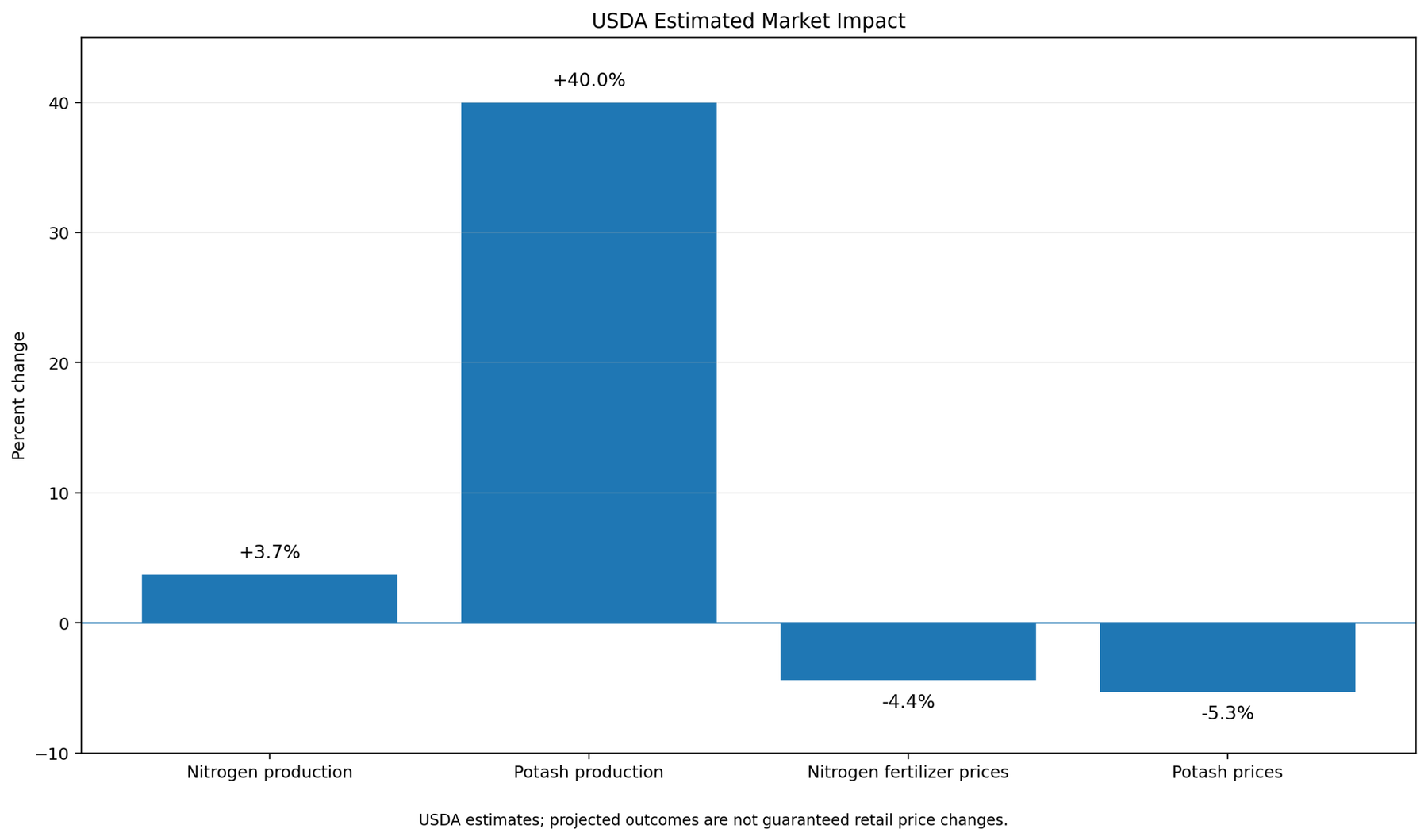
USDA’s economic analysis estimates that the additional production associated with the selected projects could reduce nitrogen fertilizer prices by approximately 4.4% and potash prices by 5.3% once the new capacity is operational.
The department also estimates that the projects could increase U.S. domestic nitrogen production by approximately 3.7% and potash production by nearly 40%.
The potash percentage is especially large because current U.S. mine production is small relative to domestic consumption and imports.
However, USDA’s estimated price effects should not be interpreted as a guaranteed reduction at the farm gate.
Actual fertilizer prices will continue to depend on:
- natural gas prices;
- global ammonia and urea markets;
- potash imports;
- phosphate supply;
- freight and rail costs;
- crop prices and seasonal demand;
- trade policy;
- plant operating rates;
- how quickly the projects reach full production.
The projects have been selected, but most capacity does not exist yet
A critical distinction is that USDA has selected the projects to move forward in the FIELDS funding process.
The announcement does not mean 1.08 million tons of fertilizer are already being produced.
Several projects still require construction, equipment installation, financing, permitting, commissioning or expansion work before their stated annual capacity becomes available.
The approximately 1.08-million-ton figure therefore represents expected future production or supported capacity, not current additional fertilizer output.
Intrepid Potash would add 220,000 tons of sulfate of potash
The largest single USDA funding selection is approximately $139 million for Intrepid Potash.
The company proposes to invest approximately $265 million in a new sulfate of potash manufacturing facility near Carlsbad, New Mexico.
USDA says the facility would produce approximately 220,000 tons annually.
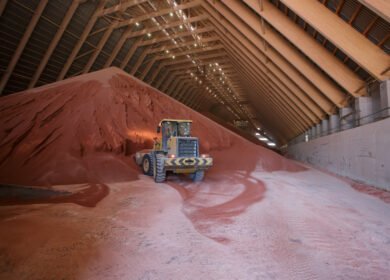
Sulfate of potash, commonly known as SOP, supplies both potassium and sulfur and is frequently used for chloride-sensitive crops such as fruits, vegetables, nuts and certain specialty crops.
The project differs from conventional muriate of potash, or MOP, production. MOP is potassium chloride and represents the majority of global potash fertilizer consumption, while SOP commands a different market because of its lower chloride content.
Why the Intrepid project could have an outsized effect on U.S. potash production
The United States relies heavily on imported potash, particularly material supplied from Canada.
Domestic potash mine production represents only a small share of U.S. consumption, which is why USDA estimates that the selected projects could increase domestic potash production by nearly 40% even though the absolute tonnage increase is much smaller than total U.S. fertilizer demand.
This percentage should therefore be understood relative to the relatively small existing domestic production base.
TalusAg plans 20 modular ammonia units in seven states
TalusAg was selected for approximately $99.8 million in proposed USDA funding toward a $270.2 million distributed ammonia project.
The company plans to deploy 20 modular ammonia manufacturing units at 11 locations across Iowa, Kentucky, Minnesota, Tennessee, Nebraska, Illinois and South Dakota.
USDA expects the network to produce approximately 130,000 tons of anhydrous ammonia annually.
Unlike traditional centralized ammonia plants, TalusAg’s strategy relies on smaller modular facilities located closer to fertilizer customers.
TalusAg would produce ammonia from air, water and electricity
TalusAg says its modular systems use air, water and electricity to manufacture ammonia locally.
The company describes the technology as a way to reduce dependence on long-distance fertilizer logistics and exposure to volatile delivered ammonia prices.
Its distributed production model is particularly relevant because anhydrous ammonia is costly and operationally complex to transport and store.
Instead of producing all ammonia at one large coastal or Gulf Coast complex, the TalusAg project would distribute production across multiple agricultural regions.
Distributed ammonia could change fertilizer logistics
Large conventional ammonia plants benefit from economies of scale, but they also create long supply chains between production sites and inland agricultural regions.
Modular production attempts to trade some of those scale advantages for shorter transportation distances and greater regional supply resilience.
Whether the model ultimately lowers delivered fertilizer costs will depend on electricity prices, plant utilization, maintenance, capital costs and local ammonia demand.
PCI Nitrogen would modernize plants in Texas and Oregon
PCI Nitrogen was selected for approximately $100 million in USDA funding toward a $200 million modernization program.
The investment covers facilities in Pasadena, Texas, and St. Helens, Oregon.
USDA says the improvements are expected to support approximately 148,280 tons of annual fertilizer production, including ammonium sulfate and urea.
This project is notable because it strengthens production in two different regional markets rather than concentrating investment at one location.
AdvanSix would expand ammonia production in Virginia
AdvanSix was selected for approximately $47.4 million toward a $98.1 million modernization and expansion of its ammonia manufacturing facility in Hopewell, Virginia.
USDA expects the project to support approximately 84,000 tons of annual anhydrous ammonia production.
The Hopewell complex is already one of the world’s largest single manufacturing sites for ammonium sulfate, according to AdvanSix.
The facility operates an integrated chemical platform in which ammonia is used across fertilizer and industrial value chains.
“As a U.S. manufacturer, AdvanSix is uniquely situated to enable reliable, domestic supply.”
— Erin Kane, President and CEO of AdvanSix
Kane made the comment earlier this year while discussing a separate expansion of the company’s integrated ammonia platform. It highlights the strategic role the Hopewell facility already plays in domestic chemical and fertilizer supply.
Peace Valley would add 250,000 tons of mixed fertilizer products
Peace Valley received the largest stated production figure among the individual FIELDS selections.
The Florida company was selected for approximately $19.9 million toward a $50.6 million expansion in Bartow.
USDA says the project would produce approximately 250,000 tons annually of fertilizers containing nitrogen, phosphorus, potassium and sulfur.
Because the stated production includes multiple nutrient combinations, the tonnage should not be compared directly with nutrient-equivalent tons of pure nitrogen, phosphate or potash.
SUL4R-PLUS Illinois would add 100,000 tons of sulfur fertilizer
SUL4R-PLUS Illinois was selected for approximately $34.9 million in federal support toward a $69.7 million expansion at Marissa, Illinois.
The project would add a new manufacturing line and improve storage and transportation infrastructure.
USDA expects approximately 100,000 tons of annual sulfur fertilizer production.
Sulfur has become increasingly important in fertilizer markets as crop sulfur deficiencies have become more common in some U.S. soils and as sulfur prices have experienced significant volatility.
True Organic Products would use agricultural byproducts
True Organic Products was selected for approximately $15.3 million toward a $30.6 million expansion across facilities in California, Oregon and Arizona.
The project is expected to support approximately 142,805 tons of annual fertilizer production using agricultural byproducts.
This represents a different part of the domestic fertilizer strategy: recycling nutrient-containing materials rather than relying exclusively on mined minerals or conventional ammonia synthesis.
Dairy manure would become liquid ammonium nitrate in Kansas and Indiana
Agriculture Project Holdco was selected for approximately $116.9 million toward a much larger $360 million investment.
The company plans two facilities in Lewis, Kansas, and Fair Oaks, Indiana.
The projects would convert dairy manure into approximately 4,100 tons per year of liquid ammonium nitrate fertilizer.
That is by far the smallest fertilizer tonnage among the eight projects despite representing the largest total project investment.
This demonstrates why comparing the projects only on a dollars-per-ton basis can be misleading: some projects include waste management, nutrient recovery, infrastructure and processing systems that provide functions beyond fertilizer volume alone.
Federal funding represents about 43% of total project investment
Across all eight projects, proposed USDA funding represents approximately 42.6% of the $1.344 billion total investment.
The remaining roughly 57% would come from private capital or other project financing.
| Funding source | Approximate amount | Share |
|---|---|---|
| Proposed USDA funding | $573.2M | 42.6% |
| Other/private project investment | $771.0M | 57.4% |
| Total | $1.344B | 100% |
The federal strategy is about competition as well as supply
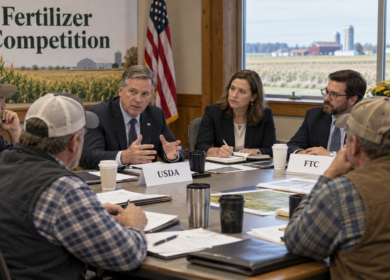
USDA is presenting FIELDS not only as a production program but also as a competition policy.
The department says four companies control approximately 77% of North American nitrogen fertilizer production capacity, while two companies account for more than 90% of phosphate production capacity and two producers represent roughly 90% of North American potash.
Those concentration figures are USDA estimates and refer to production capacity, not necessarily retail fertilizer sales or total U.S. supply after imports.
Fertilizer Daily has previously examined U.S. fertilizer antitrust litigation and federal scrutiny of major fertilizer companies.
USDA wants projects outside dominant fertilizer suppliers
FIELDS was specifically designed to support independent fertilizer manufacturing capacity.
The program criteria state that supported manufacturing should be outside dominant fertilizer suppliers, U.S.-based, innovative, secure and focused on farmer needs.
That makes the program structurally different from a general subsidy available to every existing fertilizer producer.
The program was launched with $500 million
USDA opened applications for FIELDS in July 2026 with up to $500 million initially available through the Commodity Credit Corporation.
Competitive awards were designed to range from $15 million to $150 million and require matching funds.
USDA later said additional resources recovered from projects previously supported through the Fertilizer Production Expansion Program would also be redirected toward the newly selected projects.
This explains why the approximately $573 million associated with the October selections exceeds the original $500 million FIELDS announcement.
USDA is emphasizing projects that can actually reach operation
One of the most important differences in the current funding strategy is the emphasis on projects described as financially viable and implementation-ready.
USDA says priority was given to projects with committed private investment, identifiable demand and measurable manufacturing outcomes.
This matters because fertilizer projects can remain in development for years without reaching construction or commercial production.
USDA frames fertilizer supply as a national-security issue
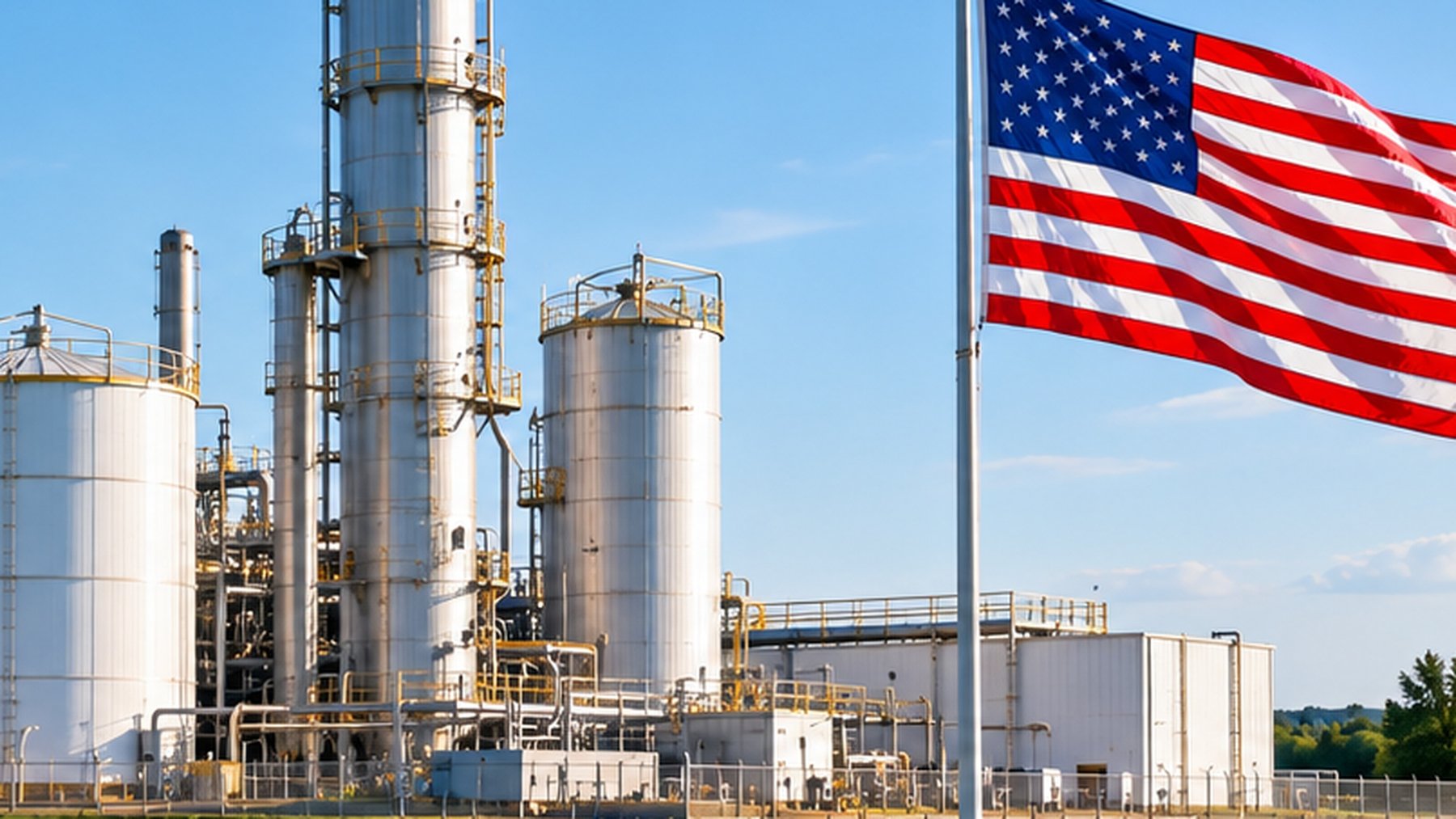
The administration is also linking fertilizer manufacturing to broader agricultural and national-security policy.
“Farm security is national security.”
— Brooke Rollins, U.S. Secretary of Agriculture
USDA argues that dependence on imported fertilizer and raw materials can expose farmers to geopolitical disruptions, sanctions, export restrictions and freight shocks.
The U.S. remains particularly dependent on imports for potash and relies on international trade for substantial volumes of nitrogen and phosphate fertilizers and fertilizer raw materials.
Not all fertilizer imports represent the same supply risk
Import dependence needs to be interpreted by nutrient.
Canada supplies much of the potash imported by the United States and is deeply integrated with U.S. agricultural supply chains.
Phosphate supply is more concentrated among a limited number of domestic producers and imports, while nitrogen fertilizer can come from domestic gas-based production as well as international ammonia and urea producers.
This means the strategic benefit of additional domestic capacity differs substantially between ammonia, potash, sulfur and specialty fertilizer projects.
The United States already expanded nitrogen production sharply after 2010
USDA transportation data show that U.S. nitrogen fertilizer production approximately doubled between 2010 and 2020 before leveling off.
That expansion was supported in part by relatively low U.S. natural gas prices, since natural gas is the primary feedstock used to produce hydrogen for conventional ammonia synthesis.
Domestic phosphate production followed a different trajectory and declined in many years as mines aged and ore quality deteriorated.
Why 1.08 million tons should not be treated as one commodity
The headline capacity figure combines very different fertilizer products.
Anhydrous ammonia, urea, ammonium sulfate, sulfate of potash, sulfur fertilizers and mixed NPK products have different nutrient concentrations and agronomic values.
For example, one physical ton of anhydrous ammonia contains far more nitrogen than one ton of a lower-analysis mixed fertilizer.
The combined 1.08-million-ton figure therefore measures gross production or capacity rather than a standardized nutrient-equivalent quantity.
Three projects account for more than half of the announced tonnage
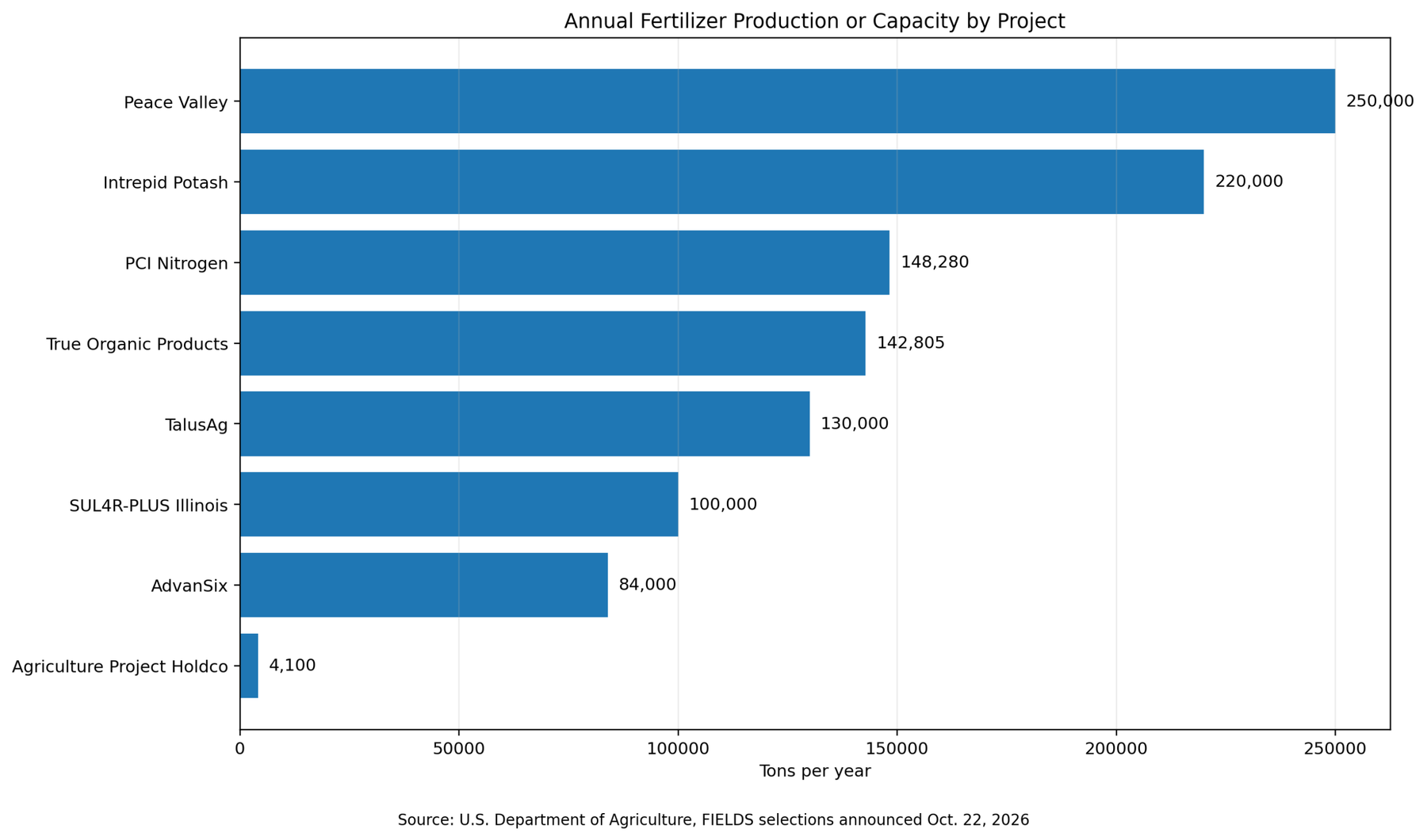
Peace Valley, Intrepid Potash and PCI Nitrogen together account for approximately 618,000 tons of the stated annual production or capacity.
That equals roughly 57% of the combined 1.079 million tons.
| Project | Annual tons | Share of total announced capacity |
|---|---|---|
| Peace Valley | 250,000 | 23.2% |
| Intrepid Potash | 220,000 | 20.4% |
| PCI Nitrogen | 148,280 | 13.7% |
| True Organic Products | 142,805 | 13.2% |
| TalusAg | 130,000 | 12.0% |
| SUL4R-PLUS Illinois | 100,000 | 9.3% |
| AdvanSix | 84,000 | 7.8% |
| Agriculture Project Holdco | 4,100 | 0.4% |
The projects are geographically distributed
The selected investments span major agricultural and industrial regions across the United States.
Locations include:
- Iowa;
- Kentucky;
- Minnesota;
- Tennessee;
- Nebraska;
- Illinois;
- South Dakota;
- Florida;
- Texas;
- Oregon;
- New Mexico;
- Virginia;
- California;
- Arizona;
- Kansas;
- Indiana.
The geographic spread is important because fertilizer economics depend heavily on transportation.
Locating production closer to agricultural demand can reduce rail, truck, terminal and storage requirements even when the manufacturing cost itself is unchanged.
Will the projects really reduce fertilizer prices by 4% to 5%?
USDA’s estimate is plausible as a modeled supply effect, but the final outcome will depend on market conditions when the projects become operational.
If global fertilizer prices fall sharply before commissioning, the absolute price impact could be difficult to isolate.
If imports become constrained or another supply disruption occurs, new domestic production could have greater value than the model suggests.
Retail prices also include transportation, dealer margins, storage and regional demand, meaning farmers may not see the exact percentage change calculated at the broader market level.
More production does not automatically guarantee more competition
Adding independent producers can increase the number of available suppliers, but effective competition also depends on distribution.
A fertilizer manufacturer must still reach customers through terminals, rail networks, trucking, storage facilities, cooperatives and retailers.
This issue is increasingly important in the wider U.S. debate about fertilizer market concentration.
Fertilizer Daily has also reported on farmer concerns about fertilizer competition and barriers facing new suppliers.
What happens next?
The October announcement marks project selection rather than the end of the process.
The main milestones to watch are:
- final funding agreements;
- permitting;
- financial close;
- construction starts;
- equipment installation;
- commissioning;
- first fertilizer production;
- ramp-up toward stated annual capacity.
The ultimate impact of FIELDS will depend less on the amount of money announced and more on how much of the selected capacity reaches sustained commercial operation.
Frequently asked questions
The eight selected projects include approximately $573.2 million in proposed USDA funding and about $1.344 billion in total proposed investment.
USDA estimates approximately 1.08 million tons of annual domestic production or manufacturing capacity across the eight projects.
No. Some involve existing facilities, but the announced tonnage includes future production from expansions, modernization and new construction. The projects still need to complete the relevant implementation steps.
USDA estimates that additional production could reduce nitrogen fertilizer prices by approximately 4.4% and potash prices by 5.3%. These are modeled estimates, not guaranteed retail price reductions.
Intrepid Potash has the largest individual proposed allocation at approximately $139 million.
Peace Valley has the largest stated annual production figure at approximately 250,000 tons of nitrogen-, phosphorus-, potassium- and sulfur-containing fertilizer products.
TalusAg and AdvanSix together account for approximately 214,000 tons of stated annual anhydrous ammonia production, in addition to nitrogen fertilizer production associated with other projects.
USDA says the objective is to increase domestic production, add independent suppliers, reduce supply-chain risk and increase competition for U.S. farmers.
Sources: U.S. Department of Agriculture, USDA Rural Development, TalusAg, AdvanSix, Intrepid Potash

Enjoyed this story?
Every Monday, our subscribers get their hands on a digest of the most trending agriculture news. You can join them too!

Discussion0 comments