

U.S. Corn Growers Urge Faster Fertilizer Antitrust Action as Prices Keep Rising



Three major U.S. corn grower organizations are urging the federal government to accelerate its investigation into fertilizer-market competition as retail fertilizer prices remain above year-ago levels across all eight major products tracked by DTN.
The Iowa Corn Growers Association, Ohio Corn & Wheat Growers Association and Texas Corn Producers Association sent a joint letter to President Donald Trump on October 27 calling for the administration to support and advance federal scrutiny of alleged anticompetitive conduct in fertilizer markets.
The groups argue that rising fertilizer costs are eroding the benefit of recent federal farm-support measures and that farmers need more than short-term financial relief if input costs remain elevated.
Corn growers ask White House to move fertilizer investigation forward
The three grower organizations called on the administration to support the Federal Trade Commission as it continues an industry-wide investigation into fertilizer pricing and market concentration.
The request follows months of farmer complaints about fertilizer affordability, market concentration and barriers facing new suppliers.
“Farmers are facing fertilizer costs that simply do not reflect a competitive marketplace.”
— Steve Kuiper, President, Iowa Corn Growers Association
Kuiper said growers are concerned that federal relief measures are being offset by rising input costs before those programs can meaningfully improve farm economics.
Growers say fertilizer costs are reducing the value of farm aid
The October 27 letter followed the administration’s announcement of an $8 billion Harvest Fuel Relief program intended to help farmers cope with elevated diesel and other operating costs.
The corn groups welcomed that support but argued that fertilizer remains one of the largest cost pressures facing growers.
According to the letter, Iowa farmers reported anhydrous ammonia quotes approximately $150 per ton higher than in mid-September.
National DTN data show a smaller but still meaningful increase over the same general period, with average anhydrous prices rising from approximately $945 per ton in mid-September to $987 per ton in the second week of October.
All eight major fertilizers are more expensive than a year ago
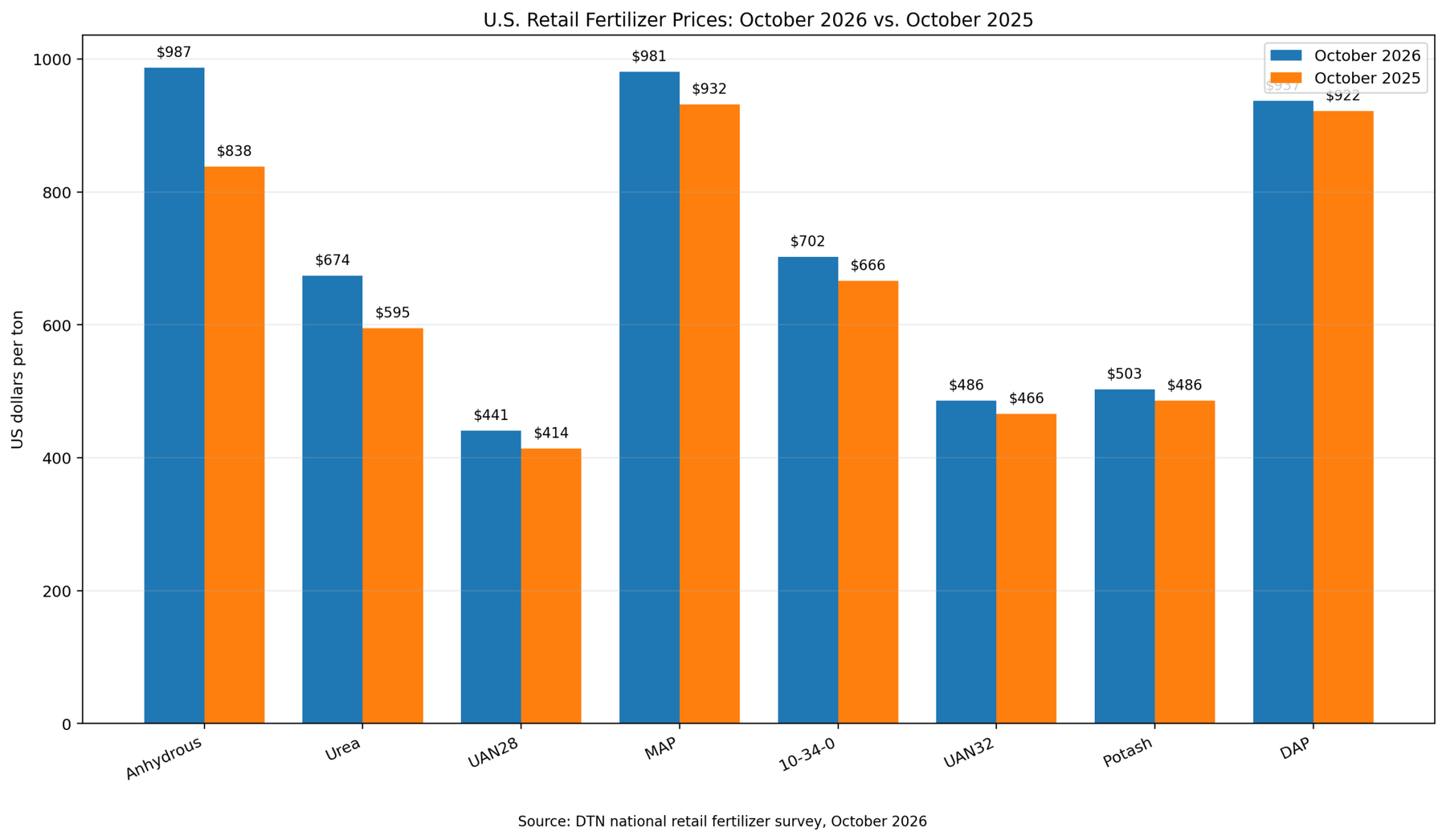
DTN’s latest national retail fertilizer survey shows every major fertilizer product in its index above year-ago levels.
| Fertilizer | Oct. 2026 price | Oct. 2025 price | Approx. year-on-year change |
|---|---|---|---|
| Anhydrous ammonia | $987/t | $838/t | +18% |
| Urea | $674/t | $595/t | +13% |
| UAN28 | $441/t | $414/t | +7% |
| MAP | $981/t | $932/t | +5% |
| 10-34-0 | $702/t | $666/t | +5% |
| UAN32 | $486/t | $466/t | +4% |
| Potash | $503/t | $486/t | +3% |
| DAP | $937/t | $922/t | +2% |
The latest data reinforce the argument from grower groups that fertilizer affordability remains a problem even as the federal government introduces new support measures for agriculture.
Nitrogen remains the biggest year-on-year pressure
The largest increases are concentrated in nitrogen fertilizers.
Anhydrous ammonia is approximately 18% more expensive than a year ago, while urea is about 13% higher.
UAN28 is roughly 7% higher and UAN32 approximately 4% higher.
This matters particularly for corn because nitrogen is typically one of the crop’s largest variable input costs.
UAN32 posted the strongest recent monthly increase
Among the eight fertilizers tracked by DTN, UAN32 recorded the strongest move compared with the previous month.
The average price rose approximately 6% to $486 per ton.
DTN considers a monthly move of 5% or more significant.
Anhydrous ammonia and UAN28 were both approximately 5% higher than a month earlier, at $987 and $441 per ton respectively.
Not every fertilizer moved sharply higher in October
The current market is not experiencing a uniform price spike across all products.
DAP, MAP, potash and urea increased only modestly from the previous month, while 10-34-0 actually declined slightly.
This distinction is important because fertilizer markets are driven by different feedstocks and supply chains.
Nitrogen prices depend heavily on natural gas, ammonia production and global urea trade, while phosphate prices are influenced by sulfur, ammonia, phosphate rock and trade policy. Potash has a separate supply structure dominated by mining operations in countries including Canada, Russia and Belarus.
Anhydrous is still the cheapest major nitrogen source per pound of N
Although anhydrous ammonia has the highest price per physical ton among the nitrogen fertilizers in the DTN survey, it remains the least expensive on a nutrient basis because it contains approximately 82% nitrogen.
| Nitrogen fertilizer | Average price | Approx. cost per pound of N |
|---|---|---|
| Anhydrous ammonia | $987/t | $0.60/lb N |
| Urea | $674/t | $0.73/lb N |
| UAN32 | $486/t | $0.76/lb N |
| UAN28 | $441/t | $0.79/lb N |
This is one reason anhydrous ammonia remains an important fertilizer for U.S. corn production despite its high headline price per ton.
Farmers are increasingly focused on market competition
The latest letter does not simply ask the government to reduce fertilizer prices directly.
The grower organizations are asking federal agencies to determine whether the structure and conduct of fertilizer markets are limiting effective competition.
The Federal Trade Commission opened an industry-wide fertilizer investigation in May 2026.
The inquiry is examining whether fertilizer prices and market behavior reflect normal commodity-market conditions or potentially anticompetitive practices.
No federal agency has concluded that major fertilizer producers engaged in unlawful price fixing, and allegations of anticompetitive conduct remain under investigation.
The growers want enforcement, not another review
The October letter suggests farmer organizations are becoming increasingly impatient with the pace of the investigation.
“Farmers need more than another statement of concern.”
— Iowa, Ohio and Texas corn grower organizations
The groups called for what they described as meaningful enforcement action if federal investigators find evidence that competition law has been violated.
Phosphate prices remain a particular point of frustration
Ohio growers highlighted phosphate fertilizer as an example of where policy relief has so far produced little visible price benefit.
The administration temporarily suspended certain countervailing duties on Moroccan phosphate fertilizer earlier this year.
According to the grower letter, some Ohio farmers have seen phosphate quotes only about $5 per ton below last year’s local levels despite the duty suspension.
National DTN data tell a similar story.
DAP currently averages approximately $937 per ton, around $15 per ton above the comparable week last year.
MAP averages approximately $981 per ton, roughly $49 per ton higher than a year ago.
Why phosphate prices have not fallen sharply
Trade duties are only one component of phosphate fertilizer pricing.
Phosphate producers also face costs associated with:
- phosphate rock;
- sulfur;
- sulfuric acid;
- ammonia;
- energy;
- plant operating rates;
- freight;
- international supply conditions.
A major global sulfur shortage in 2026 has increased production costs for MAP and DAP producers.
This means removing or suspending an import duty does not necessarily translate into an equivalent decline in retail fertilizer prices.
Mosaic production cuts have added to farmer concerns
The corn groups also criticized production curtailments by Mosaic, the largest U.S. phosphate producer.
Growers argue that reducing domestic production while phosphate prices remain high reinforces concerns about market concentration.
However, Mosaic and other phosphate producers have also faced unusually high sulfur costs and difficult production economics during 2026.
Production curtailments therefore need to be assessed alongside both competition concerns and underlying manufacturing costs.
The U.S. fertilizer market is highly concentrated in several segments
USDA recently estimated that four companies control approximately 77% of North American nitrogen fertilizer production capacity.
The department also said two companies account for more than 90% of phosphate production capacity and two producers represent approximately 90% of North American potash production.
Those figures refer to production capacity rather than the entire U.S. retail market, which also includes imported fertilizers.
High concentration can increase antitrust scrutiny, but concentration alone does not establish illegal conduct.
Washington is also trying to create new fertilizer suppliers
The federal government is approaching fertilizer affordability from both enforcement and supply perspectives.
USDA recently selected eight fertilizer manufacturing projects representing approximately $1.34 billion in proposed investment and about $573 million in federal support.
The projects are expected to add roughly 1.08 million tons of annual domestic fertilizer production or manufacturing capacity if they are completed.
Fertilizer Daily recently examined the eight USDA-supported fertilizer projects and their expected capacity.
New plants will not solve current fertilizer prices immediately
Even if all eight projects reach commercial operation, most of their impact will be long term rather than immediate.
New fertilizer plants and expansions require construction, permitting, financing, equipment installation and commissioning.
Farmers purchasing fertilizer for the 2027 crop season therefore remain exposed primarily to current domestic inventories, imports and existing production capacity.
The retail price data show how quickly conditions can change
Fertilizer prices moved sharply during 2026.
Urea, for example, climbed from approximately $625 per ton in early March to more than $860 per ton by late April before falling back below $700 during the summer.
Anhydrous ammonia moved above $1,100 per ton during the spring disruption before declining and then beginning to rise again during the fall.
That volatility complicates both farmer purchasing decisions and government attempts to measure the impact of individual policy interventions.
Global supply shocks remain part of the price story
Not all of the current fertilizer price pressure can be explained by U.S. market structure.
Global markets have faced several major disruptions in 2026.
These include:
- Strait of Hormuz disruptions affecting Middle Eastern nitrogen exports;
- changes in Chinese urea export policy;
- high sulfur prices affecting phosphate production;
- changes in Russian and Belarusian fertilizer trade;
- production outages and curtailments;
- higher shipping and insurance costs.
These factors can raise U.S. fertilizer prices even in a competitive domestic market.
Nutrien’s Trinidad shutdown reduced another source of nitrogen supply
Nutrien announced earlier in October that it would indefinitely shut down its Trinidad nitrogen operations.
The Trinidad complex has historically supplied ammonia and other nitrogen products into international markets.
The shutdown reduces available production at a time when nitrogen supply chains remain vulnerable to geopolitical and energy-market disruptions.
China remains an important swing supplier
China’s fertilizer export policy is another factor affecting international nitrogen availability.
China returned to controlled urea exports during 2026, but export volumes and minimum prices remain subject to government policy.
Additional Chinese supply can pressure international urea prices lower, while renewed restrictions can quickly tighten import markets.
Higher fertilizer costs matter more when corn prices are weak

For farmers, fertilizer affordability depends on more than the nominal fertilizer price.
The critical relationship is between crop revenue and input costs.
A $900-per-ton fertilizer product is less problematic when corn prices and farm margins are strong than when grain prices are weak.
Grower organizations argue that the current combination of elevated fertilizer prices and pressured crop margins is making the cost environment particularly difficult.
Fall purchasing decisions will affect 2027 crop economics
Many U.S. corn producers purchase or apply fertilizer during the fall before the following growing season.
Current anhydrous and phosphate prices can therefore influence production costs for the 2027 crop well before planting begins.
Farmers must decide whether to:
- lock in current prices;
- delay purchases;
- apply fertilizer in the fall;
- wait for spring pricing;
- adjust nutrient rates;
- change fertilizer products;
- use soil testing and variable-rate application to reduce unnecessary input use.
Waiting for lower prices also carries risk
Deferring fertilizer purchases can reduce costs if markets weaken, but it can also expose farmers to higher spring prices or local supply constraints.
Fertilizer markets can move quickly when international supply changes or when large agricultural regions begin purchasing simultaneously.
There is therefore no single purchasing strategy that eliminates price risk.
What the corn growers are asking federal agencies to do
The grower groups are not asking regulators to set fertilizer prices.
They are asking the federal government to determine whether the market is functioning competitively and to take enforcement action where evidence supports it.
Their requests include:
- advancing the FTC fertilizer investigation;
- examining alleged anticompetitive conduct;
- addressing barriers facing new suppliers;
- improving fertilizer-market transparency;
- supporting greater domestic production capacity.
What happens next?
The FTC investigation remains active, but no public timetable has been announced for a final conclusion.
Additional federal fertilizer-competition announcements have been expected following meetings between USDA, farmers and competition agencies earlier this fall.
The next major developments to watch include:
- any FTC enforcement action;
- new Department of Justice involvement;
- USDA competition-policy announcements;
- monthly retail fertilizer price trends;
- spring 2027 nitrogen and phosphate prices;
- progress on new USDA-supported fertilizer projects;
- changes in Chinese fertilizer exports;
- global sulfur and ammonia markets.
Frequently asked questions
Grower groups say fertilizer prices remain high despite federal relief programs and other policy actions, and they want regulators to determine whether insufficient competition or anticompetitive practices are contributing to those costs.
Yes. DTN reports that all eight major fertilizers in its national retail index were more expensive in the second week of October 2026 than during the comparable period in 2025.
Anhydrous ammonia has the largest year-on-year increase among the eight DTN products, at approximately 18%, followed by urea at about 13%.
DTN reported a national average retail price of approximately $987 per ton during the second week of October.
No industry-wide violation has been established. Federal agencies are investigating competition and alleged anticompetitive behavior, while fertilizer companies and industry organizations dispute claims that current prices demonstrate unlawful conduct.
Not immediately. Most of the new capacity still needs to be built or expanded. USDA estimates that additional domestic supply could eventually reduce nitrogen and potash prices, but those are modeled long-term effects.
Trade duties are only one cost factor. Phosphate fertilizer prices also depend on sulfur, ammonia, phosphate rock, production rates, logistics and global supply conditions.
Sources: Iowa Corn Growers Association, DTN, DTN, The White House

Enjoyed this story?
Every Monday, our subscribers get their hands on a digest of the most trending agriculture news. You can join them too!








Discussion0 comments