Skip to content
  • Professionals
  • Gardeners
 
Search
Log in
EN
RU
  • Markets
  • Business
  • Politics
  • Technologies
  • Interviews
  • Rankings
  • Environment
  • Events
  • Stock Quotes
  • Business Directory
Trending topic:
Featured company:
 
RU
  • Professionals
  • Gardeners
Sections
    Events
    Stock Quotes
    Business Directory
    Trending topic:
    Featured company:
    Follow us...
    Helpful information
    • About
    • Team
    • Advertise
    • Contacts
    • Submit a Tip
    • Privacy Policy
    • Terms of Service
    Sections
      Seasonal tips
      • Spring
      • Summer
      • Autumn
      • Winter
      Trending topics
      • compost
        23
      • garlic
        2
      • lemon
        1
      • potato
        12
      Follow us...
      Helpful information
      • About
      • Team
      • Advertise
      • Contacts
      • Submit a Tip
      • Privacy Policy
      • Terms of Service
      Copyright © 2014-2026 DigitalTree LLC. All rights reserved.
      We deliver content lightning-fast thanks to the managed cloud WordPress hosting with CDN.
      16+

      Home / Technologies

      New drone and satellite-based tool can detect dicamba damage in soybeans from the sky

      Timothy Bueno avatar Timothy Bueno
      July 28, 2025, 10:00 am
      July 28, 2025, 10:00 am
      [esi post-views ttl=0]
      Technologies
      New drone and satellite-based tool can detect dicamba damage in soybeans from the sky

      Save for later
      Share

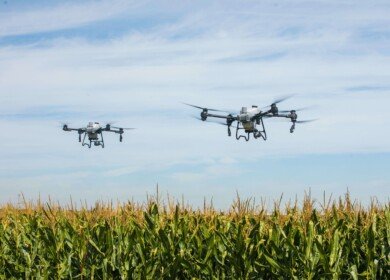
      A research team at the University of Illinois has developed a remote-sensing system to detect dicamba herbicide damage in soybean fields using drone and satellite imagery. The system offers what the team describes as the first unbiased method to assess the scale of off-target impacts.

      The project, led by Extension weed specialist Aaron Hager, crop sciences professor Marty Williams, and doctoral candidate Dylan Kerr, uses spectral imaging to detect damage in soybeans as early as eight days after dicamba exposure—well before visible symptoms appear. The technology captures changes in the way soybean leaves reflect light, indicating stress caused by herbicide drift or volatilization.

      “Until now, we really didn’t have a good way to estimate how extensive this was in any given year,” said Hager. The new system enables researchers to identify dicamba-affected areas in non-tolerant soybean fields without relying on visible symptoms or farmer complaints, which can be inconsistent.

      Dicamba has been used in corn production since the 1960s, but concern over its drift into soybean fields escalated after dicamba-tolerant soybean varieties became commercially available in 2017. That year, the Illinois Department of Agriculture received 119 formal damage complaints; the number peaked at 723 in 2019 before declining.

      ADVERTISEMENT

      Damage from dicamba can result from several factors, including physical drift during application, residue in spraying equipment, and volatilization, when the chemical converts to gas and moves off-target. Volatilization is particularly difficult to control and can carry the herbicide miles from its original application site, especially under high-temperature conditions.

      The research team’s first phase involved using drones equipped with remote-sensing platforms to detect dicamba exposure as low as one ten-thousandth of the labeled application rate. The next step includes applying this spectral data to NASA satellite imagery to analyze dicamba’s impact in past growing seasons retrospectively. Depending on the availability of historical satellite data, the project may eventually assess soybean damage over several decades.

      Williams emphasized that the initiative does not advocate for or against dicamba technology. “We didn’t do this work to try to choose sides,” he said. “This is a legitimate scientific question where we didn’t really have a good metric to use before this work.”

      According to Hager, once the satellite analysis is complete, the findings could inform future regulatory decisions by comparing the extent of past damage with the timing of label changes intended to mitigate drift. “If those changes weren’t effective, perhaps it’s time to consider new measures,” he said.

      The researchers expect to complete the satellite imagery analysis within the next 12 months.

      crop analysis
      data analytics
      dicamba
      herbicide
      research
      satellite imaging
      soybean
      spectral analysis
      study
      University of Illinois

      Enjoyed this story?

      Every Monday, our subscribers get their hands on a digest of the most trending agriculture news. You can join them too!

      Sign me up
      Check the example

      Discussion0 comments

      Спасибо за комментарий, он будет опубликован на сайте после проверки модератором. Хотите, чтобы ваши комментарии появлялись на сайте мгновенно? Достаточно пройти регистрацию.
      Congratulations, you can be the first to start the conversation.
      Do you have a question or suggestion? Please leave your comment to ignite conversation.
      What’s on your mind?
      Cancel Log in and comment
      Or continue without registration
      Get notified about new comments by email.
      Advertisement
      In focus
      How to get here?
      Stock quotes
      Bayer
      12.1
      6.7
      Bayer Crop Science
      41.67
      7
      CF Industries
      85.05
      2.63
      Corteva Agriscience
      69.94
      1.58
      ICL Group
      5.51
      1.85
      Intrepid Potash
      34.02
      7.22
      Mosaic
      27.64
      5.46
      Nutrien
      66.2
      7.94
      Yara International
      20.93
      4.03
      See all
      Most read
      ADAMA and BASF agree to develop new fungicide for European crops
      ADAMA and BASF agree to develop new fungicide for European crops
      Mosaic curtails phosphate production in Brazil as sulfur prices surge
      Mosaic curtails phosphate production in Brazil as sulfur prices surge
      China’s ECEC to build $2 billion phosphate fertilizer complex in Iraq
      China’s ECEC to build $2 billion phosphate fertilizer complex in Iraq
      Lithuanian port signals readiness to resume Belarus fertilizer handling
      Lithuanian port signals readiness to resume Belarus fertilizer handling
      U.S. lifts sanctions on Belaruskali after talks in Minsk
      U.S. lifts sanctions on Belaruskali after talks in Minsk
      Events
      International Crop-Science Conference & Expo
      Dubai, UAE
      Jan 19 — 20, 2026
      Fertilizer Latino Americano
      Miami (FL), USA
      Jan 26 — 28, 2026
      Argus Fertilizer Africa
      Dar es Salaam, Tanzania
      Feb 10 — 11, 2026
      CRU Nitrogen + Syngas
      Barcelona, Spain
      Feb 10 — 12, 2026
      TFI Annual Business Conference
      Orlando (FL), USA
      Feb 16 — 18, 2026
      See all
      Live
      Isabelita Barreiro
      December 11, 2025, 01:54 am
      Excellent management of water resources and effective use of water-soluble fertilizers!
      Argentine nano-fertilizer firm AKO Agro expands to Brazil
      Meripa Corson
      August 4, 2025, 01:18 pm
      Where does the money actually go? As a timber land owner, how do I benefit from the legislation?
      USDA commits $80 million to expand timber markets and improve forest resilience
      Patonkas Luksompulus
      January 21, 2025, 12:36 pm
      Greece meeds biological fertilizers! Great news about De sangosse.
      DE SANGOSSE expands operations with Greek subsidiary
      Pedro Diaz
      November 20, 2024, 08:42 pm
      Is it a Roundup lawsuit or more about bad financials? I think the market reacted only to announced financial results.
      Bayer’s shares are pressed down by ongoing Roundup cancer lawsuit
      Johan Fredin
      August 22, 2024, 07:57 pm
      Europe is falling behind in this field. The concerns 30 years ago was reasonable. Now not so much. We need crops that can survive in a more extreme future climate. Handle droughts and hot weather better. Crops that are less tasty to pests like hogs and deere.
      Gene-edited crops set for groundbreaking European trials
      About
      Sections
      Markets  ·  Business  ·  Politics  ·  Technologies  ·  Interviews  ·  Rankings  ·  Environment
      Support
      About  ·  Team  ·  Advertise  ·  Contacts  ·  Submit a Tip  ·  Privacy Policy  ·  Terms of Service
      Copyright © 2014-2026 DigitalTree LLC. All rights reserved.
      We deliver content lightning-fast thanks to the managed cloud WordPress hosting with CDN.
      16+
      More to read
      University of Florida scientists to build AI tool for crop damage assessment after hurricanes
      University of Florida scientists to build AI tool for crop damage assessment after hurricanes
      US court bans three dicamba-based herbicides
      US court bans three dicamba-based herbicides
      DJI Agriculture sees drone use surge, driven by looser rules and cost benefits
      DJI Agriculture sees drone use surge, driven by looser rules and cost benefits
      Advertising that helps us do quality reporting