

Smarter agriculture marketplaces, stronger farms: how digital platforms could help growers cut costs and build trust



Rising fertilizer prices, geopolitical disruptions, and narrowing farm margins are forcing growers to rethink how they purchase agricultural inputs. While digital marketplaces have transformed procurement across many industries, agriculture—particularly fertilizer distribution—remains dominated by local retailers, long-established relationships, and complex logistics.
A growing body of academic research suggests that one of agriculture’s biggest challenges is not simply connecting farmers with buyers or suppliers but improving transparency throughout the supply chain. A 2025 study by researchers at Ghent University, published in the journal Agribusiness, found that greater transparency between farmers and buyers is directly associated with stronger farm performance by improving relationship quality, underscoring the value of reducing information asymmetries across agricultural markets.
Rather than replacing that ecosystem, industry experts increasingly believe agriculture marketplaces could evolve into powerful decision-support platforms that help farmers optimize input costs, discover innovative technologies, compare verified suppliers, and make more informed purchasing decisions. In a market where every dollar invested in fertilizer can directly affect profitability, reducing information gaps may be just as valuable as reducing prices.
The fertilizer industry has been under pressure from supply chain disruptions, trade tensions, higher transportation costs, and volatile commodity markets. International markets are no better. Brazil, for example, may see a surge in farm auctions due to rising farm debt and worsening economic conditions. Farmers increasingly find themselves balancing fertilizer affordability with the risk of lower yields, while retailers manage uncertain demand and inventory decisions. Although experts interviewed for this report do not expect agriculture marketplaces to replace existing distribution channels, many believe they could substantially improve transparency and accelerate the adoption of technologies that help growers produce more with fewer inputs.
Fertilizer procurement remains rooted in local relationships
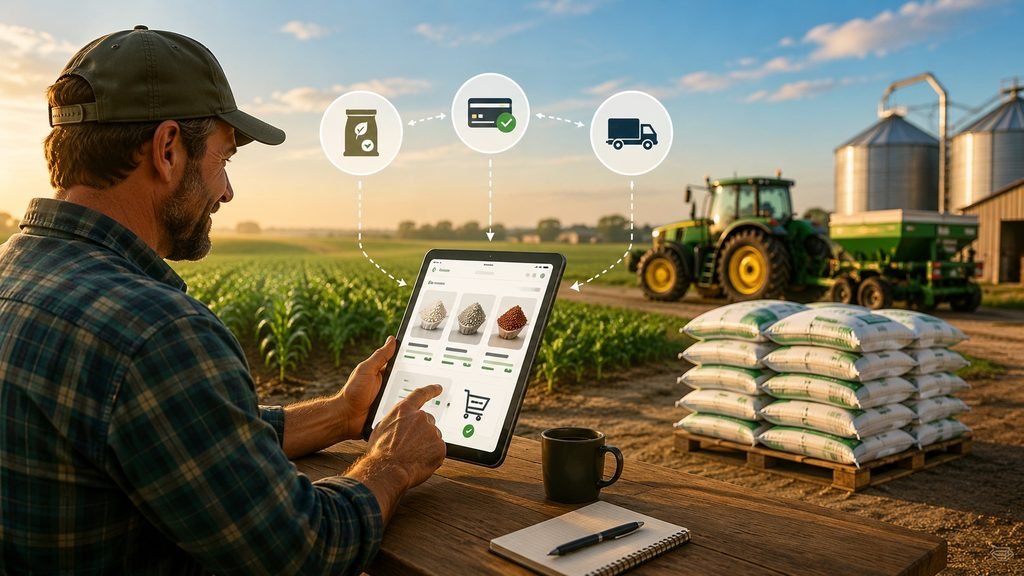
Unlike many industrial products, fertilizers cannot simply be ordered from the lowest-priced online supplier. Their bulk nature, transportation costs, application requirements, financing arrangements, and agronomic support have created a distribution model centered on local retailers.
Hunter Swisher, President and CEO of Phospholutions, said current market conditions have become particularly difficult for phosphate fertilizers.
“We saw demand destruction. A lot of our customers were down 25% to 30% on their phosphate demand last fall,” Swisher said. “Farmers will skip phosphates first when prices become too high. They’re being forced to adapt to some of the worst affordability conditions we’ve ever seen.”
Swisher explained that fertilizer affordability is increasingly measured against grain prices rather than fertilizer prices alone. As margins compress, retailers delay purchases while farmers postpone applications, reduce nutrient rates, switch crops, or, in extreme cases, leave acres unplanted. This pattern wouldn’t change even if the most sophisticated agriculture marketplace were available to all market players.
“Nitrogen can’t really be skipped,” he said. “When nitrogen becomes too expensive, you’ll often see growers shift from corn to soybeans because soy requires significantly less nitrogen.”
These decisions ripple throughout the supply chain, affecting manufacturers, distributors, retailers, and ultimately food production.
Agriculture marketplaces face structural barriers
Despite the rapid expansion of digital commerce in other sectors, experts interviewed for this report agree that fertilizer marketplaces face unique structural limitations.
Swisher believes digital platforms may improve visibility but are unlikely to materially reduce fertilizer costs.
“Fertilizer is a bulky material that has to move efficiently through a physical supply chain,” he said. “Those who move it most efficiently will generally offer the best pricing. A digital platform, like an agriculture marketplace, may provide additional price visibility, but it won’t fundamentally change the economics.”
He noted that farmers typically purchase fertilizer through nearby retailers, many of whom also provide application services.
“You’re not going to buy fertilizer from two states away because it’s a few dollars cheaper. Transportation costs quickly eliminate those savings.”
Tom Snipes, CEO of Ostara, shares a similar view.
“When it comes to researching and understanding products, farmers rely heavily on the internet,” Snipes said. “But when it comes to purchasing fertilizer, we really haven’t seen digital platforms achieve meaningful success in the United States.”
According to Snipes, fertilizer purchasing involves much more than simply selecting the lowest price.
“Farmers still value the local retailer because of the service they provide. If there’s a disease outbreak, an insect problem, or a crop management issue, growers need someone nearby who understands their operation.”
Retailers also frequently provide financing, precision agriculture services, agronomic consulting, and application equipment—functions that agriculture marketplaces alone cannot easily replace.
The opportunity extends beyond transactions to cost optimization
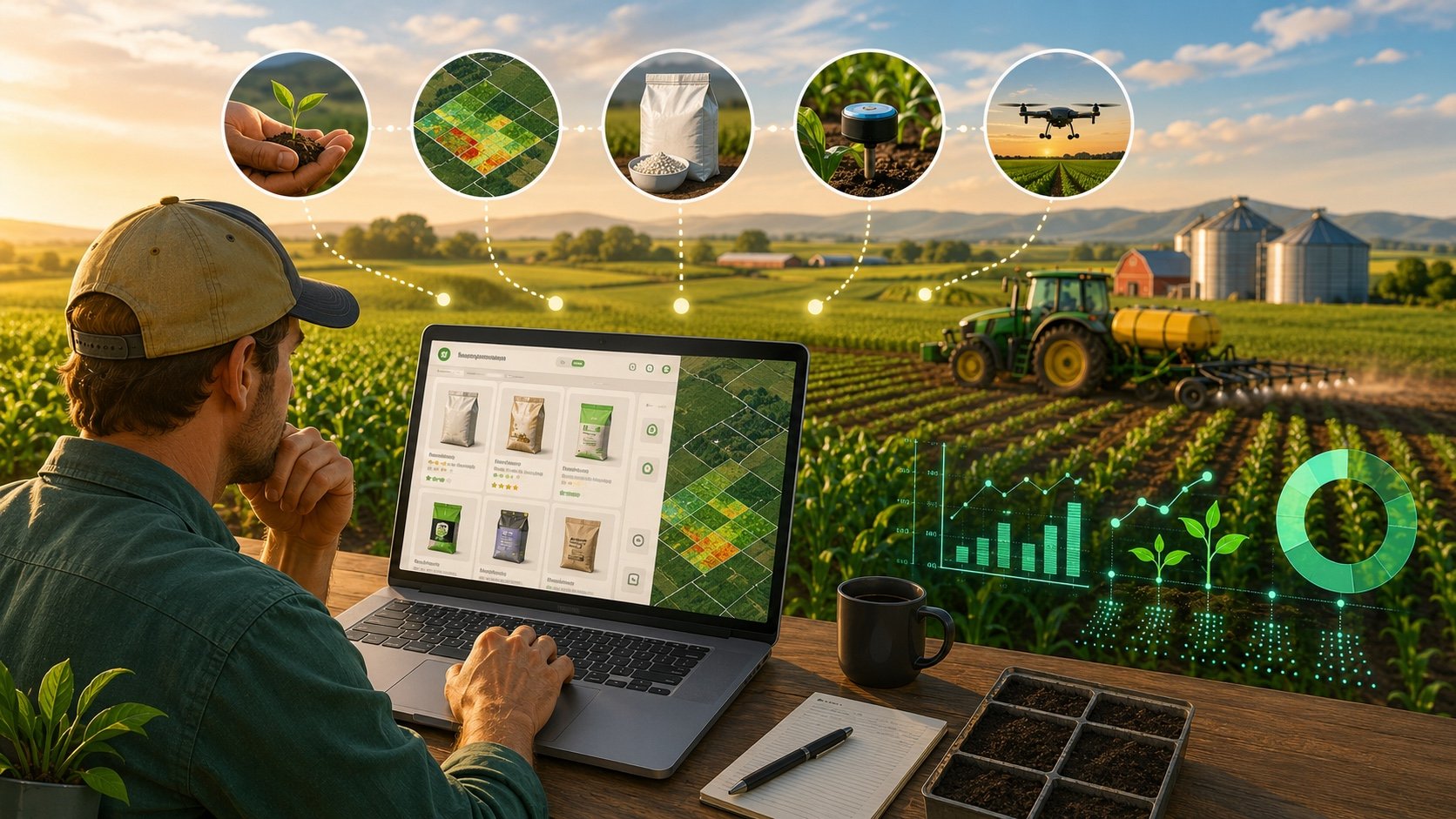
Although experts remain cautious about online fertilizer purchasing, they see significant opportunities for digital platforms that help farmers optimize production costs rather than simply execute transactions.
One of agriculture’s biggest inefficiencies is the amount of time required to discover, evaluate, and compare new technologies. As fertilizer prices rise, growers are increasingly willing to consider products that improve nutrient efficiency rather than simply reduce application rates.
“I don’t think switching to organic fertilizers is realistic on a global scale,” Swisher said. “But the willingness for retailers and farmers to adopt technologies that improve efficiency becomes much greater in environments like this.”
Those technologies include precision agriculture, improved nutrient placement, better soil analytics, variable-rate application, and fertilizer-enhancing products designed to increase nutrient uptake.
“The goal is getting more from what we apply,” Swisher said. “You either reduce costs while maintaining yields or improve yields without significantly increasing fertilizer use.”
This is where agricultural marketplaces can create the greatest value. Rather than competing with local retailers, they could make it easier for growers to discover emerging technologies, compare independent performance data, evaluate return on investment, and identify solutions that fit their specific production systems.
Transparency and supplier validation could become the next competitive advantage
Experts also believe the future of agriculture marketplaces depends less on enabling online purchases and more on making trusted information easier to access.
Eran Mizrahi, Founder and CEO of Source86, believes marketplaces can improve procurement by increasing transparency while preserving rigorous supplier qualification.
“This idea could potentially increase transparency and make it easier for buyers and suppliers to connect,” Mizrahi said. “However, produce sourcing is often more complex than simply matching supply with demand.”
According to Mizrahi, buyers continue to evaluate suppliers based on consistency, certifications, food safety standards, logistics capabilities, production capacity, traceability, and long-term reliability.
“A marketplace may help facilitate introductions, but supplier qualification and relationship-building will likely remain important parts of the sourcing process,” he said.
Instead of replacing procurement teams, agriculture marketplaces could dramatically reduce the time required to identify qualified suppliers, compare capabilities, and evaluate new technologies.
“In many cases, buyers spend significant time compiling information on suppliers and comparing their capabilities,” Mizrahi said. “A properly designed marketplace could simplify that process by making supplier information more accessible, although buyers must still verify the accuracy of the information before making purchasing decisions.”
The same principle applies to fertilizer procurement. Farmers may benefit more from finding another supplier offering the same commodity than from discovering verified products and technologies that improve nutrient efficiency, lower application costs, or increase yields.
Building the agriculture marketplace of the future
The interviews suggest that the next generation of agriculture marketplaces will look very different from conventional e-commerce platforms.
Rather than focusing primarily on buying and selling products, successful marketplaces are likely to become trusted ecosystems where growers can discover verified suppliers, compare innovative technologies, evaluate independent performance data, access agronomic recommendations, monitor regional pricing trends, and estimate the economic return of different production strategies.
Trust will remain the industry’s most valuable currency. Fertilizer distribution depends on local logistics, storage infrastructure, financing, application services, and long-standing relationships that cannot easily be replaced by software alone. As both Swisher and Snipes emphasized, local retailers will continue to play a critical role because they provide more than just product delivery—they offer agronomic expertise, credit, application services, and rapid support throughout the growing season.
The greatest opportunity for agriculture marketplaces, therefore, is not disintermediation but optimization. By reducing the time and uncertainty involved in discovering new technologies, validating suppliers, comparing product performance, and evaluating costs, marketplaces could help farmers make better-informed decisions while preserving the trusted relationships that agriculture depends upon.
As farm margins continue to tighten and input costs remain volatile, the ability to optimize every purchasing decision may become one of agriculture’s most valuable competitive advantages. The platforms that succeed are unlikely to be those that simply connect buyers and sellers. Instead, they will be the ones that combine transparency, verified participants, independent data, and trusted expertise into a single ecosystem that helps farmers lower production costs, improve profitability, and confidently adopt the next generation of agricultural innovation.

Enjoyed this story?
Every Monday, our subscribers get their hands on a digest of the most trending agriculture news. You can join them too!






Discussion0 comments