

Potatoes in lunar soil: 30% vermicompost restores growth in trial

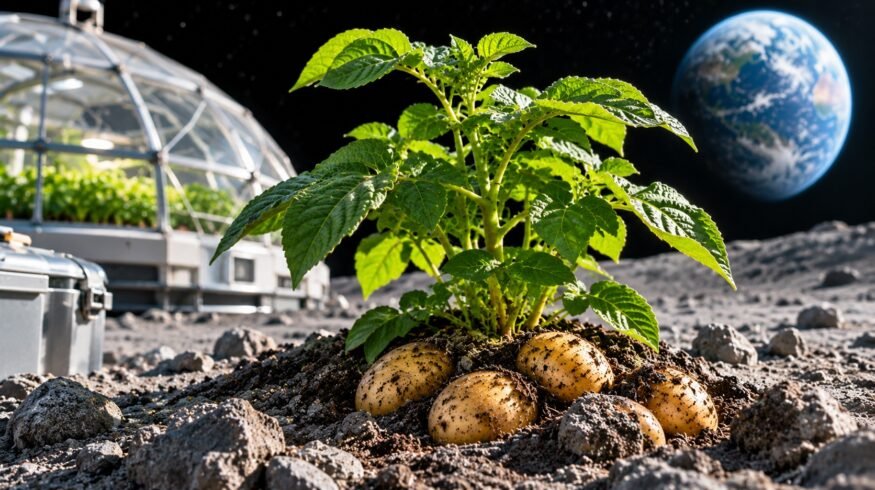

Potato plants grown in simulated lunar soil with 30% vermicompost reached biomass and growth levels comparable with an Earth-soil control in a greenhouse study led by Oregon State University researchers. The study, published Nov. 19 in npj Microgravity, tested five lunar regolith simulants and found that crop responses varied with the substrate.
The result points to organic matter as one possible way to support food production in lunar regolith, the loose rock and dust covering much of the Moon. The experiments took place in a controlled greenhouse, however, and used Earth-made simulants rather than lunar soil returned from the Moon.
Vermicompost improved potatoes in lunar soil simulants
In one experiment, the researchers grew the Modoc potato variety in LMS-1E mare regolith simulant blended with vermicompost at 0%, 15% or 30% by volume. Plants in the unamended simulant had the lowest total, shoot, root and tuber biomass, and three of four plants had root mass below the study’s minimum detection threshold.
Plants grown in a mix of 70% simulant and 30% vermicompost were significantly larger than those in pure simulant and comparable with plants in Adkins-series sandy soil across most measured traits. Tuber mass matched or exceeded the terrestrial control in some replicates. The 15% compost treatment produced intermediate biomass, while the study found no statistically significant difference from either the unamended simulant or the Earth-soil control.
The team also tested five simulants representing lunar mare and highland materials, each mixed with 5% vermicompost, against the Adkins soil control. Potatoes produced harvestable tubers in all five, but tuber mass remained significantly lower than in the control. The highland simulant NUW-LHT-5M caused the strongest impairment: only three of five plants grew large enough to be measured and produced harvestable tubers.
Lunar regolith differences shaped crop stress
The 30% comparison came from the LMS-1E experiment, not every substrate. In the second experiment, which used 5% vermicompost across five simulants, each produced significantly less tuber mass than the Earth-soil control. The researchers chose the lower rate to retain enough substrate stress for molecular analyses, rather than to maximize yield. The findings therefore show a compost response in one simulant while underscoring that results depend on both the material and amendment rate.
Leaf gene-expression profiles differed among the simulants, indicating that potato plants experienced substrate-specific stress rather than one uniform response. The researchers said the variation matters because real lunar regolith is not uniform, and the five simulated materials represented different geological settings, including mare and highland regions.
Vermicompost is organic matter produced as earthworms break down material. The study used it as an amendment to improve growth in regolith simulants, not as a complete nutrient source: all treatments also received slow-release fertilizer to prevent nutrient deficiency from confounding the tests. The researchers proposed that organic matter may bind some potentially harmful compounds, although the study did not establish that mechanism conclusively.
Potato tuber metabolite profiles changed only modestly across treatments, and the study found no statistically significant rise in the two main glycoalkaloids it measured, solanine and chaconine. Researchers did detect modest accumulation of some metals: copper and zinc in tubers from certain simulants, and aluminum in tubers grown in two highland simulants. The authors said nutritional quality and food safety require confirmation in future experiments.
The work was supported by NASA and is relevant to plans for longer-duration lunar missions, where growing food could reduce dependence on resupply from Earth. A follow-up study will assess 10 potato varieties in regolith simulants. Before lunar agriculture can be evaluated at operational scale, researchers will need to test more varieties and growing conditions and establish how simulated materials compare with actual lunar regolith.
Earlier research covered by Fertilizer Daily examined plant growth in lunar and Martian soils and the use of fungi to unlock scarce nutrients in lunar regolith.
Source: Oregon State University

Enjoyed this story?
Every Monday, our subscribers get their hands on a digest of the most trending agriculture news. You can join them too!








Discussion0 comments