

U.S. Fertilizer Prices Split Sharply as Urea Jumps 9% and UAN28 Falls 11%



U.S. fertilizer prices moved sharply in different directions in early October, with urea and potash rising while UAN28 and phosphate products weakened, signaling a growing split between nutrient markets as farmers move deeper into fall application planning.
For the week ending October 2, average U.S. distributor asking prices showed urea at $796.25 per short ton, up 9.1% from the previous reported period, while potash rose 6.8% to $571.35 per ton. UAN28 moved in the opposite direction, falling 11.1% to $533.34 per ton.
The latest data come only days after Fertilizer Daily reported that all eight major U.S. fertilizers tracked by DTN were above year-ago levels. The new numbers suggest that the market is no longer moving as a single complex: nitrogen products are increasingly diverging by form, while phosphate prices remain comparatively soft.
Urea and potash lead the latest price increases
| Fertilizer | Average price | Weekly change |
|---|---|---|
| Urea | $796.25/short ton | +9.1% |
| Potash (MOP) | $571.35/short ton | +6.8% |
| UAN28 | $533.34/short ton | -11.1% |
| DAP | $945.56/short ton | -1.7% |
| MAP | $978.00/short ton | -3.8% |
| Ammonium sulfate | $573.50/short ton | -1.2% |
The numbers are based on USDA Agricultural Marketing Service production-cost reports compiled across multiple U.S. agricultural regions. They represent distributor asking prices on an FOB basis rather than final farm-gate prices, which can be higher after freight and dealer margins.

That distinction matters because fertilizer markets remain highly regional. A national average can show broad direction, but local transportation, inventory and dealer conditions can produce substantially different prices for farmers in the Corn Belt, Plains and Southern states.
Urea is again separating from the rest of the nitrogen market
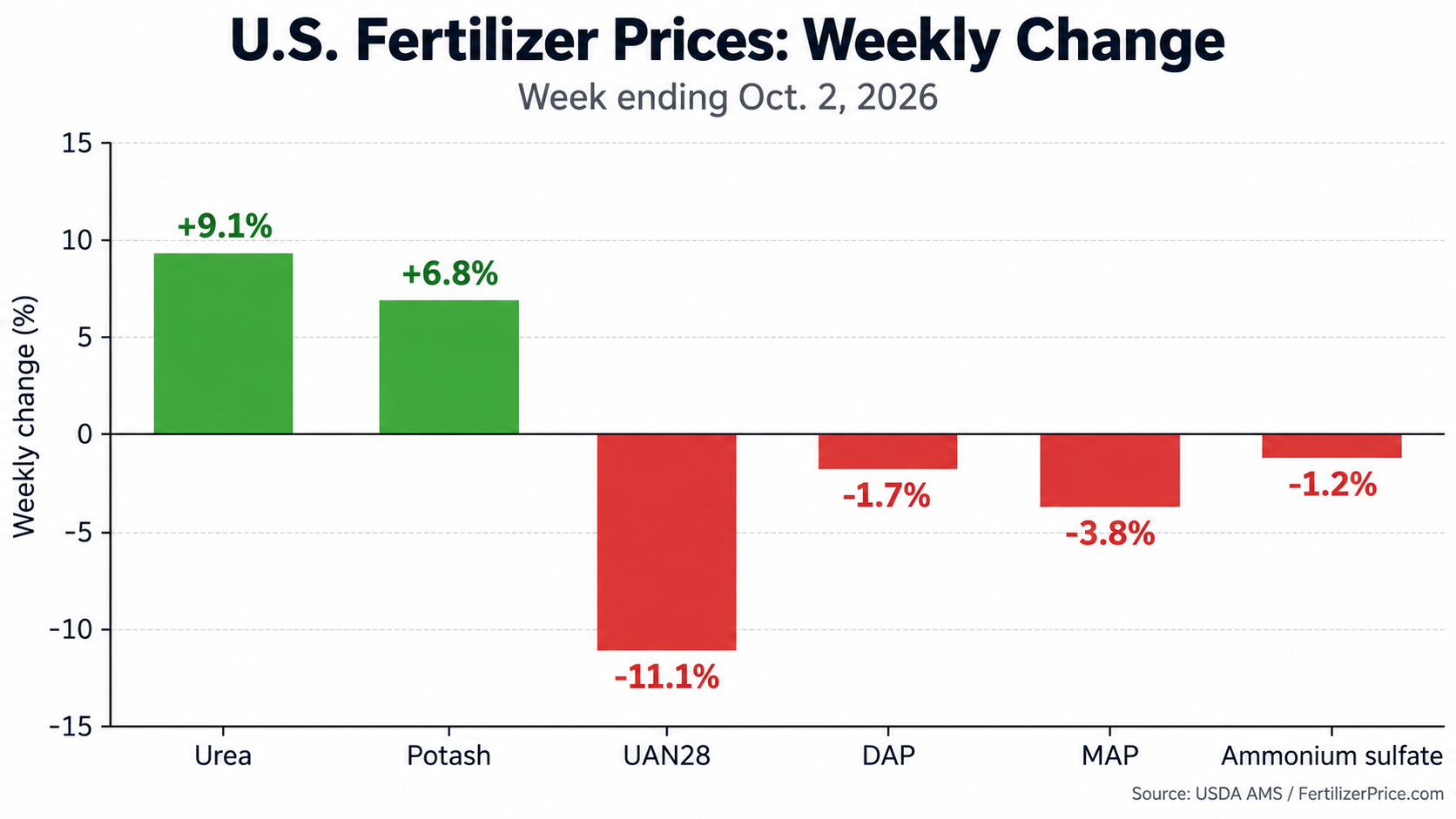
The strongest upward move was in urea.
At $796.25 per short ton, the latest average represents a $66.25 increase from the previous reported level. The 9.1% weekly move is notable because urea had already gone through a major correction from its spring 2026 highs.
Earlier this year, U.S. and international nitrogen markets experienced extreme volatility after fertilizer trade through the Strait of Hormuz was disrupted. Urea later retreated as shipping conditions improved and Chinese exports returned.
By late June, urea futures had fallen 22% in one month, while U.S. retail markets followed with a lag.
The latest rise therefore suggests that the summer correction has not removed the market’s underlying sensitivity to supply conditions.
UAN28 moved the other way

The sharpest decline in the latest data came from UAN28, which fell 11.1% to $533.34 per short ton.
The divergence between urea and UAN28 is particularly important because both are nitrogen fertilizers used by U.S. growers, yet their pricing can respond differently to production economics, regional distribution and seasonal application patterns.
Urea is a globally traded dry fertilizer with strong exposure to seaborne supply and international trade policy. UAN, by contrast, is a liquid product whose economics are more closely tied to regional production, storage and transportation.
This means a sharp move in urea does not automatically imply an equivalent move in UAN.
Potash rose nearly 7%

Potash prices also strengthened, increasing 6.8% to $571.35 per short ton.
The move is especially relevant after the United States reopened trade channels with Belarus, one of the world’s largest potash producers.
As Fertilizer Daily reported, a 30,000-tonne Belarusian potash cargo is heading to New Orleans, marking the first physical shipment of its kind to the U.S. market in four years.
One cargo is too small to materially alter the U.S. supply balance, and the latest price increase reinforces that point. Additional supplier competition may matter over time, but the market has not yet priced in a major structural shift in potash availability.
Phosphate prices moved lower
DAP and MAP both declined in the latest report.
DAP fell 1.7% to $945.56 per short ton, while MAP declined 3.8% to $978 per ton.
The moves are modest compared with the changes in urea, UAN28 and potash, but they show that phosphate markets are not following the same direction as nitrogen and potassium.
That separation has become increasingly common in 2026. Phosphate pricing has been influenced by sulfur costs, ammonia input prices and regional production constraints, while nitrogen has been more directly affected by gas prices, Middle Eastern shipping disruptions and Chinese export policy.
The market is becoming more product-specific
Fertilizer Daily analysis: the latest U.S. price data are less important for the overall direction of fertilizer prices than for the divergence between products.
Three distinct signals are visible:
- Urea is strengthening again, suggesting renewed tightness or stronger buying interest in the dry nitrogen market.
- UAN28 is weakening sharply, showing that liquid nitrogen supply and regional market conditions are behaving differently.
- Potash is moving higher even as new Belarusian supply becomes possible, indicating that the first reopened trade flows have not yet changed the physical balance enough to pressure prices.
This is a different market from the broad-based fertilizer rally seen earlier in 2026.
During the spring shock, most nutrient prices moved higher together as energy costs, logistics risks and global supply disruptions intensified. The early-October data instead point to increasingly independent nutrient markets.
Farmers should be cautious when comparing headline prices
One reason fertilizer price comparisons can be misleading is that different datasets measure different points in the supply chain.
The latest October figures represent distributor asking prices sourced from USDA AMS reports. By contrast, DTN’s widely followed series tracks retail fertilizer prices.
The two datasets therefore should not be directly compared as though they were identical national market prices.
The distinction explains why, for example, the latest $796.25 urea figure is significantly above the $675-per-ton retail average reported by DTN in late September. They reflect different reporting systems, regions and transaction stages.
For market analysis, the most reliable use of each series is to track its own direction over time rather than compare absolute prices across methodologies.
Input costs remain a major issue heading into 2027
The broader farm-cost environment remains challenging.
USDA’s Economic Research Service currently forecasts total U.S. farm production expenses at $492.8 billion in 2026, up $21.2 billion, or 4.5%, from the 2025 estimate.
Even after adjusting for inflation, production expenses are expected to increase.
That cost environment means fertilizer volatility is arriving at a difficult point for farmers, particularly in crops such as corn where nitrogen represents a major share of variable production costs.
Economists have already warned that elevated input costs could affect financing and crop decisions for the 2027 season.
What to watch next
The next several weeks will show whether the early-October price split is temporary or develops into a broader pattern.
The key indicators will be:
- whether urea remains above its recent range;
- whether UAN28 continues to fall or rebounds;
- regional ammonia demand during fall application;
- additional potash cargoes entering the U.S. market;
- China’s urea export availability;
- and dealer inventory levels ahead of winter procurement.
If urea continues higher while liquid nitrogen remains weak, U.S. growers could see increasingly different economics depending on fertilizer form and local application strategy.
FAQ
The latest distributor asking-price average is approximately $796.25 per short ton for the week ending October 2, 2026.
Urea increased by approximately 9.1%, or $66.25 per short ton, from the previous reported level.
UAN28 posted the largest decline in the latest dataset, falling 11.1% to approximately $533.34 per short ton.
The products have different supply chains, storage requirements, regional markets and exposure to international trade. Urea is much more globally traded, while UAN pricing can be more regional.
No. The October figures represent distributor asking prices reported on an FOB basis. Farm-gate prices can differ after freight, dealer margins and local market conditions.
Not yet. Potash increased in the latest report. The first Belarusian cargo is relatively small, and recurring shipments would be needed before the reopened trade route could materially affect U.S. supply.
Sources: FertilizerPrice.com, USDA AMS, USDA ERS, DTN

Enjoyed this story?
Every Monday, our subscribers get their hands on a digest of the most trending agriculture news. You can join them too!








Discussion0 comments