

Saline soil breakthrough: microbes, manure and silica lift oat hay yield 25% in China trial



Combining a Bacillus microbial agent, cow-manure organic fertilizer and silica powder raised available phosphorus in saline soil by 137.65% to 158.28% and lifted oat hay yield by about 25% in a two-year field trial in northwestern China. The study, led by researchers at Ningxia University, was published in Frontiers in Microbiology.
The result matters for fertilizer efficiency on degraded land. All plots received the same base rates of 90 kg/ha nitrogen, 177 kg/ha P₂O₅ and 60 kg/ha K₂O, so the gains came from making existing nutrients available rather than adding more fertilizer.
A tough saline soil test site
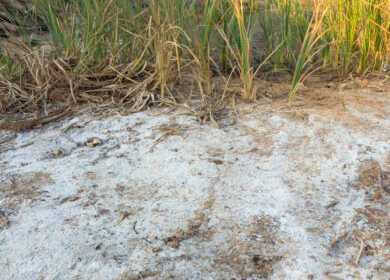
The trial ran at Qianjin Farm in Shizuishan City, Ningxia, where annual rainfall averages 188.8 mm against evaporation of 2,512.6 mm. The moderately saline plow layer held just 8.08 g/kg of organic matter, 0.47 g/kg total nitrogen and 5.47 mg/kg available phosphorus, with groundwater 1.5 meters below the surface pushing salt upward.
Researchers compared five treatments on two oat varieties: salt-tolerant Musite 2 and salt-sensitive Tianyan 60. The microbial agent, containing at least 200 million Bacillus cells per milliliter, was applied at 30 kg/ha. Organic fertilizer was applied at 12 tonnes per hectare and silica powder, at least 90% silicon dioxide, at 105 kg/ha.
Saline soil chemistry shifts in the root zone
Against the untreated control, the combined treatment raised available potassium by 10.71% to 23.78%, soil water content by 16.27% to 50.58% and soil organic matter by 11.05% to 251.3%. Soil pH fell by 4.13% to 10.11%, and nitrate nitrogen dropped by 53.10% to 66.22%, which the authors read as lower salt stress and less leaching.
Available phosphorus under the combination averaged 70.17% higher than with the microbial agent alone, 44.91% higher than organic fertilizer alone and 66.93% higher than silica alone. Alkaline phosphatase and urease activity rose 26.05% to 44.70% and 23.46% to 25.87% respectively.
The authors describe a cascade. Bacillus speeds manure decomposition, while silica slowly forms silicic acid that lowers pH. Lower pH reduces phosphorus and potassium fixation and helps soil hold ammonium. Humic acid from the manure and silicic acid bind into porous colloids that improve soil structure and water retention.
Yield and forage quality gains
Musite 2 hay yield under the combination was 25.23% above the control on a two-year average, against 21.51% for organic fertilizer alone. Crude protein peaked at 9.42% in Musite 2 and 9.28% in Tianyan 60. Random forest analysis ranked soil organic matter as the strongest predictor of yield, ahead of key microbial groups and available phosphorus.
Metagenomic sequencing showed Bacteroidota up 111.92% in the combined plots, with fungal richness indices also rising. Soil properties explained 84.04% of the variation in bacterial communities.
Caveats before scaling up
The trial covered one site over two years with three replicates, and it did not test pairwise combinations, so the contribution of each component is unclear. The authors also flag possible long-term risks from silica, including silicon build-up and antagonism with iron and molybdenum, though none appeared during the study.
Salinity already raises nitrogen losses from saline soils by 61%, according to earlier research. Biological and mineral amendments that free locked-up phosphorus could stretch fertilizer budgets on those soils as phosphate prices stay high.
Source: Frontiers in Microbiology

Enjoyed this story?
Every Monday, our subscribers get their hands on a digest of the most trending agriculture news. You can join them too!





Discussion0 comments