

Study links dry climates to elevated river nitrate across 2.9 million segments

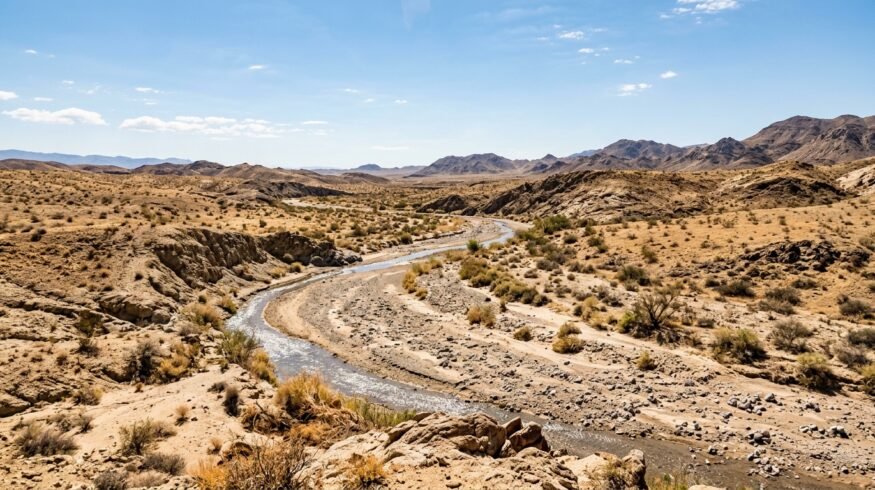

An analysis published in Science linked arid climate conditions to elevated river nitrate concentrations across an estimated 2.9 million river segments, including remote areas with little farming or urban development.
The global model suggests that climate helps shape where nitrate accumulates alongside sources such as fertilizer, wastewater, and runoff. The finding broadens the range of factors that water managers may need to consider when monitoring pollution, particularly in small streams and regions with limited sampling.
What drives river nitrate in dry climates
Researchers Kayalvizhi Sadayappan and Li Li of Penn State combined millions of nitrate readings from more than 7,000 monitoring sites with information on climate, land use, soils, and other landscape characteristics. They trained machine-learning models to estimate long-term average concentrations, then mapped results across nearly 2.9 million river segments worldwide.
The analysis found elevated concentrations across land-use gradients, including locations far from major agricultural and urban centers. In the Sahara, modeled river nitrate concentrations were comparable to or higher than those in some humid regions with extensive development, according to Penn State’s summary of the study.
In water-scarce environments, naturally occurring nitrate can build up in soils and waterways when limited water movement does not flush or dilute it. The researchers also identified small headwater streams as important hotspots; some flow only seasonally, leaving low-flow periods in which concentrations can rise.
Human sources remain central to nitrate pollution
The study does not reduce the role of agriculture or wastewater. Sadayappan said human inputs still have the largest impact, while the model indicates that long-term climate conditions, including temperature and rainfall, also help explain nitrate levels. Fertilizer losses remain a source that can be managed even where aridity contributes to local concentrations, and an Illinois project is testing how much nitrogen inhibitors cut nitrate loss from fields. Nitrogen runoff from U.S. farmland also feeds the Gulf of Mexico dead zone.
The paper’s global estimates indicate that modeled river concentrations exceeded an ecological threshold across about 33% of global land area and a health threshold across about 2%. The authors estimated that the affected areas correspond to roughly 5.6 billion people for ecological exceedance and 500 million for health-threshold exceedance. These are model-based estimates of population near rivers, not counts of people whose drinking water was tested or found unsafe.
The distinction matters because river nitrate is not the same as tap-water quality. Local drinking-water risk depends on the water source, treatment, and testing. Penn State reports that the U.S. drinking-water standard is 10 milligrams of nitrate per liter, while the researchers discussed potential chronic risks at lower concentrations; the study’s global river map does not substitute for local testing or advisories.
Sparse monitoring limits the global picture
The model fills gaps where direct measurements are scarce, but it cannot eliminate them. Most monitoring data came from temperate regions such as North America and Europe, while arid areas, including parts of North Africa, had fewer observations. The researchers used about 1,000 models to assess uncertainty, but estimates in poorly monitored regions still need comparison with additional field measurements.
For fertilizer producers, agronomists, and water managers, the result is a reason to interpret nutrient readings in the context of their local climate and flow, not to discount runoff controls. Further sampling in dry and seasonal headwaters could help determine where modeled hotspots reflect persistent exposure and how land use interacts with drought and rainfall over time.
As aridity shifts, nitrate may become more concentrated in some waterways even without additional human inputs. The study calls for broader monitoring and for water-quality standards that account for risks across a wider range of concentrations.
Source: Nature World News

Enjoyed this story?
Every Monday, our subscribers get their hands on a digest of the most trending agriculture news. You can join them too!






Discussion0 comments