

Almond compost nitrous oxide emissions fall 35% in four-year UC study

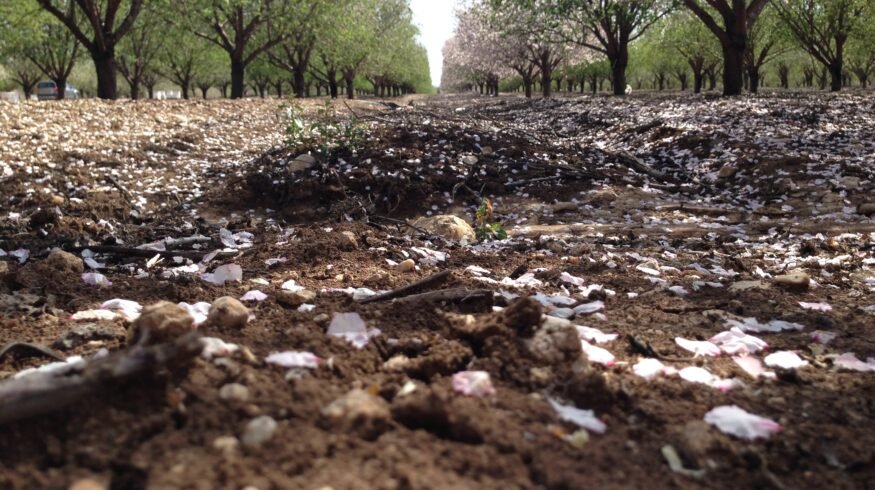

iStock: almond orchard compost
A four-year study in a 40-acre commercial almond orchard in California’s Central Valley found that combining dairy manure compost with fertilizer delivered through irrigation cut nitrous oxide emissions by about 35% compared with fertigation alone, according to UC Agriculture and Natural Resources (UC ANR).
The trial followed 480 trees and compared four treatments: no added nutrients, compost alone, fertigation alone and compost combined with fertigation. UC ANR reported that crop yields were maintained or increased in the compost treatments, although its public summary did not provide yield figures or an economic analysis. The emissions result applies to nitrous oxide, not to the full greenhouse-gas footprint of almond production.
Almond compost nitrous oxide emissions fall against fertigation
The comparison matters because the combined treatment added organic nitrogen and carbon from manure compost while retaining synthetic nitrogen supplied through fertigation. The researchers found lower nitrous oxide emissions in that treatment than in trees receiving fertigation alone, even though the compost added nitrogen to the system.
Adolfo Coyotl, a soil biogeochemist and doctoral student at the University of California, Davis, said the growing conditions became hotter and drier during the study. Conventionally fertigated trees struggled, while those receiving compost with fertigation were more resilient, he said. Trees that received compost also grew faster than those without it, though the university’s account did not quantify the difference.
Coyotl said one possible explanation is that compost-derived carbon helped soil microbes retain nitrogen for the trees instead of allowing it to escape as nitrous oxide. That mechanism remains under investigation. The reported result is an observed emissions difference; it does not yet establish which microbial processes caused it or how reliably the effect would carry across orchards. Other field work has linked management changes to lower emissions, including a study showing nitrous oxide emissions fall up to 48% with reduced tillage during an organic grain transition.
A nutrient loop links almond orchards and dairies
The work also tests a route for moving nutrients between two major California agricultural sectors. Almond hulls are used in dairy cattle feed, while composted dairy manure can return nutrients and carbon to orchard soils. The researchers are part of the national Dairy Soil & Water Regeneration project, which studies conservation practices and soil outcomes across dairy-producing regions.
The finding may interest growers and nutrient managers looking for ways to handle manure and reduce field emissions without cutting fertilizer inputs. The trial did not establish application costs, a financial return for growers, or a commercial recommendation. Compost supply in the state is growing, with projects such as the 70-acre composting center planned by Agromin and Limoneira. Compost quality, transport distance, application rates, irrigation practices and soil conditions could all affect whether the approach is practical elsewhere.
Yield response and profitability still need testing
Earlier almond-orchard trials show why the emissions result should not be treated as proof that compost will raise yields in every setting. A separate five-year UC Cooperative Extension report found no increase in tree growth or yield from composted green waste or manure in two other orchards. Those trials used different sites and treatments and did not test the same emissions question, so they are not a direct replication of the newer work.
The newer study’s yield statement is also preliminary in the sense that its results have not yet appeared in a journal. UC ANR said the researchers plan to submit the findings for publication later. Peer-reviewed results, more detail on measured yields, and comparisons across sites will help determine whether the 35% reduction can be reproduced and whether the practice fits commercial orchard economics.
For now, the study points to a potential emissions benefit from pairing compost with fertigation under the conditions tested. It does not show that compost can replace synthetic fertilizer, guarantee a yield increase, or deliver the same reduction in every almond-growing region.
Source: UC ANR

Enjoyed this story?
Every Monday, our subscribers get their hands on a digest of the most trending agriculture news. You can join them too!



Discussion0 comments