

UN Hormuz Fertilizer Mechanism Could Move 3–7 Ships a Day

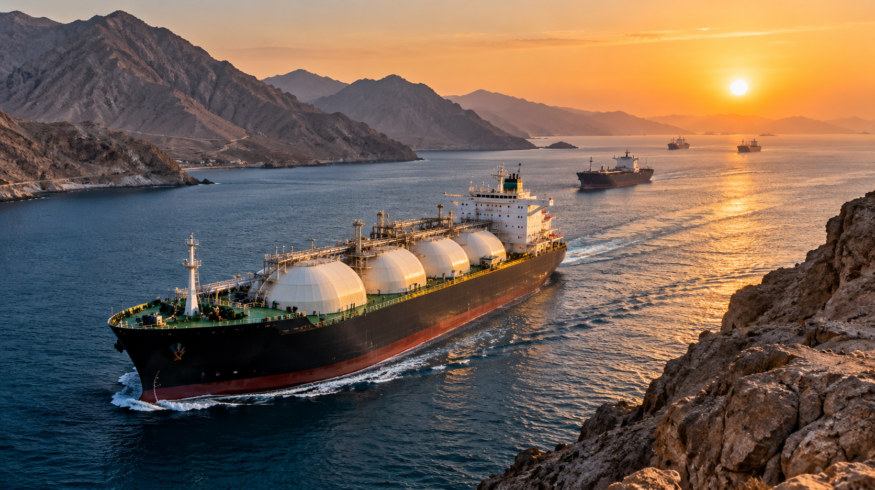

The United Nations says a proposed fertilizer-focused shipping mechanism for the Strait of Hormuz could be operational within one week if the parties to the conflict give political approval, potentially restoring the movement of roughly three to seven fertilizer vessels per day through one of the world’s most important agricultural supply chokepoints.
The latest details were outlined by UN Under-Secretary-General and UNOPS Executive Director Jorge Moreira da Silva during an exchange with European lawmakers this week. The mechanism would initially focus on fertilizers and related raw materials, including products such as urea, ammonia and sulfur, rather than attempting to restore all commercial shipping through the Strait.
The proposal remains unapproved. UN officials say the technical system is ready, but the parties to the conflict have not yet provided the mandate required to activate it.
UN says 3–7 fertilizer vessels a day could move under the mechanism
Speaking during an exchange with the European Parliament’s foreign affairs committee, Moreira da Silva said fertilizer traffic through Hormuz before the war was relatively small in vessel count compared with total commercial traffic.
Before the disruption, approximately 130 vessels of all types crossed the Strait each day. Fertilizer-related movements accounted for roughly three to seven vessels per day, according to the UN task force.
That difference is central to the proposal. The UN is not attempting to restore the entire pre-war shipping system through a limited humanitarian mechanism. Instead, it is proposing a narrow arrangement designed to move a manageable number of fertilizer and raw-material vessels while broader diplomatic negotiations continue.
UNOPS said on September 24 that the mechanism is ready and could be rolled out within one week once the necessary political agreement is secured.
| Proposed Hormuz fertilizer mechanism | Current status |
|---|---|
| Initial focus | Fertilizers and related raw materials |
| Indicative vessel traffic | 3–7 fertilizer vessels/day |
| Pre-war total Strait traffic | About 130 vessels/day |
| Technical system | Ready |
| Deployment time once approved | About one week |
| Political approval | Not yet secured |
The mechanism would register, monitor and verify vessel movements
The UN Strait of Hormuz Task Force was established in March 2026 and includes UNOPS, UN Trade and Development (UNCTAD), the International Maritime Organization (IMO) and the International Chamber of Commerce (ICC).
The proposed system draws on earlier UN-backed shipping and verification mechanisms, including the Black Sea Grain Initiative, the UN Verification and Inspection Mechanism for Yemen and the UN2720 mechanism for Gaza.
According to UNOPS, the Hormuz mechanism would create a structured process for:
- vessel registration;
- deconfliction between parties;
- prioritization of eligible cargoes;
- facilitation of transit;
- monitoring of vessel movements;
- verification;
- reporting.
Moreira da Silva told European lawmakers that vessels could be tracked through existing maritime identification and GPS systems during transit.
The UN describes the proposal as a confidence-building mechanism, not a substitute for freedom of navigation and not a new authority over the Strait. It would be time-limited and focused on essential commodities.
Hormuz normally carries 20–30% of internationally traded fertilizer
The scale of fertilizer dependence on the Strait explains why even a small number of additional vessel transits could matter.
FAO Director-General Qu Dongyu said in September that the Gulf supplies approximately 30–35% of global urea, around 50% of sulfur exports and 20–30% of ammonia.
The Strait itself normally carries approximately 20–30% of internationally traded fertilizer.
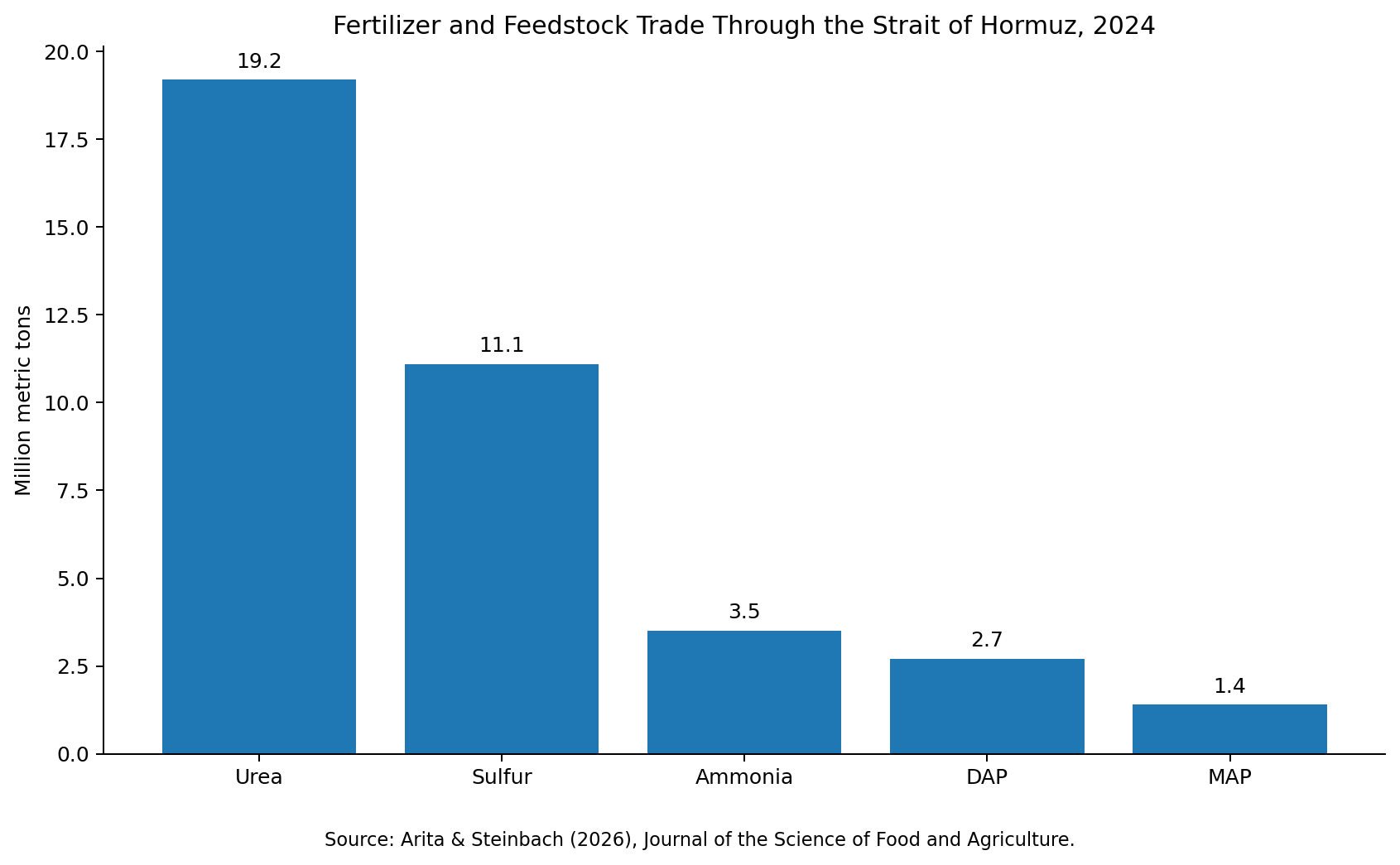
A 2026 analysis of pre-crisis trade estimated that around 39 million metric tons of fertilizers and fertilizer feedstocks moved through Hormuz in 2024.
| Product | Estimated 2024 volume through Hormuz |
|---|---|
| Urea | 19.2 million t |
| Sulfur | 11.1 million t |
| Ammonia | 3.5 million t |
| DAP | 2.7 million t |
| MAP | 1.4 million t |
Those volumes show that Hormuz is not only a nitrogen corridor. It is also a critical route for sulfur, the raw material used to make sulfuric acid for phosphate fertilizer production.
Sulfur remains the most difficult fertilizer bottleneck
Nitrogen fertilizer markets have partially adjusted to the disruption by redirecting cargoes and increasing supply from alternative exporters, but sulfur remains significantly tighter.
Fertilizer Daily reported in August that reduced Gulf sulfur exports had become one of the main constraints on global phosphate fertilizer production.
The impact has spread well beyond Gulf producers because major phosphate manufacturers in Morocco, the United States, China and other markets depend on imported or traded sulfur.
Mosaic reduced phosphate output at several North American facilities during the summer as sulfur supply tightened.
By September, spot sulfur prices had exceeded $1,000 per metric ton in some markets, fundamentally changing phosphate fertilizer production economics.
A shipping mechanism that restores even limited Gulf sulfur flows could therefore have an effect beyond direct fertilizer imports by easing feedstock pressure on phosphate producers elsewhere.
Urea would be the largest fertilizer flow affected
Urea accounted for the largest fertilizer volume moving through Hormuz before the disruption, at approximately 19.2 million tonnes in 2024.
Major Gulf producers in countries including Qatar, Saudi Arabia, Oman and Iran have historically supplied customers across India, Brazil, Australia, Southeast Asia and other import-dependent markets.
When the Strait became severely restricted, buyers responded by increasing procurement from China, Russia, North Africa and other available origins.
That diversification helped nitrogen prices retreat from their most extreme spring levels, but the market remains exposed to seasonal demand and supply concentration.
Earlier Fertilizer Daily tracking identified more than 1 million tonnes of urea stranded in the Gulf during the disruption.
Monthly fertilizer trade losses reached millions of tonnes
FAO estimates that between 1.5 million and 3 million tonnes of fertilizer trade per month have been delayed during the crisis.
The agency also reported that tanker movements through the Strait fell by more than 90% compared with normal conditions.
U.S. fertilizer imports from Hormuz-affected ports fell sharply in May, illustrating how the disruption reached markets far outside the Middle East.
FAO said the effect is especially serious because fertilizer demand follows crop calendars. A shipment arriving several months late cannot necessarily replace fertilizer that was unavailable during the crop’s application window.
Why only a few vessels could matter
Three to seven vessels per day may appear small compared with the approximately 130 ships that crossed Hormuz each day before the disruption.
For fertilizer markets, however, the comparison is misleading because bulk fertilizer vessels carry large cargoes and the pre-war fertilizer vessel count itself was only in the three-to-seven range.
If the mechanism restored a meaningful share of that specialized traffic, it could improve availability of:
- granular and prilled urea;
- ammonia;
- elemental sulfur;
- phosphate fertilizers;
- other fertilizer feedstocks.
The effect would depend on which vessels are prioritized, cargo sizes, origin ports and destination markets. The UN has not published a guaranteed tonnage that would move under the mechanism.
The proposal could reduce risk premiums even before full normalization
One of the less visible costs of the Hormuz disruption has been the increase in shipping risk.
War-risk insurance, vessel availability and uncertainty over safe passage have increased freight costs even when cargoes were technically available.
A verified and monitored transit mechanism could potentially reduce part of that uncertainty if shipowners, insurers and cargo owners consider the system credible.
That does not mean freight and insurance costs would immediately return to pre-war levels. Full normalization would still depend on security conditions and restoration of normal commercial navigation.
The UN itself stresses that the mechanism is a temporary confidence-building tool rather than a permanent shipping solution.
The biggest obstacle is political, not technical
The technical architecture is largely complete.
UNOPS said in July that the task force had already developed procedures for registration, prioritization, monitoring, verification and reporting after consultations with governments and other stakeholders.
In September, Moreira da Silva said the system could be deployed in a week.
The missing element is political authorization from the parties whose cooperation is required for safe transit.
During the European Parliament exchange this week, he said the UN had received broad support from member states but had not yet obtained the mandate needed from the parties to operationalize the system.
This means the proposal should not yet be interpreted as a reopening of the Strait for fertilizer traffic.
What a partial reopening could mean for fertilizer prices
The price effect would differ significantly by nutrient.
Urea: additional Gulf exports would increase competition with Chinese, Russian and North African supply and could reduce the premium created by continued Gulf uncertainty.
Ammonia: restored movements could improve feedstock availability for downstream fertilizer and chemical producers that rely on imported merchant ammonia.
Sulfur: this may be the most important market. Because Gulf supply represents such a large share of global sulfur exports, even partial restoration could ease the severe feedstock shortage affecting phosphate production.
DAP and MAP: effects would be both direct, through renewed fertilizer cargoes, and indirect, through improved sulfur availability for phosphate producers.
Actual price moves would also depend on inventory levels, seasonal demand, alternative supply and how quickly Gulf production and port operations can normalize.
The fertilizer crisis has become a food-security issue
FAO has repeatedly warned that the Hormuz disruption is no longer simply an energy or shipping problem.
Higher fertilizer costs can lead farmers to reduce application rates, switch crops or delay purchases. In regions where fertilizer use is already low, even relatively small reductions in nutrient application can have disproportionate effects on yields.
FAO Director-General Qu Dongyu said in September that global fertilizer markets remained severely disrupted and that delayed fertilizer trade was threatening future planting seasons.
UNOPS has linked continued fertilizer disruption to the risk of tens of millions of additional people falling into acute food insecurity.
This food-security argument is why the proposed mechanism initially focuses on fertilizers rather than attempting to cover all energy and commercial cargoes.
What happens next
The key question is whether the parties to the conflict agree to activate the UN mechanism.
If they do, UNOPS says implementation could begin rapidly.
The main indicators to watch are:
- formal political approval for the mechanism;
- publication of eligibility rules for fertilizer vessels;
- the first registered vessel movements;
- actual daily fertilizer-vessel transit rates;
- changes in war-risk insurance costs;
- Gulf sulfur export volumes;
- Middle Eastern urea and ammonia exports;
- the response of phosphate and nitrogen fertilizer prices.
For global fertilizer markets, the importance of the proposal is not the headline number of vessels alone. It is the possibility of reopening a concentrated supply route for commodities that cannot be quickly replaced elsewhere.

Enjoyed this story?
Every Monday, our subscribers get their hands on a digest of the most trending agriculture news. You can join them too!

Discussion0 comments